Showing posts with label politics. Show all posts

Thursday, March 20, 2025

The Age of Confusion (or: the more things change...)

Last year my parents downsized from the house in which I grew up to a condo, and in the process of moving gave away a lot of things including most of their music and book collections. Naturally, I ended up with a lot of records and CDs. I also picked a few books that looked interesting. I've recently been reading one of them, 28 Science Fiction Stories of H.G. Wells, and it's quite interesting indeed. I found the first story, a novel called Men Like Gods, so interesting - and timely - that I felt compelled to write something about it!

Men Like Gods, which Wells described as a "scientific fantasy," was published in 1923 and is set in 1921. The premise is that the protagonist, an Englishman named Mr. Barnstaple, is transported to an alternate dimension along with about a dozen other Earthlings. They find themselves on a strangely Earth-like world inhabited by humans but in a very different society than that they know, a futuristic society in which humanity has apparently used science to solve all its problems. A Utopia, as Mr. Barnstaple quickly comes to think of it.

There is a lot of commentary on the state of mankind and society in the 1920s - and I was struck by how relevant it all seemed to the 2020s. So I wanted to share some of the passages I found most striking along with my reactions to them.

The story begins thusly:


"They all cost money, with a cheerful disregard of the fact that everything had gone up except Mr. Barnstaple's earning power," I read, and chuckled, because apparently inflation was also a big concern a hundred years ago.

That was just the beginning.

Mr. Barnstaple is the sub-editor of a newspaper called the Liberal, "that well-known organ of the more depressing aspects of advanced thought." We learn that he is "obsessed by apprehensions of some sort of financial and economic smash that would make the great war seem a mere incidental catastrophe." The "great war," which we now, of course, know as World War I, was a recent event when this story was written. And of course, the Great Depression was not too far in the future, so Mr. Barnstaple and H.G. Wells seem prescient here.

We often like to think that we live in unusually tumultuous and terrifying times, and although there are certainly a lot of really bad and frightening things happening today, I don't know whether that's really true.

"Even in ordinary times Mr. Peeve [Mr. Barnstaple's boss] would have been hard enough to live with; but the times were not ordinary [emphasis mine], they were full of disagreeable occurrences that made his melancholy anticipations all too plausible. The great coal lock-out had been going on for a month, and seemed to foreshadow the commercial ruin of England; every morning brought intelligence of fresh outrages from Ireland... a prolonged drought threatened the harvests of the world; the League of Nations... was a melancholy and self-satisfied futility; everywhere there was conflict, everywhere unreason; seven eights of the world seemed to be sinking down towards chronic disorder and social dissolution."

"Mr. Barnstaple was, indeed, ceasing to secrete hope... His hope had always been in liberalism and generous liberal effort, but he was beginning to think that liberalism would never do anything more for ever than sit hunched up with its hands in its pockets grumbling and peeving at the activities of baser but more energetic men. Whose scrambling activities would inevitably wreck the world." That passage could have been written today, right? Have baser but more energetic men always been wrecking the world? Probably for as long as civilization has existed, and yet somehow the world has continued to go on, not entirely wrecked.

As stated in the opening sentence of the story, Mr. Barnstaple needs a holiday, and we learn that "the most hopeful thing about" his situation is that "he owned a small automobile of his very own." Of this automobile, we learn that "Mr. Barnstaple used it to come up to the office from Sydenham because it did thirty-three miles to the gallon and was ever so much cheaper than a season ticket." 33 miles per gallon. A hundred years ago. The best-selling cars in America today are Ford F-series pickup trucks; the popular F-150 gets about 23 miles per gallon. Good lord, what are we even doing? But I digress.

Mr. Barnstaple thinks due to all the turmoil in 1921 that "if anything it was a sillier year than 1913, the great tango year, which, in the light of subsequent events, Mr. Barnstaple had hitherto regarded as the silliest year in the world's history." From my perspective our current era seems a contender for silliest in history, but I'm undoubtedly very biased. Also, I have no idea why 1913 might have been "regarded as the silliest year in the world's history," and have no idea what even happened in that apparently very silly year. I wonder what people will think of our current era a hundred years from now?

After being transported to Utopia, Mr. Barnstaple and the other Earthlings learn about this strange world from some of its residents, the Utopians. They learn that Utopia seems to be essentially a parallel universe Earth but farther along in history. At some point in Utopia's past it was much like the Earth of 1921. That era is now known to the modern-day Utopians as "the last Age of Confusion."

The Utopians are interested in learning what it's like to live in such an age, and so one of the Earthlings, Mr. Burleigh, gives "a brief account of the world of men," including "states and empires," "wars and the Great War," "economic organization and disorganization," "the difficulties of finding honest statesmen and officials," "the unhelpfulness of newspapers," and "all the dark and troubled spectacle of human life."

I mean, sounds like a good summary of the world today, right? Replace "newspapers" with news sources in general - newspapers, TV, news websites, social media - all of which have failed to prevent and have indeed helped enable the lurching toward fascism that is currently happening in the United States. We bemoan this as a problem of our age, but perhaps it's always been a problem.

The Earthlings are then told of how things work in Utopia, and are astonished to learn that there is no central government; "Decisions in regard to any particular matter were made by the people who knew most about the matter."

One thing I find fascinating about this story is that when it was written, two terrible global events were both in recent memory: World War I, and the flu pandemic of 1918-1920. The Great War is mentioned multiple times in the story. The flu pandemic? Never mentioned explicitly, but a number of points in the story seem to have come out of the pandemic being on the author's mind. Here we get the first, when the Earthlings ask, "But suppose it is a decision that has to be generally observed? A rule affecting the public health, for example? Who would enforce it?"

The answer: "It would not need to be enforced. Why should it?"

At the beginning of COVID, many people were surprised to learn that there had been a deadly global pandemic a hundred years earlier, because they'd never heard of it. It killed more people than World War I, but whereas World War I is a major part of history classes and contributes to the setting of all sorts of notable literature, the same just isn't the case for the flu pandemic. But then once we'd lived through a pandemic for a while, people realized it made sense that after experiencing it, most people would just want to go back to normal life as if the pandemic hadn't happened. People wouldn't want to read or write a novel set during the pandemic.

And so the choice by Wells not to mention the pandemic when he lists all the recent problems of the world, but the clear influence of the pandemic on his story (an influence I wouldn't have recognized had I not lived through a pandemic myself), fascinates me.

Jumping forward in the story, the more prominent evidence of the flu pandemic's influence comes when, on the second day after the Earthlings arrive, the "great epidemic in Utopia" begins. Utopians had long ago eliminated all disease from their world and as a result their immune systems are not prepared for the infections the Earthlings are carrying. "Though not one of them was ailing at all, it became clear that someone among them had brought latent measles into the Utopian universe, and that three or four of them had liberated a long suppressed influenza."

(When I read the story earlier this year, I didn't realize how timely the measles reference would be. Oof.)

These diseases rapidly spread through the population, and our band of Earthlings is then approached by people in gas masks who tell them, "Quarantine. You have to go into quarantine. You Earthlings have started an epidemic and it is necessary to put you into quarantine."

Amusingly, some of the Earthlings think that their natural immunity makes them superior to the Utopians and will allow them to conquer the planet as its inhabitants all fall ill, but the Utopians' science quickly turns things around. Then, in one last pandemic reminder, the funniest moment of the story to me came when the Utopians mention that research is being undertaken to develop a method to send the Earthlings back to their own dimension. Father Amerton, the voice of organized religion among the motley crew from Earth, asks what the nature of the treatment will be - "Is it to be anything in the nature of vaccination?"

He then goes on, "I may say at once that I am a confirmed anti-vaccinationist. Absolutely. Vaccination is an outrage on nature. If I had any doubts before I came into this world of - of vitiation, I have no doubt now. Not a doubt! If God had meant us to have these serums and ferments in our bodies he would have provided more natural and dignified means of getting them there than a squirt."

Yep, these words were written in the early 1920s. Other than a few amusing anachronistic terms (like "anti-vaccinationist" and "squirt"), nearly the exact same words could have been spoken by countless people a hundred years later - and as a result of this, hundreds of thousands of people died preventable deaths.

So much for humanity becoming more enlightened as history progresses.

Mr. Barnstaple realizes that the more he hears about the last Age of Confusion in Utopia's past, "the more it seemed to resemble the present time on Earth." He forms an outline in his mind of the history of Utopia from that confused era onward. In this outline, a period of tremendous advancement in scientific inquiry occurred.

"The Utopians, who had hitherto crawled about their planet like sluggish ants or travelled parasitically on larger and swifter animals, found themselves able to fly rapidly or speak instantaneously to any other point on the planet." Note that powered flight and instantaneous communication to locations around the globe were both recent developments when Wells wrote this story!

"They found themselves, too, in possession of mechanical power on a scale beyond all previous experience, and not simply of mechanical power; physiological and then psychological science followed in the wake of physics and chemistry, and extraordinary possibilities of control over his own body and over his social life dawned upon the Utopian."

These developments did not lead to an instant transformation from Age of Confusion to Utopia, though. At first they were only appreciated by a small minority of people, while most people "spent the great gifts of science as rapidly as it got them in a mere insensate multiplication of the common life."

The next passage sounds very much like a description of the world of today: "The economic system... became more and more a cruel and impudent exploitation of the multitudinous congestion of the common man by the predatory and acquisitive few. That all too common common man was hustled through misery and subjection from his cradle to the grave; he was cajoled and lied to, he was bought, sold and dominated by an impudent minority, bolder and no doubt more energetic, but in all other respects no more intelligent than himself. It was difficult... for a Utopian nowadays to convey the monstrous stupidity, wastefulness and vulgarity to which these rich and powerful men of the Last Age of Confusion attained."

Gee, does that remind you of anyone?

"What plenty and pleasure was still possible in the world was filched all the more greedily by the adventurers of finances and speculative business."

Are we talking about Utopia in the Age of Confusion, Earth in the 1920s... or Earth in the 2020s?

Eventually, the people of Utopia's past came to realize that "the state could not do its work properly nor education produce its proper results, side by side with a class of irresponsible rich people. For, by their very nature, they assailed, they corrupted, they undermined every state undertaking; their flaunting existences distorted and disguised all the values of life." Again, does that remind you of anyone? And eventually, after centuries of struggle, the control of "greedy, passionate, prejudiced and self-seeking men" over society was wrested away, and a society in which science and education were held in paramount by all was established.

In this utopian society, Mr. Barnstaple learns, there are "Five Principles of Liberty, without which civilization is impossible." The most striking of these is the fourth: "that Lying is the Blackest Crime."

As the young Utopian explaining this to Mr. Barnstaple states, "Where there are lies there cannot be freedom."

This, again, calls to mind events of our present era, and, apparently, of the era one hundred years' past. Mr. Barnstaple contends that "half the difference between Utopia and our world... lay in this, that our atmosphere was dense and poisonous with lies and shams... The fundamental assumptions of earthly associations were still largely lies, false assumptions of necessary and unavoidable difference in flags and nationality... impostures of organized learning, religious and moral dogma and shams."

Mr. Barnstaple gets especially worked up about "the suppression and falsifications of earthly newspapers," which is "a question very near his heart."

"The London newspapers had ceased to be impartial vehicles of news; they omitted, they mutilated, they misstated. They were no better than propaganda rags."

Don't we all today, people from all parts of the political spectrum, bemoan the state of the news media and how various parts of it (which parts depending on one's point of view) are no better than propaganda? And don't we, like Mr. Barnstaple, yearn for a past era in which this was not so much the case?

I do think that the collapse of any sort of commonly agreed upon objective reality is a striking problem of modern life. It's said that a tool of authoritarianism is constantly bombarding the public with lies, not so much to get people to believe the lies as to get people to stop believing that there is any sort of truth. As I look with anguish on what's happening in my country, I very much believe this, and from my perspective it seems like a relatively novel problem in the span of modern American life. But it's clearly not a novel problem in human history. And it's probably been a problem, to a greater or lesser extent, for as long as civilization has existed.

Of course, it could probably go without saying that the idea that humans could ever agree on an objective reality to the extent that it would be possible to outlaw lying - and to do so in service of the truth and not to an oppressive regime - is far-fetched.

Reading this story, I found myself wondering two things about H.G. Wells's thoughts on this imagined world of his. The first is, did Wells view Utopia, this world where all the problems of modern society had been solved and everyone could live a life of comfort and plenty, as good?

His protagonist, Mr. Barnstaple, becomes quite the Utopia stan (as the kids say), but all the other Earthlings are, to various degrees and for various reasons, quite critical. One interesting critique: "Life on earth was... full of pains and anxieties, full indeed of miseries and distresses and anguish, but also, and indeed by reason of these very things, it had moments of intensity, hopes, joyful surprises, escapes, attainments, such as the ordered life of Utopia could not possibly afford."

There's also the matter of Utopia having been achieved in part through heavy use of eugenics, something that today is generally regarded as a Bad Thing, but that may have been viewed more favorably by many in the past.

The second thing I wonder is whether Wells viewed it as plausible that at some point in the future humanity could progress to a society like that portrayed in the story. Or if not exactly like that, then at least a society where those familiar problems - constant conflict, ubiquitous unreason, unhelpful and dishonest newspapers, rich and powerful men laying waste to society - had largely been banished to the past.

When I was a kid, I got the impression of the story of humanity as one of continuous progress. In the future, things, in general, would be better than they were in the past. I certainly no longer feel that way. I'm not sure whether that change is simply due to me being older, or if it's also a reflection of a general change in how humans view the future. A lot of classic science fiction portrays futures in which technology has made life easier for all humans rather than just for the privileged. I don't think that's the case anymore.

When I read this story, the fact that so many of the problems a hundred years ago sound exactly the same as the problems today makes me skeptical that the problems will ever be solved. Mr. Barnstaple leaves Utopia feeling confident that one day, "Earth would tread the path Utopia had trod." What about H.G. Wells? Was he, from the vantage point of 1923, able to look to the past the way that I can from 2025 and see how all the problems he described echoed things that had already happened? Or did the "Age of Confusion" seem like a temporary state through which humanity was passing?

To be fair, he did describe the struggle to go from Age of Confusion to Utopia as having taken thousands of years. Even still, it's hard for me to imagine that transition ever occurring, because there are certain fundamental aspects of human nature.

Wouldn't it be nice, I've thought recently, if we could just live in a world where everyone had two basic character traits:

1. They cared about other people. Other people in a general sense, not just a certain subset of other people. There are, I think, a lot of people who do, but there are also a lot of people who don't.

2. They had decent critical thinking skills. That is, if presented with evidence for an argument, they could evaluate the evidence and come to a reasoned conclusion about the strength of the argument. And if presented with an argument that's obvious BS if examined carefully, they would be suspicious of it. They wouldn't just believe things for no sound reason and cling to those beliefs even in the face of an overwhelming amount of contradictory evidence. This, I think, is something that no one is perfect at, but some people are good at it, while some people are okay at it, and some people quite frankly aren't very good at it, at all.

It seems that the difference between Wells's Utopia and the real world, and the reason that the real world could never become like Utopia, could be summarized as that many, many people in the real world have neither or just one of those two character traits, and there's no reason to think that will ever change.

And it's interesting to me that that's true. It seems that that's how we evolved. Why is it that some people do have those traits, and others don't? (Perhaps the remarkable thing is that a lot of people do have those traits instead of no one having them?)

What would the world be like if everyone cared about humanity and could be swayed by evidence toward believing true things and disbelieving false things?

Granted, there are issues where, even working under that imagined framework, there aren't clear right and wrong answers. Take the aforementioned COVID pandemic. There were tradeoffs between trying to slow the spread of a deadly disease and trying to live as a social species for which being social is a basic need (especially for the developing minds of children, who conveniently were themselves at low risk from the disease!) and there was no way to avoid doing some measure of harm in some direction. The actual response to the pandemic was a disaster in a multitude of ways, but I don't think there's an ideal world where there's a clearly correct response with no downsides.

But there are also issues where there are very clear right answers, and the problem is that a lot of people just don't want to accept those answers as right, or reflexively oppose them because they don't like the people who are proposing the ideas.

To use a pet issue of mine as an example, it's inarguably true that improving bike and pedestrian infrastructure and public transit would benefit the health of individual people, of society, and of the planet. In a cost-benefit analysis, the benefits outweigh the costs by a mind-boggling amount. Operating under a Utopian framework, we would just do this and the only questions would be about the details, not about whether or not to do it. Sadly, the real world doesn't work that way.

But then, every form of progress does have unintended consequences (rip scribes). Perhaps in the imagined world full of compassionate and rational people, accelerated progress compared to the real world would have inadvertently brought about our premature demise.

Or perhaps we would be living in a utopia.

Either way, I find it simultaneously depressing and comforting to realize that so many of the problems that seem new or at least newly terrible to us today are the same problems that have been faced over and over again by other people in the past. Depressing, because it's sad to think about how no matter how hard people try to fix the world, in some ways it's probably unfixable. But comforting, because when you're in a bad situation there's comfort in knowing that you aren't alone, that not only are other people feeling the some things but other people have felt the same things in the past. Lots of people lived through times like the times we're living through now and were still able to find meaning and joy in their lives. Lots of people lived through far worse times and were still able to find meaning and joy.

It was really funny to me to read this story from a century ago and have the protagonist remark that "the times were not ordinary" for reasons that are in many ways the same as reasons that we, today, say that the times are not ordinary.

There's a joke I've seen a lot, where someone says that we're living in unprecedented times, and concludes, "I want to live in precedented times." But I think the truth is that, while some things about the times in which we live are unprecedented, other things have plenty of historical precedent. And I think this has been true for people everywhere for at least the last few centuries and perhaps for as long as civilization has existed. (Go far enough back in history, and I suspect the idea of "unprecedented times" wasn't so common, because the rate at which life changed was too slow to be noticeable in the lifetime of a typical human.)

The truly unprecedented elements of our lives relate mostly to the continuous and accelerating state of technological innovation. The things that merely seem unprecedented but actually do have precedent, I think, are often more fundamental things about human life that arise from fundamental aspects of human nature. Deep down, humans don't change nearly as rapidly as our technology does, and thus, the same themes play out over and over again, whether the main source of news (and propaganda) about the unfolding events is newspapers or television or social media. Yes, what's happening in the United States right now is unprecedented in this country in my lifetime, but it's far from unprecedented in human history.

Mr. Barnstaple leaves Utopia feeling invigorated by the hope that the efforts of people like him on Earth would not be in vain, and that one day in the future Earth would become a utopia as well. Reading his story a century later, that seems exceedingly unlikely, but I don't see that as a reason to despair or to give up the fight. Fighting to prevent a dystopia is perhaps even more important than fighting to achieve a utopia. As long as we're able to have those "moments of intensity, hopes, joyful surprises, escapes, attainments" that are provided to us by the privilege of living on this amazing, awful, yet wonderful world, the fighting isn't and wasn't in vain.

In a post I wrote a few months ago, I shared this quotation:


That was before I read Men Like Gods. After reading it, these words seem even more timely.

Life. It sure is something, isn't it?

Friday, November 15, 2024

How did it come to this?

The day after Donald Trump was elected president in 2016, I said that the only other events that were comparable in how they'd made me feel were 9/11 and my first wife Cara's death. Looking back eight years later, there was absolutely no hyperbole in that statement.

It's a little unsettling how Donald Trump's second election to the presidency, while still extremely upsetting, isn't eliciting nearly as strong an emotional reaction in me - this despite his second election being a much worse event than his first. I don't think it would be out of line to suggest that this is the worst thing that has happened in our country in my lifetime. But Trump's first term in office and the COVID pandemic made me more than a little numb to bad things happening in the news. And, of course, this election result wasn't a shock in the way the 2016 result was. We were more prepared for the possibility.

On the bright side, another reason 2016 was so hard on me was that I was alone. Now I'm married to a wonderful partner in Erin and we have a beautiful three month old daughter. A daughter whose future I worry about deeply, but whose presence is an incredible source of comfort and joy.

A man who has been described as a fascist by people who worked in his first administration, who incited a violent insurrection and attempted to install himself as a dictator after losing the 2020 election, and who is a thoroughly reprehensible person in every way has just been elected to be the most powerful person in the world. It's a really bad situation! It leaves us to wonder, how is this possible? How did this happen to our country?

I have a lot of thoughts on that, but I'll just briefly summarize what I think are the three most important points:

1. Our country was founded on the idea of "all men" being "created equal" but on the reality of Black people being enslaved, and much of our country was originally built on slave labor. The Civil War ended slavery, but the whole history of the country since then has been a struggle between people fighting for the principles of equality on which the country was ostensibly founded, and people fighting to keep the racial hierarchy in place. Whenever there's major progress toward equality, there's a backlash. Reconstruction happened after the Civil War, and the backlash led to Jim Crow. A Black man was elected president, and the backlash spawned the MAGA movement.

2. For the last thirty or so years, Fox News and other right-wing media outlets have been waging a propaganda campaign that has now caused a large segment of the population to be thoroughly detached from reality on most of the issues affecting their votes. Perhaps even worse, whereas 20 years ago most of the leading GOP politicians were probably in on the scam and just using their duped audience to get more tax cuts for the rich, now many of the important figures have grown up on this propaganda diet and are themselves true believers in the cult. The ease of spread of misinformation on the Internet, of course, makes this all worse.

3. Specific to the 2024 election, the economy and inflation since the end of the pandemic led to an incredibly strong anti-incumbency voting environment worldwide. No incumbent party won a national election this year (which had never happened before), and Democrats in the U.S. did better than most. That's likely the main reason Republicans won this particular election, whereas points 1 and 2 are my postulated reasons for the emergence of the insane Trumpist cult and its takeover of one of our two major parties.

Those are my thoughts on how our country got into its current terrible condition. But that's not really what this post is about.

What I find really remarkable, looking at it all, is not that this catastrophe happened in the country I was taught as a child was the greatest on Earth. What I find really remarkable is, well, everything.

Everything about human society. Everything that human beings have accomplished. How? How did it all happen?

Collective human achievement

There are so many amazing things that humanity has achieved. We often take it for granted, but if you take a moment to think about it, it's really quite staggering. We've risen from primitive hunter-gatherer ancestors to create a world-spanning civilization. We've sent humans to the moon and sent space probes to the farthest reaches of our solar system, where we can still communicate with them from Earth many decades after they were launched. We've cracked the genetic code underlying life. We've created vaccines that have saved hundreds of millions of human lives. We've created tremendous and awe-inspiring works of art and culture and music. We've created various modes of transit enabling individuals to cover distances unimaginable on foot, from the airplane to the bicycle (the most efficient form of transportation there is). We've created a global communications network on which we can almost instantaneously look up almost any piece of human knowledge. The list goes on and on and on.

What's really awe-inspiring about all this is that none of these things could ever have been accomplished by a single person starting from scratch. In fact, the distance from what a single person starting from scratch could accomplish to what humanity has accomplished is so vast that it seems absurd. Everything we take for granted in life is the result of the cumulative work of countless other humans over tens and hundreds and thousands of years. It's all been built up over those years on scaffolding built by the people who came before. And for that scaffolding to hold, a functional society, in one form or another, had to exist.

Human beings did not evolve to live in a society like the one in which we live. We evolved to live in small groups of people without any of the technology that makes modern society possible and without any knowledge of what was happening in the rest of the world. Over the last few millennia and especially the last few centuries, the pace of evolution of human society has vastly outstripped the pace of our biological evolution. Biologically, a human today isn't tremendously different from a human ten thousand years ago. Take a newborn from today and transport them to ten thousand years in the past, or take a newborn from ten thousands years in the past and transport them to today, and they'd not be aware of anything amiss and would grow up a totally normal member of the society to which they'd been transported. But do the same time travel with an adult, and they'd be utterly befuddled by the strange world they found.

I don't think there's any other species for which this would be true, certainly not to nearly the same extent as it would be for humans.

I'm of the firm belief that the human brain is the most amazing thing in the known universe. A biological supercomputer in an organism that evolved over billions of years from primitive single-celled ancestors and can perform so many incredible computations and feats, the underlying mechanisms of which we're only beginning to understand. One of my favorite things about my brain is that in its neural networks are stored tens of thousands of different songs (some stored with higher fidelity than others). How do our brains do that? Why do our brains do that? And that's far from the most amazing thing about the brain.

All the amazing feats of humanity I listed are the accomplishments of the human brain, but not just one human brain, thousands upon thousands of human brains collaborating across both space and time.

But something that takes millennia to build can be destroyed in an instant.

The human brain is an amazing thing, but it has many failure modes, and it wasn't designed to deal with the complexities of the modern world. Given the right (or wrong) circumstances, a whole bunch of human brains might collectively decide that electing someone like Donald Trump to be their leader is a good idea.

Democracy

Our country was founded nearly 250 years ago as a representative democracy. It wasn't the first attempt at a democratic system of government in history, but at the time, it was a big divergence from how nations were typically run. The founders of our country were embarking on a grand experiment, one they feared wouldn't last. Benjamin Franklin was famously quoted as answering, when asked if our government would be a republic or a monarchy, "a republic, if you can keep it."

And to quote a timely and unsettling recent Atlantic article by Tom Nichols:

[George] Washington feared that, amid constant political warfare, some citizens would come to “seek security and repose in the absolute power of an individual,” and that eventually a demagogue would exploit that sentiment.

Clearly, Donald Trump is the sort of demagogue that Washington feared. Trump frequently expresses admiration for dictators, would enjoy being one himself, and already tried to make himself one four years ago. (Note: if you disagree with these statements despite the mountains upon mountains of evidence, no amount of evidence will ever convince you, and this post probably isn't for you.)

It seems remarkable, given that Trump has now been voted into office not just once but twice, that in the previous nearly two and a half centuries no one of that nature had ever been elected to the presidency. Quite a few previous presidents did despicable things, some assaulted democratic norms in certain ways, but none ever tried to keep their hold on power when their time in office was up. All respected the founding principle of our country that power lies with the people and not with any one man. All until Trump.

Why did this happen now and never before? Is there something special about our present era, or was it a fluke occurrence? The sample size is just too small (n = 1 would-be despots among 45 men who have held the presidency) to draw any conclusion.

It is important to note that America didn't truly become a full-fledged representative democracy until less than 60 years ago with the 1965 Voting Rights Act. It's possible that democracy will both have been achieved and ended in this country within my parents' lifetimes. Will we still have free and fair elections in four years? I'm hopeful, but I wouldn't place a bet in either direction.

Democracy, it seems, is a fragile thing. Every time there's an election and the ruling party loses, for democracy to continue, they have to cede power. Every time. If just one time, those in charge decide not to respect the results of an election, they get their followers on board, and they have their hands firmly enough on the levers of power to succeed in their scheme, then bam, no more democracy. After the 2020 election Trump decided not to respect the results and got a lot of his followers on board but he didn't have enough control of the levers of power and there were still enough safeguards in place. Will that still be true if Trump or another MAGA Republican tries the same thing in the future?

Going from democracy to authoritarianism seems much simpler than the reverse. In the 1930s, Germany went from democracy to authoritarianism. Going back to democracy only happened after the fascist regime lost a horrifically bloody World War. That's not a typical course of events and not one that anyone would hope to see happen! The 1930s also saw a fascist movement in America. Perhaps it was because we fought the Nazis in WWII that the idea "fascism is bad" became strongly enough ingrained in the American identity for it to take most of a century before the resurgence of such a movement. Long enough for memories of that devastating war to have faded.

Anyway, I guess one aspect of "how did it come to this?" is "how has democracy even persisted for this long?"

Trying to understand a complex world

As I already stated, the human brain was not meant to understand a world as big and complex as ours. The decisions that voters make depend in part on how they understand the world. But do most voters, in any meaningful sense, understand the world?

In our modern world, we have access to just such an overwhelming amount of information. How can the average person filter out the good information from the bad? Honestly, in many cases, I doubt it's even possible. And once someone starts down the path of a given system of beliefs, algorithms just provide more and more information to reinforce those beliefs, regardless of the accuracy of that information.

It's no wonder that so many people believe so many untrue things. But was it any different in the past?

People today have access to far more information than people in any previous era of history. And a huge amount of that information is bad information. But it's not like people in the past were getting only good information.

Think about someone 50 years ago. 100 years ago. 200 years ago. How was their understanding of the world formed? They didn't have the Internet. They could get information from things like school, newspapers, books, people they knew, or authority figures in religion, business, politics, etc. There's no guarantee that most of that information was accurate, and undoubtedly, a lot of it wasn't. And today it's at least possible for an ordinary person to find accurate information on just about any given topic. In the early years of our nation's existence, there was no way to do this!

So yes, the explosion of misinformation today makes it hard for people to correctly understand what's going on in the world. But were most people in the past any better able to understand the world than most people today are? I doubt it.

Another important point is that whether people were getting their information from newspapers and authority figures in their community or whether they're getting it from the Internet and cable TV, people who already have money and power have a baked in advantage at getting their views out and influencing people's beliefs. Propaganda is effective.

Although I doubt that average people's understanding of the world has gotten significantly worse over time, I do have some speculation on how the changing information environment might contribute to the mess we find ourselves in today.

One, although propaganda has always existed and has always been effective, I think that cable TV, the Internet, and the consolidation of media from many independent sources to largely being controlled by a handful of corporations have together made it much easier for certain bad actors to capture a large portion of the population with the same coordinated propaganda messages. A century ago, a rich businessman who wanted to control what people thought of him might have purchased a newspaper that served one city, or maybe even a few newspapers for a few cities. Today, someone like that might buy, oh, Twitter? That is, one of the major means of disseminating and discussing news for the entire world.

Two, I think that the fact that we have access to so much information might give people misplaced confidence in their own understanding of the world. Maybe in the past, most people accepted that they didn't really understand the bigger picture of how the world works because they didn't have access to much information on how it works. So maybe they placed more confidence in authority figures, who often did understand things at least better than the average person did. Today a lot of people are very confident in beliefs about how the world works that are totally detached from reality, and think they know better than authority figures (on topics such as, for example, vaccines) when they really don't.

Three, I think the Internet has a big reinforcing effect on extreme beliefs. Before the Internet, people's views were more influenced by other people in their physical communities. If you started getting into a really crazy belief system, it wouldn't be likely that everyone around you would have those same crazy beliefs. The information you got from people around you could pull you back toward reality. Today, if you believe something crazy, you can find a community of like-minded individuals online and get most of your information from that online bubble, and then your crazy beliefs will just be pulled more and more toward craziness.

That's just speculation, though, and the general statement that most people have never had a good understanding of how the world works and have never made truly well-informed decisions when selecting their leaders is one I feel pretty confident about!

Evidence

I'm a scientist. From childhood, I've been passionate about learning things, acquiring knowledge about the amazing world in which we live. As a child, I did this mainly by reading books. Acquiring knowledge through reading continues to be something I love, but an exciting aspect of my career is acquiring new knowledge - knowledge that not only I didn't have before, but no one had before.

To make a claim of a new piece of knowledge, one should have strong evidence for that claim. I inhabit a world where arguments are made by accumulating evidence for the argument and presenting it in an organized, logical way. To me, if you want to convince someone to your point of view, that's the best way to do it. So I've spent a lot of time in my life, especially on the Internet, presenting a pile of evidence, data and graphs and explanations, to try to persuade people to my perspective on various issues. I'm not saying that my perspective has always been right, but that's how I operate.

I've come to realize that most of the time, this doesn't actually work.

If someone strongly believes in something, most of the time you can present all the evidence in the world to them and even if their belief is utterly wrong and the evidence shows it's wrong, their mind isn't going to be changed.

In the case of the 2024 election, the deciding issue, the reason Democrats were in an almost impossible position as the incumbent party, was the state of the economy and inflation. And you could show people graphs that illustrate how inflation has been a worldwide problem and how since the pandemic ended it's dropped more in the U.S. than it has in peer nations, so it makes no sense to blame inflation on the Biden administration. You could show people articles about how basically all credible experts say Trump's proposed policies would be terrible for the economy. A reasoned, evidence-based argument would show that voting for Trump because of the economy and inflation is at best horribly misguided. But this literally doesn't matter to most voters.

Something that I've noticed about myself and that I've come to feel is fairly unusual is that if I believe something and then come across solid evidence that seems to contradict that belief, I get excited and want to learn more so I can better understand the topic and update my beliefs. In my first ever research project, I set out to find evidence supporting a hypothesis that I was initially led to believe was probably correct, but I eventually discovered that the hypothesis was probably incorrect, and I very enthusiastically pursued and laid out the evidence.

Most people, it seem, just don't function in that way. If they already believe something, showing them evidence to the contrary doesn't seem to make much difference. This is often true even with scientists, I've found. Other scientists I've worked with have been very tied to certain pet hypotheses and are very resistant to accepting evidence that those hypotheses are wrong. I'm not saying I'm immune to this - we all have our biases - but I honestly do feel a certain glee in accumulating evidence to dismantle a belief that I previously held! I can think of multiple times I've done this!

I think that no belief should be held too strongly unless the evidence for it is overwhelming, and I think that's a philosophy that more people should follow, but that's not the reality of how people form beliefs. People come to very strongly believe things based on scant or misleading evidence, and after that happens, showing them that the evidence against their belief is overwhelming is usually (not always, but usually) a pointless exercise.

Everyone believes lots of things that aren't true. Most people very strongly believe in some things that aren't true, to the extent that trying to change their minds using evidence and logic is pointless. Some of those beliefs are more harmful than others. And some of those beliefs are more widespread than others. Some very widespread and very harmful incorrect beliefs have basically formed the basis for the existence of the MAGA cult, with consequences such as (among many others) a violent insurrection attempt and hundreds of thousands of preventable COVID deaths among people who didn't get vaccinated. But people from all parts of the political spectrum also strongly hold various other incorrect beliefs.

This has undoubtedly always been true, and I think it's really interesting to consider this when we think about not only the problems we face, but also about all the great things humans have achieved.

Discovery 

So much of what we take for granted about modern life could not exist without scientific discovery. Doing good science is hard work. It's not for everyone. It requires inquisitiveness, sharp observation skills, critical thinking, an ability to evaluate the strength of evidence with both an open mind and skepticism - skepticism being especially important, and this is one of the hardest parts for most, when evaluating your own ideas - and more. Most people don't have all these qualities. (Whether most people inherently don't have all these qualities or if they could develop them under the right circumstances is something I'm not sure about.) Based on my own personal experience, even many people who do science for a living seem to not have the right skill set to do truly good and rigorous science.

Multiple people whose opinions I value highly have said that I'm a very good scientist, and it's something I take a lot of pride in. Discovering new things about how the natural world works and doing so in a rigorous way so that we can feel confident we're describing something real is an awe-inspiring experience. And maybe being able to do it well is a rare gift. That doesn't mean scientists are better or more important than other people, of course. There are all sorts of talents people have which they use to contribute to society in all sorts of valuable ways. Taking care of other people. Creating beautiful art. Producing food and turning that food into delicious meals. Etc., etc., etc.

Without there being some people with the ability to discover true things about how the world works, though, society wouldn't have progressed very far.

(How can we know for sure that we're discovering true things? Well, we can never be 100% sure, but if we build models of reality that make predictions and our models approximate the truth, then the predictions should come true. For example, our understanding of how diseases and immunity work led to predictions about the effects of giving vaccines - and those predictions were validated when vaccinated people had much lower rates of getting sick and dying.)

This doesn't always have to be via strict application of scientific methods. People have discovered things about the world in many ways. But a common element of these discoveries is that people make predictions based on their understanding of the world, and then collect and evaluate evidence to see whether those predictions come true. This could apply to anything from the development of agricultural methods to the development of gravitational theory.

This is kind of meandering but the point I'm getting to is that, based on the culture of a society and the priorities of its leaders, scientific discovery and the resulting progress might be encouraged or might be discouraged. In the United States, in the last century a high priority was placed on promoting and funding scientific research, and it helped us become the most powerful and prosperous nation in the world. (That's not to say that scientific discovery hasn't also led to bad things, but it's worth noting that before the development of modern medicine and sanitation/hygiene methods, average human life expectancy was less than 40.) Societies led by religious extremists, on the other hand, have generally not valued science and have often acted to prevent it from being freely undertaken (see, for example, Galileo being called a heretic for his correct claim that the Earth orbits the Sun).

Donald Trump is very clearly someone who does not value a correct understanding of how the world works. Listening to him speak on a variety of subjects from climate change to economic policy, he doesn't even seem capable of understanding complex issues. What he seems good at understanding (perhaps intuitively) is how to con people and get gullible people to like him. But another thing he surely does know is that scientists and educated people in general tend not to like him. (This is probably because being educated makes it easier to recognize that Donald Trump is a crazy idiot and a fraudster.) Hence, a society run by someone like Donald Trump is not going to be a society that values or encourages discovery and knowledge. In Donald Trump's world, the truth has no value. The only value any belief has is whether that belief helps Trump. And because an understanding of how the world works leads to the inevitable recognition that Trump's ideas are incoherent and harmful, people who honestly strive to understand how the world works must be shunned.

A society entirely controlled by people with such values would be a society in which scientific discovery would rarely happen and even more rarely have any lasting influence. And because scientific discovery is a process that builds on itself over centuries, if people like Donald Trump had been in charge of human society for all of history, none of the amazing things we have as a result of that science would exist. Modern medicine? Gone. Modern transportation methods? Gone. Weather prediction? Gone. Television and radio and the Internet? Gone.

None of it would ever have existed.

What makes humanity great

Humans individually and the human race collectively have done so many great and good things. The most staggering achievements to me are (1) the discoveries we've made about the world and universe from the inner workings of the atom to the evolution of life to the wonders of the cosmos and (2) the indescribably beautiful works of art and music and literature and architecture that in their own way also say so much about the nature of reality and of our existence. But there's also, I think, a basic goodness to most human beings in the compassion that we have for other people and animals. I've witnessed it so many times and it's so sad when it gets pushed into hiding by the hateful rhetoric and propaganda that so often dominate our politics. But I think it's still there. Cara, when she was sick with the lung cancer that eventually took her life, once wrote, "I cry, but most times it's out of gratitude and awe. I am moved every single day by the kindness of friends, family and total strangers." Those words still ring true to me most of the time, even if kindness does seem to be in shorter supply these days in segments of our society.

To me, those are the biggest things that make humanity great. Sadly, Donald Trump is the antithesis of all those things.

He has no intellectual curiosity and shuns any attempt to understand the world if it would undermine him. He's never shown, to my knowledge, any meaningful appreciation for arts and culture, and people like him in general tend to value such pursuits for their use as propaganda rather than for trying to gain any insight into the human condition. And lastly and most importantly, he is entirely self-centered and seems functionally unable to understand concepts like empathy or working for a greater good (see, for example, his many disparaging comments about soldiers).

If human society had always had people like Donald Trump in charge, most of the amazing discoveries humans have made about the world would never have happened and society would never have progressed anywhere. But beyond that: if the human race was entirely made up of people like Donald Trump, people that self-centered and amoral, our species would likely have gone extinct long ago.

Gratitude and awe

When I really take a step back and think about all the things I've gotten to do in my life, I'd have to consider myself very lucky. A lot of people talk about what a horrible place the world has become. In some ways, I suppose that's true, although in some ways, things have always been horrible. But then there's the good. The things I've gotten to do that most people in human history never could have dreamed of.

I've traveled by airplane to take amazing vacations in Costa Rica and Spain and fantastic destinations throughout our country. Only possible within the last century.

I've seen so many incredible concerts. A part of human life for who knows how long, but the diversity of genres and sounds we have today has only existed for decades. And I can carry my entire music collection (over 16,000 songs) in my pocket. Only possible within the last two decades. (Yes, of course, it's possible to access even far more music than that on a device you carry in your pocket, but fuck Spotify, musicians deserve a living wage, rant over.)

I've gotten to experience the joy and exhilaration and sense of freedom that come from riding a bicycle. Only in wide use since the late 19th century. And mountain biking? That's only taken off in the last few decades.

I've discovered a previously unknown function of a specific motor neuron in the feeding system of the sea slug Aplysia californica. Every member of the species has this neuron (one of many neurons that have been identified through decades of painstaking work by many researchers) and the neuron does this specific thing in this specific behavior and before me, no one ever knew this, and now we do. That might sound interesting or it might just sound really weird, I don't know, but to me it's so incredibly cool to be able to discover real things about how the world works and about how life works and about how animal behavior works. Animal behavior is so fascinating (humans, of course, are animals, and our behavior is some of the most fascinating of all). The ability to do research of this sort on the functions of single neurons is something that has also only existed for a matter of decades.

Think of all the amazing and cool things you've gotten to do in your life that depend on the ingenuity and hard work and creativity of human beings, past and present. I'm sure there are a lot.

I have an immense amount of gratitude for all the collective achievements of humanity that have made all those incredible experiences possible.

Simultaneously, I'm in awe that all those things were collectively achieved by the same species that, collectively, could also do something as indescribably fucking stupid as elect Donald Trump president.

Not just once, but twice. And the second time more convincingly! Which might make one wonder whether our species, which has such an incredible capacity for learning by individuals and small groups of people, is even capable of learning at an overall collective level.

One day in May 2019, I was walking through New York City and on a sidewalk near the main branch of the public library, I saw this:


I was so struck by these words. I think there's so much truth in them.

I think that deep down, we humans haven't changed much over the whole course of recorded human history. We're still pretty nearly the same, as biological entities, as we were when our country was founded, or in ancient Rome, or 10,000 years ago. But the world has changed so much and society has changed so much and the human race has accomplished so many staggering feats, all through the actions of people building on the actions of people before them building on the actions of people before them.

Think about it. All the tasks we do in our day to day lives that seem so normal, like driving a car or going on the Internet or cooking dinner, we weren't designed to do and we didn't evolve to do any of those things. Our brains simply evolved to have the flexibility and adaptability to be able to do many things, and then cultural and technological evolution far outstripped the pace of biological evolution, and now all those things seem like second nature even though there's nothing innate in us when we're born that instructs us on how to do them.

And everything we as a species have accomplished, we've accomplished despite what I believe is very likely to be the case (although I might, of course, be wrong) that the majority of things believed by the majority of people about how the world works are basically wrong.

I'm not saying this as a call out of Trump voters, by the way; I think this is true of people in general.

At best, any single person can understand a few specific things really well, understand a much broader range of things moderately well, and have the humility to recognize that there are far more things that they don't understand. Most people, I think, don't reach that bar. The world is so much bigger and more complicated than what our brains evolved to comprehend that I don't think it's even realistic for most people to reach it.

A common refrain I've heard about the election is "voters are idiots." It's tempting to agree, but let's examine this statement. If we say "voters are idiots," we're really saying "human beings are idiots." Human beings are a species of animal. It's common to say we're the most intelligent animal on this planet. Certainly, we seem to have the most cognitive capacity. If human beings are idiots, what does that make all the other animals? Would we say, for instance, "crows are idiots"? What would that even mean?

Humans have the greatest capacity to understand the world we inhabit and how it works... but perhaps this also means we have the greatest capacity to misunderstand the world.

Perhaps humans are simultaneously the smartest animals and the stupidest animals.

Perhaps that's just the duality of mankind and the duality of life. Both wonderful and terrible. We couldn't have one without the other. We're just a bunch of hairless apes living in a world we weren't mean to live in and that none of us could ever hope to really understand, just trying to do the best we can in our own little lives, in a society built on layers upon layers of scaffolding erected by long dead people who similarly didn't really understand the world around them and were just trying to do the best they could in their own little lives, and somehow it all still works (often not very well but well enough to keep going) and we keep innovating and discovering and creating the most astonishing and fantastic and beautiful things while also doing the most stupid and cruel and pointless things, and...

And I don't know how much of this will even make sense to anyone, but everything I've written in this post is what I've been spending a lot of time thinking about for the last nine days. In November 2016 I learned that my expectations of humanity had been too high and I became horribly depressed as a result. In November 2024 I've learned that my expectations should be ratcheted down yet another notch, but instead of being depressed, I find myself in awe of all the good and wonderful things that such a flawed species has achieved.

Maybe it's just that my brain is constantly bathing in oxytocin thanks to spending time with my beautiful daughter.

I know it's not easy in times like this. I know that I'm lucky to not be directly threatened the way a lot of people are. But in a world with so much horror and so much beauty, we do have a choice in what gets our attention. And so much of how we feel and our mental and emotional states can be determined by where our attention is directed. This is something I know well from experience.

We shouldn't ignore the horror. But constantly immersing ourselves in it isn't helpful either. Focusing on the beauty can help us to just get through the day and have the energy and motivation to fight the horror. Try it, if you haven't.

It's even supported by science.

Wednesday, July 13, 2022

Post-truth America

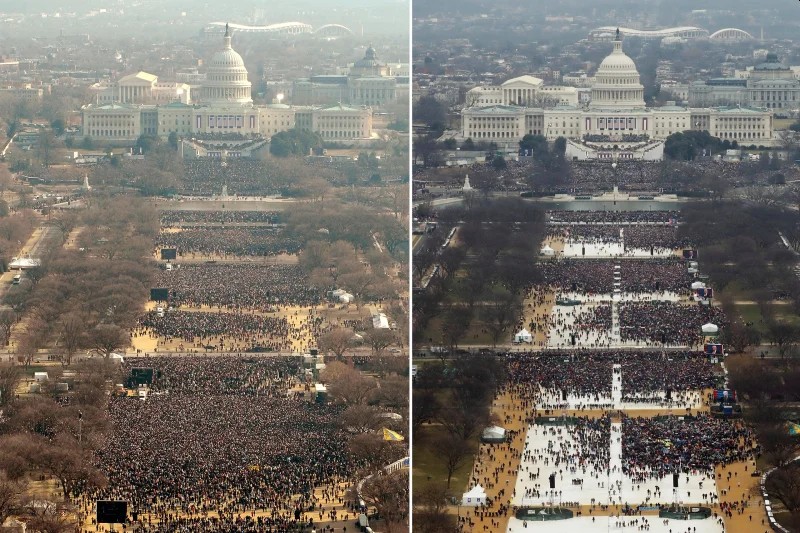
On January 20, 2017, Donald Trump was inaugurated as President of the United States. Leading up to the event, Trump boasted about the enormous crowds he was certain his inauguration would draw. This led many in the media to point out, after the inauguration, that it had in fact not drawn as large a crowd as either of Barack Obama's inaugurations.

Crowds from Barack Obama's first inauguration (left) and Donald Trump's inauguration (right). Emily Barnes—Getty Images; Lucas Jackson—Reuters

The next day, at White House Press Secretary Sean Spicer's first press briefing in his new job, he attacked the media and falsely claimed that Trump's inauguration had drawn the "largest audience to ever witness an inauguration – period – both in person and around the globe."

Later, high-ranking Trump staff member Kellyanne Conway defended Spicer's lie by claiming that Spicer was merely giving "alternative facts," and I feel like this infamous statement was a preview of so much that has happened in the five-plus years since. I feel like we are living in a country where more and more, everyone has their own alternative facts and it's getting increasingly difficult to bridge the divides they create.

I wrote a post last year in which I outlined the reasons that I characterize the modern Republican Party as akin to a cult. The reasons I focused on were two very prominent false beliefs around which the Republican Party had come to organize itself - one, that COVID vaccines are bad, and two, that Trump won the 2020 election. The first of those false beliefs has led to hundreds of thousands of preventable deaths. The second of those false beliefs led to a violent mob assault on the US Capitol and continues to threaten to tear apart our democracy.

These are only the tip of the iceberg when it comes to alternative facts popular on the right. The epidemic of mass shootings and gun violence in this country gets worse and worse and nothing gets done because one of our two major political parties has concluded against all evidence that the solution is more "good guys with guns." Abortion bans are now going into effect in many states, the proponents of which ignore many inconvenient facts such as (to name just one) that ectopic pregnancies are never viable and the only safe course of action is abortion. Laws targeting LGBT people or targeting the accurate teaching of the role of racism in American history continue to be pushed forward based on total fantasies about non-existent harm to children, and instead cause very real harm to ordinary people who are just trying to live their lives.

I recently attended a birthday party for a relative and saw a number of other relatives who I hadn't seen in quite some time. I was reminded of how nice and enjoyable it can be to just spend time with people in person. But also of how there are certain topics that you just can't talk about because you're inhabiting two different worlds. Avoid those topics, and it's a perfectly lovely day with perfectly lovely people. Get into those topics, and you'll just get a headache as the alternative facts fly.

I've written a lot about the falsehoods that are popular on the American right. I'm also becoming more and more aware that different sets of alternative facts are becoming increasingly popular among many on the left. Don't get me wrong, I'm not saying the two are equivalent to each other - the American right is waging an active campaign to end democracy based on lies, and no one in a position of real power or influence on the left is doing the same. Nonetheless, it's all bad and I feel it's all contributing to the fracturing of society.

With the recent disastrous rulings by the Supreme Court, a lot of people have pointed out that these things wouldn't be happening if Hillary Clinton had won the 2016 election, as a way of highlighting the importance of voting. Other people, many of whom in 2016 were diminishing the importance of voting for the Democratic nominee, have gotten angry at these statements.

Look, I get their frustration at the many failures of the Democratic Party, but that doesn't make it less true that the Supreme Court would not be making these rulings if not for Donald Trump, rather than Hillary Clinton, getting to appoint three new justices. That's a fact. The idea that voting doesn't matter is an alternative fact.

(I think we should take a "yes, and" approach in discussions of who is to blame for the current fiasco instead of a "no, but" approach. So if someone says that more people should have voted for Hillary, you can respond, "This is true, and at the same time, the Democratic Party should have done x, y, and z," instead of saying, "No, the Democratic Party should have done x, y, and z, so it's their fault, not people who didn't vote." There are so many things that could have been done differently to avert this nightmare, and I'm not pinning all the blame on not enough people turning out to vote for Hillary Clinton, just using that as an example.)

One issue where I'm becoming increasingly aware of alternative facts becoming popular in some circles on the left is COVID. Obviously, as I've written about before, COVID misinformation on the right has taken a horrible toll. I don't want to minimize that at all. But I also see a lot of people on the side who say we should "follow the science" who... aren't following the science.

For a couple of specific examples, here are things I've seen people say on Twitter recently that were racking up huge numbers of likes and that I think represent pretty common sentiments among certain groups of people. Yes, I'm sure these views are over-represented on Twitter compared to society as a whole, but I'm also pretty sure there are a lot of people out there who think similarly.

One was a person posting the weekly case averages for the state of Virginia at this time in 2020 (608 cases/week), 2021 (200 cases/week), and 2022 (2,695 cases/week). "The biggest changes? No more mask requirements and a governor who refuses to acknowledge this multi-organ damaging virus is an issue," they wrote.

No. The biggest change, or at least by far the most important, is that the version of COVID circulating today spreads much more easily and is much more immune evasive than the versions circulating in 2020 and 2021. To an absolutely ridiculous extent. These numbers say literally nothing about the effectiveness of mask requirements or guidance from the government. Yet many people out there very confidently hold the incorrect belief that the much higher case numbers now vs. one year ago are because of mask mandates going away.

My other example is someone who said this:

Every time I tell a friend their in-person social activities prolong the pandemic & prolong my isolation, 9 times out of 10 they say, "I need SOMETHING to give me release/a break."

And I say, "So do I, but your actions mean it'll be longer until I can."

Many of them are still friends because we have conversations about why their actions are ableist & they change their behavior.

The ones who don't are no longer friends.

The person who said this has some sort of condition (I'm not sure what it is) that puts them at higher risk from COVID. I have a huge amount of sympathy for people like this. I hate that this is the new reality of the world. It has to be unbearably awful to feel that you have to isolate yourself for an unknown duration because even in spite of being vaccinated, your level of vulnerability to a COVID infection is still too high to risk getting infected. (I think there are some people who are correct in feeling this way and some people who are overestimating their risk, but I don't know which category this person falls into and I'm not criticizing their personal risk assessment.)

The harsh reality, though, is that the idea that people engaging in in-person social activities are "prolonging the pandemic" is not an idea grounded in evidence.

Imagine that somehow we could make everyone stop their in-person social activities for some amount of time. (We can't, without being a totalitarian state, but imagine we could.) The number of cases would go down, but the virus wouldn't be eradicated because it's too widespread (even in many non-human animals!) and a functional society requires some contact between people and other people. Also, lots of bad side effects would happen - people's mental health would suffer; businesses like restaurants and music venues would have to close, etc. Eventually, after whatever amount of time, social activities would resume... and the case numbers would go right back up. Stopping in-person social activities would have accomplished nothing toward the goal of ending the pandemic.

To be fair, I said similar things about people "prolonging the pandemic" in 2020 and early 2021, and I can see now that I was wrong. I now think that once the virus started to spread globally, it was essentially inevitable that we would eventually reach a situation like our current one. But in my past self's defense, back then, we didn't yet know that the virus would evolve to a form where reaching herd immunity would be impossible even with very good vaccines. Also, in 2020 there was a very clear goal - by limiting in-person social activities to reduce the number of people infected until vaccines were available, we could clearly save a lot of lives. And it was a goal with an end point. Now there's no clear goal and no end point.

I want to also say that there is a lot of very justified frustration about people pretending the pandemic is over and the government not doing more about it! There are a lot of things we should still be doing - namely, pouring huge amounts of funding into improving indoor air quality and into research on better vaccines, as well as mandating paid sick leave, and better accommodations such as remote options for vulnerable people. All of these would have huge benefits both in the near term and for the foreseeable future. But I don't think there's anything that anyone could realistically do right now that would change the reality of a virus still running rampant.

The people who think there is seem to also be ignoring that, with the much more easily transmissible and immune evasive omicron variants, case numbers continue to surge even in countries that had largely suppressed the virus through the pandemic's first year-plus. This is no longer a situation where America is screwing up and we can look to a lot of other countries that are doing a lot better. We can just all be grateful that the surges in case numbers are becoming decoupled from surges in deaths.

Why is this such a big problem? These alternative COVID facts on the left aren't directly causing a bunch of people to die the way the alternative COVID facts on the right have. So what's the harm?

Well, let's look at what the second person I quoted said. "Many of them are still friends because we have conversations... & they change their behavior. The ones who don't are no longer friends."

So what we have, really, is someone telling their friends to do something based on ideas that aren't well supported by evidence. And then cutting people out of their lives who don't do that. They certainly have a right to make that decision, yes. But it's pretty bad, I think, especially if it's happening on a large scale! I think people everywhere are building up a huge amount of resentment toward other people because they don't subscribe to the same alternative facts. And it's all contributing to the fracturing of society.

Specifically, regarding alternative facts on the left, I think that with the growing threat of fascism from the right, anything that leads to a fracturing of the different groups of people who should be united to oppose fascism is a big problem.

I realize as I write this that I might sound like I think I'm above all the other people with their alternative facts and I'm some ultimate arbiter of truth. I'm not. I'm sure there are things I believe that aren't true. I just try to be really careful about believing too strongly in things that aren't really well supported by evidence.

So a big question about all of this is, are things really different now from how they've been at various other times in human history? I mean, people everywhere have always believed things that aren't true.

I'm not sure of the answer to this question. But one thing I think might make this moment actually different is the Internet. In the pre-Internet days, everyone everywhere believed some things that weren't true, but they just had their own untrue beliefs, or the untrue beliefs shared by relatively small (at a societal or global level) groups. They didn't have the ability to instantly connect with lots of other people around the world who have similar untrue beliefs, leading to increasing reinforcement of those untrue beliefs. During the flu pandemic of a century ago, someone could tell their friends an alternative fact about the flu. But they couldn't send that alternative fact out into the world and instantly be rewarded with hundreds of little hearts and the resulting little dopamine hits.

People have always to some degree self-segregated themselves based on beliefs they hold. But it seems like the extent to which that is happening today, to which people are organizing their whole lives around certain sets of alternative facts and then organizing themselves into social groupings based on belief in those alternative facts, is unusual. Perhaps even unprecedented.

It feels like we've entered a post-truth America, a place and time where the truth largely just doesn't matter. Where different groups of people all live in their own alternate realities. From my perspective, it seems like the alternate reality that is shared by the most people, and that is the most threatening to society, is that inhabited by many on the right. And that it's imperative that everyone else recognize that threat and work to stop it, but instead different groups on the left and center are drifting off into their own alternate realities. But maybe that's just what it looks like from my perspective.

Anyway, it's all pretty scary!

I don't know what the answer is. I guess I'll keep trying to do my own little part to encourage people to look at the evidence on things and not just accept at face value whatever so-called facts are popular in their in-group. As well as to encourage people to regard other human beings and their life situations with empathy and decency. It often seems futile, but I'll try.

Sunday, September 19, 2021

Thoughts on sharing a country with a cult

When I was in grad school, I spent several years as a teaching assistant for my PhD advisor's class. I remember well something that he liked to say to me and the other TAs about teaching.

If a handful of students did poorly on a particular assignment, those individual students could be blamed for their poor performances. But if a large number of students did poorly on an assignment, we shouldn't blame the individual students as much as we should blame ourselves.

I think there was a lot of wisdom in that. It was our responsibility to impart to the students the information they would need to complete the assignment successfully. If so many of the students were unable to succeed in the assignment, the instructors had failed. It wasn't just a failure of individual students, it was a systemic problem within the class, and therefore the responsibility of the people in charge of the class.

Right now in the United States of America, there is a simple assignment being given to people, an assignment with very clear right and wrong answers, and millions upon millions of people are failing that assignment.

Over the course of the COVID pandemic, people have had to make a lot of difficult decisions, decisions where the right and wrong answers haven't always been clear. I think a lot of liberal discourse on COVID has failed to acknowledge some of these complexities. That's not to say there haven't been a lot of people on the clearly wrong side of certain issues - but, for example, the "stay home and save lives" mantra, although well intentioned, can come across as awfully dismissive of people who, because of their jobs, never had the option to stay home. And there are a lot of other examples.

With the arrival of the vaccines, though? Now we have a decision that, if you are operating with the correct information, should be the opposite of difficult for the vast, vast majority of people. A decision where there is a very clear right answer (get the free, safe, and effective vaccine) and a very clear wrong answer (don't get the vaccine, thereby dramatically increasing your own chances of contracting COVID and developing severe illness, hampering efforts to get the pandemic under control, contributing to devastating strain on our health care systems and workers, harming local businesses that are struggling because of the pandemic, etc., etc., etc.).

Depressingly large numbers of people are continuing to go with the wrong answer. After getting off to one of the fastest starts thanks to our early access to large supplies of vaccine doses, something for which we are incredibly privileged, vaccination efforts in the US are stalling at levels well below those in most peer nations.


Now I want to be clear, the disinformation campaigns that are the focus of this post are not the only reasons for people not getting vaccinated. There are people who, for instance, haven't gotten vaccinated because they are worried about having heavy side effects (a real thing, I can say from my own experience) and not being able to take a sick day from work. There are people who are members of communities that have long histories that continue to the present day of being mistreated by the medical establishment, and therefore have valid reasons to distrust the medical establishment which translate into vaccine hesitancy - an understandable reason for questioning whether to get the shot, even if in this particular case it's not a good reason to not get the shot. There is a lot more that could have been done and could still be done to get past such reasons for hesitancy and increase vaccine uptake.

But there's vaccine hesitancy, and then there's outright vaccine refusal.

It's become very clear that the people most likely to fall into the latter category are people with right wing political leanings. And now we see not only people refusing to take a proven effective and safe vaccine, but also trying to fight the disease that the vaccine protects against with quack "cures" that have no evidence of efficacy and are much riskier in terms of side effects than the vaccine is!

It's bewildering. Why is this happening?

I can't help but think of my PhD advisor's words. When this many people are failing an assignment, the fault doesn't lie primarily with the individual people. The problem is with the information the people are receiving. But whereas in the example at the beginning of this post, the problem was that the instructors were trying but failing to clearly convey the correct information, here the problem is that the "instructors" are succeeding in conveying bad information.

Right wing media personalities and Republican politicians are pounding into the heads of their viewers, listeners, and followers false information about the vaccines. Many of those public figures are themselves vaccinated, but continue to spew out this vile propaganda because they think it will be to their political advantage. It's basically a crime against humanity.

I came across a nice analysis recently showing the vaccination levels and COVID rates in all counties of the United States grouped by 2020 Trump voting rate. Here's the graph of county vaccination rate by Trump voting rate:


(Note that the 0-10% and 90-100% group have relatively small sample sizes here.)

And here's the graph of rates of COVID death since the end of June 2021, which is a good cutoff point because it means that very nearly all of these deaths would have been prevented if everyone who was eligible had gotten vaccinated:


The images pretty much speak for themselves. In a real sense, people are killing themselves and their relatives and neighbors in order to prove their loyalty to a political movement. A political movement, it's important to note, the leader of which did get vaccinated but refused to make any effort to promote vaccination because if more people got vaccinated it could be politically beneficial to his enemies.

I imagine most everyone who is reading this post has gotten vaccinated. And you are probably, at least to some extent, part of a community in which people encourage getting vaccinated. If you had lived your whole life in an insular bubble in which extreme right wing views are promoted and other viewpoints are shunned, would you still submit the correct answer on the "should I get vaccinated?" assignment? Can you really say?

We all, every single one of us, firmly believe in some things that aren't true. It's a fact of life. Speaking for myself, I can't say what those things are, but I know that there are some. As I wrote about not long ago, we should all be more humble about the things we "think we know." For all of us, this is to some extent related to the sources from which we gather information, something that is not entirely in our control.

At the same time, some people believe more strongly in more wrong things than other people, and some wrong beliefs are much more harmful than others.

There is a big overlap between tendency to believe falsehoods about COVID vaccines and another set of false beliefs that are also doing tremendous harm to our society.

recent poll found that a whopping 66 percent of Republicans believe, against all evidence, that the 2020 presidential election was stolen from Trump, with just 18 percent saying that President Biden is the rightful president. Such beliefs are, of course, being used as justification for attacks on our electoral system to try to enable Trump to steal the next election. The irony of the "rigged election" claims is that our electoral system is already effectively rigged in favor of Republicans thanks to gerrymandering, the Electoral College, and the makeup of the Senate (two senators per state regardless of population) all giving disproportionate power to rural white voters, thus enabling Republicans to control the government despite having far fewer people vote for them.

Again, when so many people are failing an assignment, we can't just blame the people as individuals; we have to blame the sources of information pertinent to the assignment. Again, Fox News, talk radio, Republican politicians, etc., are all spewing constant disinformation about our elections. This is not a new problem, but it's been getting worse and worse. At this point the Republican Party has essentially abandoned the concept of representative democracy. That isn't an exaggeration.

I have an older relative who I had always considered a really lovely person. The last few years have severely strained that perception. Recently I saw him post this on Facebook:


Let's not mince words. This (especially taken in context of other things my relative has posted) is some straight up fascist shit.

But that doesn't mean the things about my relative that made me like him for all those years aren't still there. Have a conversation about something not related to politics, and he still seems like the same person he always was. These aren't fundamentally evil people we're talking about. These are ordinary people who have had their minds warped by misinformation and as a consequence support evil things.

(This particular relative is vaccinated, by the way. But has also posted anti-vax stuff. Go figure. Cult behavior obviously doesn't have to make sense.)

I have several relatives who are like this, and I think it's hard for me to really blame them that much for the way they are. It makes me really sad. But propaganda is effective. 

It's kind of a weird balancing act for me. Recognizing that the people who are doing these things are not fundamentally horrible people, they're just very misguided, but simultaneously recognizing that by doing these things they're threatening the very foundations of our society and this has to be stopped in any way possible.

The people who I feel real animosity toward are the people who are creating and spreading the propaganda. The politicians and media figures who have filled people's heads with so much garbage that we now, literally, have people dying of a deadly virus to own the libs, and we have a still ongoing attempted insurrection trying to topple our form of elected government and replace it with white nationalist authoritarianism.

So that's the problem, as I see it. Millions upon millions of our fellow Americans have been so inundated with misinformation that they are constantly and horrifically failing the assignment of being a decent citizen of this country in multiple devastating ways. It's a cult. It really is. That's the problem.

What should we do about the problem? That's the hard part. I wish I knew. I'm largely at a loss. But I have a few thoughts, hopeless as it all sometimes seems.

People who are in a cult are never going to listen to someone trying to tell them that they're in a cult, with a possible exception if they have a close personal connection with the other person. Getting in arguments with hardcore Trump supporters and anti-vaxxers is not going to be effective.

People who do have close personal connections to cult members might sometimes be able to appeal to their better natures. Sometimes. I'd imagine the closer the connection, the more likely. And I'd imagine it also depends on how deeply someone is into the cult. But I'm definitely not an expert on the psychology of cult members so I'm not going to try to go into how to do this.

I think what's paramount in importance is the rest of us recognizing the threat and the urgency of acting to stop it.. Perhaps close to one-third of the people in this country are members of a cult that, if it gets its way, will destroy most of the things we love about this imperfect but still in so many ways amazing nation. But as depressingly large as the cult is, it's really not close to being a majority of the country. It can only succeed (with help, unfortunately, from the aforementioned biased-toward-rural-white-people electoral system) if enough of the non-cult-members keep their heads in the sand about what's going on.

We're all influenced by the information spheres we inhabit. And I think an important thing to realize about the information people in the United States receive is that, taken as a whole, the media today are incredibly biased in favor of Republicans.

"But, but, the liberal media..." you might be saying. Which if you had that reaction, is a good example of the pro-Republican bias.

We have, as I mentioned, right wing media outlets that have become just straight up propaganda factories. They aren't even attempting to accurately report what's going on. They're just trying to spin everything in whatever way is most favorable to the political right wing.

Then you have the rest of the mainstream media. They, for the most part, aren't trying to propagandize. They're trying to report the news. It's impossible to do this with no bias, and different sources have different biases. But the overriding bias of the mainstream, non-right-wing media is a bias toward trying to be unbiased - which manifests as a bias toward "both sides" reporting and "the truth is in the middle."

If you have two political parties, and both political parties are basically normal political parties that are both sincerely trying to engage with reality and the problems of the real world in different ways, then maybe this sort of "truth is in the middle" approach makes some sense. What we have instead is two political parties, and one of them is a basically normal political party, but the other one is an authoritarian white nationalist cult that is trying to overthrow democracy.

Thanks to all the "liberal media" accusations over the years, mainstream media outlets are terrified of being excessively friendly to Democrats and unfriendly to Republicans, so most of the time they try to be equally critical toward both parties. They portray disagreements between the two parties as normal partisan squabbling, just politics as usual. When one of the parties is an authoritarian white nationalist cult that is trying to overthrow democracy, and you treat this as all just politics as usual, you're doing a huge favor to the authoritarian white nationalist cult that is trying to overthrow democracy!

Most people don't really think about this. And I don't blame them; they have plenty of problems to worry about in their own day-to-day lives. But I think it's an important thing to recognize when considering why voters make the decisions they do.

As I mentioned, we all believe in things that aren't true. One such mistaken belief that I think is common for people who fall toward the middle of the political spectrum to hold is the belief that bipartisanship is, in and of itself, an important goal in the political process, rather than something that is sometimes a means toward achieving other worthy goals.

When the other party is actively trying to overthrow democracy, trying to work with that party is definitely not an important goal.

But people are set in their ways. So you have, for example, the situation in Maine where Joe Biden won the presidential vote but Republican Susan Collins was reelected to the Senate. A bunch of voters in Maine decided that although they didn't want the authoritarian white nationalist president to be reelected, they were cool with potentially giving the party led by an authoritarian white nationalist control of the Senate. That's not what their thought process was, of course, but that's the reality of their voting choices. And then you also have centrist Democrats in Congress who are putting President Biden's agenda in jeopardy and threatening to help the Republican plot to overthrow democracy, because they still seem to naively think that bipartisanship is a worthy goal.

Those are some of the obstacles we face.

We all have to think about what we can do to save American democracy. We have to engage the people around us, the people who aren't in the cult but also aren't as tuned in to politics, to make sure they aren't going to sit on the sidelines. We also have to be aware that a lot of people will just tune all this talk about fascism out. This is partly because people have an understandable need to just want to focus on their own issues, partly because of the impressions they get from the lazy "both sides" media, but regardless, those people have to be reached by other means. There should be reasons that just about any non cult member would not relish the chance of returning to the non-stop horror show of a Trumpist government. Find the reasons that are important to people around you and make sure they remember those reasons.

The election of 2020 was the most important of our lifetimes, but it unfortunately looks like every election for the foreseeable future could also be the most important of our lifetimes. What gives me hope? The Republican brand has been poisoned forever for a large majority of people my age and younger. Eventually, it's the people of these younger generations who will have the most say in our democracy.

If democracy survives that long.

So we have to do everything we can to make sure it does.