Showing posts with label covid-19. Show all posts

Thursday, March 20, 2025

The Age of Confusion (or: the more things change...)

Last year my parents downsized from the house in which I grew up to a condo, and in the process of moving gave away a lot of things including most of their music and book collections. Naturally, I ended up with a lot of records and CDs. I also picked a few books that looked interesting. I've recently been reading one of them, 28 Science Fiction Stories of H.G. Wells, and it's quite interesting indeed. I found the first story, a novel called Men Like Gods, so interesting - and timely - that I felt compelled to write something about it!

Men Like Gods, which Wells described as a "scientific fantasy," was published in 1923 and is set in 1921. The premise is that the protagonist, an Englishman named Mr. Barnstaple, is transported to an alternate dimension along with about a dozen other Earthlings. They find themselves on a strangely Earth-like world inhabited by humans but in a very different society than that they know, a futuristic society in which humanity has apparently used science to solve all its problems. A Utopia, as Mr. Barnstaple quickly comes to think of it.

There is a lot of commentary on the state of mankind and society in the 1920s - and I was struck by how relevant it all seemed to the 2020s. So I wanted to share some of the passages I found most striking along with my reactions to them.

The story begins thusly:


"They all cost money, with a cheerful disregard of the fact that everything had gone up except Mr. Barnstaple's earning power," I read, and chuckled, because apparently inflation was also a big concern a hundred years ago.

That was just the beginning.

Mr. Barnstaple is the sub-editor of a newspaper called the Liberal, "that well-known organ of the more depressing aspects of advanced thought." We learn that he is "obsessed by apprehensions of some sort of financial and economic smash that would make the great war seem a mere incidental catastrophe." The "great war," which we now, of course, know as World War I, was a recent event when this story was written. And of course, the Great Depression was not too far in the future, so Mr. Barnstaple and H.G. Wells seem prescient here.

We often like to think that we live in unusually tumultuous and terrifying times, and although there are certainly a lot of really bad and frightening things happening today, I don't know whether that's really true.

"Even in ordinary times Mr. Peeve [Mr. Barnstaple's boss] would have been hard enough to live with; but the times were not ordinary [emphasis mine], they were full of disagreeable occurrences that made his melancholy anticipations all too plausible. The great coal lock-out had been going on for a month, and seemed to foreshadow the commercial ruin of England; every morning brought intelligence of fresh outrages from Ireland... a prolonged drought threatened the harvests of the world; the League of Nations... was a melancholy and self-satisfied futility; everywhere there was conflict, everywhere unreason; seven eights of the world seemed to be sinking down towards chronic disorder and social dissolution."

"Mr. Barnstaple was, indeed, ceasing to secrete hope... His hope had always been in liberalism and generous liberal effort, but he was beginning to think that liberalism would never do anything more for ever than sit hunched up with its hands in its pockets grumbling and peeving at the activities of baser but more energetic men. Whose scrambling activities would inevitably wreck the world." That passage could have been written today, right? Have baser but more energetic men always been wrecking the world? Probably for as long as civilization has existed, and yet somehow the world has continued to go on, not entirely wrecked.

As stated in the opening sentence of the story, Mr. Barnstaple needs a holiday, and we learn that "the most hopeful thing about" his situation is that "he owned a small automobile of his very own." Of this automobile, we learn that "Mr. Barnstaple used it to come up to the office from Sydenham because it did thirty-three miles to the gallon and was ever so much cheaper than a season ticket." 33 miles per gallon. A hundred years ago. The best-selling cars in America today are Ford F-series pickup trucks; the popular F-150 gets about 23 miles per gallon. Good lord, what are we even doing? But I digress.

Mr. Barnstaple thinks due to all the turmoil in 1921 that "if anything it was a sillier year than 1913, the great tango year, which, in the light of subsequent events, Mr. Barnstaple had hitherto regarded as the silliest year in the world's history." From my perspective our current era seems a contender for silliest in history, but I'm undoubtedly very biased. Also, I have no idea why 1913 might have been "regarded as the silliest year in the world's history," and have no idea what even happened in that apparently very silly year. I wonder what people will think of our current era a hundred years from now?

After being transported to Utopia, Mr. Barnstaple and the other Earthlings learn about this strange world from some of its residents, the Utopians. They learn that Utopia seems to be essentially a parallel universe Earth but farther along in history. At some point in Utopia's past it was much like the Earth of 1921. That era is now known to the modern-day Utopians as "the last Age of Confusion."

The Utopians are interested in learning what it's like to live in such an age, and so one of the Earthlings, Mr. Burleigh, gives "a brief account of the world of men," including "states and empires," "wars and the Great War," "economic organization and disorganization," "the difficulties of finding honest statesmen and officials," "the unhelpfulness of newspapers," and "all the dark and troubled spectacle of human life."

I mean, sounds like a good summary of the world today, right? Replace "newspapers" with news sources in general - newspapers, TV, news websites, social media - all of which have failed to prevent and have indeed helped enable the lurching toward fascism that is currently happening in the United States. We bemoan this as a problem of our age, but perhaps it's always been a problem.

The Earthlings are then told of how things work in Utopia, and are astonished to learn that there is no central government; "Decisions in regard to any particular matter were made by the people who knew most about the matter."

One thing I find fascinating about this story is that when it was written, two terrible global events were both in recent memory: World War I, and the flu pandemic of 1918-1920. The Great War is mentioned multiple times in the story. The flu pandemic? Never mentioned explicitly, but a number of points in the story seem to have come out of the pandemic being on the author's mind. Here we get the first, when the Earthlings ask, "But suppose it is a decision that has to be generally observed? A rule affecting the public health, for example? Who would enforce it?"

The answer: "It would not need to be enforced. Why should it?"

At the beginning of COVID, many people were surprised to learn that there had been a deadly global pandemic a hundred years earlier, because they'd never heard of it. It killed more people than World War I, but whereas World War I is a major part of history classes and contributes to the setting of all sorts of notable literature, the same just isn't the case for the flu pandemic. But then once we'd lived through a pandemic for a while, people realized it made sense that after experiencing it, most people would just want to go back to normal life as if the pandemic hadn't happened. People wouldn't want to read or write a novel set during the pandemic.

And so the choice by Wells not to mention the pandemic when he lists all the recent problems of the world, but the clear influence of the pandemic on his story (an influence I wouldn't have recognized had I not lived through a pandemic myself), fascinates me.

Jumping forward in the story, the more prominent evidence of the flu pandemic's influence comes when, on the second day after the Earthlings arrive, the "great epidemic in Utopia" begins. Utopians had long ago eliminated all disease from their world and as a result their immune systems are not prepared for the infections the Earthlings are carrying. "Though not one of them was ailing at all, it became clear that someone among them had brought latent measles into the Utopian universe, and that three or four of them had liberated a long suppressed influenza."

(When I read the story earlier this year, I didn't realize how timely the measles reference would be. Oof.)

These diseases rapidly spread through the population, and our band of Earthlings is then approached by people in gas masks who tell them, "Quarantine. You have to go into quarantine. You Earthlings have started an epidemic and it is necessary to put you into quarantine."

Amusingly, some of the Earthlings think that their natural immunity makes them superior to the Utopians and will allow them to conquer the planet as its inhabitants all fall ill, but the Utopians' science quickly turns things around. Then, in one last pandemic reminder, the funniest moment of the story to me came when the Utopians mention that research is being undertaken to develop a method to send the Earthlings back to their own dimension. Father Amerton, the voice of organized religion among the motley crew from Earth, asks what the nature of the treatment will be - "Is it to be anything in the nature of vaccination?"

He then goes on, "I may say at once that I am a confirmed anti-vaccinationist. Absolutely. Vaccination is an outrage on nature. If I had any doubts before I came into this world of - of vitiation, I have no doubt now. Not a doubt! If God had meant us to have these serums and ferments in our bodies he would have provided more natural and dignified means of getting them there than a squirt."

Yep, these words were written in the early 1920s. Other than a few amusing anachronistic terms (like "anti-vaccinationist" and "squirt"), nearly the exact same words could have been spoken by countless people a hundred years later - and as a result of this, hundreds of thousands of people died preventable deaths.

So much for humanity becoming more enlightened as history progresses.

Mr. Barnstaple realizes that the more he hears about the last Age of Confusion in Utopia's past, "the more it seemed to resemble the present time on Earth." He forms an outline in his mind of the history of Utopia from that confused era onward. In this outline, a period of tremendous advancement in scientific inquiry occurred.

"The Utopians, who had hitherto crawled about their planet like sluggish ants or travelled parasitically on larger and swifter animals, found themselves able to fly rapidly or speak instantaneously to any other point on the planet." Note that powered flight and instantaneous communication to locations around the globe were both recent developments when Wells wrote this story!

"They found themselves, too, in possession of mechanical power on a scale beyond all previous experience, and not simply of mechanical power; physiological and then psychological science followed in the wake of physics and chemistry, and extraordinary possibilities of control over his own body and over his social life dawned upon the Utopian."

These developments did not lead to an instant transformation from Age of Confusion to Utopia, though. At first they were only appreciated by a small minority of people, while most people "spent the great gifts of science as rapidly as it got them in a mere insensate multiplication of the common life."

The next passage sounds very much like a description of the world of today: "The economic system... became more and more a cruel and impudent exploitation of the multitudinous congestion of the common man by the predatory and acquisitive few. That all too common common man was hustled through misery and subjection from his cradle to the grave; he was cajoled and lied to, he was bought, sold and dominated by an impudent minority, bolder and no doubt more energetic, but in all other respects no more intelligent than himself. It was difficult... for a Utopian nowadays to convey the monstrous stupidity, wastefulness and vulgarity to which these rich and powerful men of the Last Age of Confusion attained."

Gee, does that remind you of anyone?

"What plenty and pleasure was still possible in the world was filched all the more greedily by the adventurers of finances and speculative business."

Are we talking about Utopia in the Age of Confusion, Earth in the 1920s... or Earth in the 2020s?

Eventually, the people of Utopia's past came to realize that "the state could not do its work properly nor education produce its proper results, side by side with a class of irresponsible rich people. For, by their very nature, they assailed, they corrupted, they undermined every state undertaking; their flaunting existences distorted and disguised all the values of life." Again, does that remind you of anyone? And eventually, after centuries of struggle, the control of "greedy, passionate, prejudiced and self-seeking men" over society was wrested away, and a society in which science and education were held in paramount by all was established.

In this utopian society, Mr. Barnstaple learns, there are "Five Principles of Liberty, without which civilization is impossible." The most striking of these is the fourth: "that Lying is the Blackest Crime."

As the young Utopian explaining this to Mr. Barnstaple states, "Where there are lies there cannot be freedom."

This, again, calls to mind events of our present era, and, apparently, of the era one hundred years' past. Mr. Barnstaple contends that "half the difference between Utopia and our world... lay in this, that our atmosphere was dense and poisonous with lies and shams... The fundamental assumptions of earthly associations were still largely lies, false assumptions of necessary and unavoidable difference in flags and nationality... impostures of organized learning, religious and moral dogma and shams."

Mr. Barnstaple gets especially worked up about "the suppression and falsifications of earthly newspapers," which is "a question very near his heart."

"The London newspapers had ceased to be impartial vehicles of news; they omitted, they mutilated, they misstated. They were no better than propaganda rags."

Don't we all today, people from all parts of the political spectrum, bemoan the state of the news media and how various parts of it (which parts depending on one's point of view) are no better than propaganda? And don't we, like Mr. Barnstaple, yearn for a past era in which this was not so much the case?

I do think that the collapse of any sort of commonly agreed upon objective reality is a striking problem of modern life. It's said that a tool of authoritarianism is constantly bombarding the public with lies, not so much to get people to believe the lies as to get people to stop believing that there is any sort of truth. As I look with anguish on what's happening in my country, I very much believe this, and from my perspective it seems like a relatively novel problem in the span of modern American life. But it's clearly not a novel problem in human history. And it's probably been a problem, to a greater or lesser extent, for as long as civilization has existed.

Of course, it could probably go without saying that the idea that humans could ever agree on an objective reality to the extent that it would be possible to outlaw lying - and to do so in service of the truth and not to an oppressive regime - is far-fetched.

Reading this story, I found myself wondering two things about H.G. Wells's thoughts on this imagined world of his. The first is, did Wells view Utopia, this world where all the problems of modern society had been solved and everyone could live a life of comfort and plenty, as good?

His protagonist, Mr. Barnstaple, becomes quite the Utopia stan (as the kids say), but all the other Earthlings are, to various degrees and for various reasons, quite critical. One interesting critique: "Life on earth was... full of pains and anxieties, full indeed of miseries and distresses and anguish, but also, and indeed by reason of these very things, it had moments of intensity, hopes, joyful surprises, escapes, attainments, such as the ordered life of Utopia could not possibly afford."

There's also the matter of Utopia having been achieved in part through heavy use of eugenics, something that today is generally regarded as a Bad Thing, but that may have been viewed more favorably by many in the past.

The second thing I wonder is whether Wells viewed it as plausible that at some point in the future humanity could progress to a society like that portrayed in the story. Or if not exactly like that, then at least a society where those familiar problems - constant conflict, ubiquitous unreason, unhelpful and dishonest newspapers, rich and powerful men laying waste to society - had largely been banished to the past.

When I was a kid, I got the impression of the story of humanity as one of continuous progress. In the future, things, in general, would be better than they were in the past. I certainly no longer feel that way. I'm not sure whether that change is simply due to me being older, or if it's also a reflection of a general change in how humans view the future. A lot of classic science fiction portrays futures in which technology has made life easier for all humans rather than just for the privileged. I don't think that's the case anymore.

When I read this story, the fact that so many of the problems a hundred years ago sound exactly the same as the problems today makes me skeptical that the problems will ever be solved. Mr. Barnstaple leaves Utopia feeling confident that one day, "Earth would tread the path Utopia had trod." What about H.G. Wells? Was he, from the vantage point of 1923, able to look to the past the way that I can from 2025 and see how all the problems he described echoed things that had already happened? Or did the "Age of Confusion" seem like a temporary state through which humanity was passing?

To be fair, he did describe the struggle to go from Age of Confusion to Utopia as having taken thousands of years. Even still, it's hard for me to imagine that transition ever occurring, because there are certain fundamental aspects of human nature.

Wouldn't it be nice, I've thought recently, if we could just live in a world where everyone had two basic character traits:

1. They cared about other people. Other people in a general sense, not just a certain subset of other people. There are, I think, a lot of people who do, but there are also a lot of people who don't.

2. They had decent critical thinking skills. That is, if presented with evidence for an argument, they could evaluate the evidence and come to a reasoned conclusion about the strength of the argument. And if presented with an argument that's obvious BS if examined carefully, they would be suspicious of it. They wouldn't just believe things for no sound reason and cling to those beliefs even in the face of an overwhelming amount of contradictory evidence. This, I think, is something that no one is perfect at, but some people are good at it, while some people are okay at it, and some people quite frankly aren't very good at it, at all.

It seems that the difference between Wells's Utopia and the real world, and the reason that the real world could never become like Utopia, could be summarized as that many, many people in the real world have neither or just one of those two character traits, and there's no reason to think that will ever change.

And it's interesting to me that that's true. It seems that that's how we evolved. Why is it that some people do have those traits, and others don't? (Perhaps the remarkable thing is that a lot of people do have those traits instead of no one having them?)

What would the world be like if everyone cared about humanity and could be swayed by evidence toward believing true things and disbelieving false things?

Granted, there are issues where, even working under that imagined framework, there aren't clear right and wrong answers. Take the aforementioned COVID pandemic. There were tradeoffs between trying to slow the spread of a deadly disease and trying to live as a social species for which being social is a basic need (especially for the developing minds of children, who conveniently were themselves at low risk from the disease!) and there was no way to avoid doing some measure of harm in some direction. The actual response to the pandemic was a disaster in a multitude of ways, but I don't think there's an ideal world where there's a clearly correct response with no downsides.

But there are also issues where there are very clear right answers, and the problem is that a lot of people just don't want to accept those answers as right, or reflexively oppose them because they don't like the people who are proposing the ideas.

To use a pet issue of mine as an example, it's inarguably true that improving bike and pedestrian infrastructure and public transit would benefit the health of individual people, of society, and of the planet. In a cost-benefit analysis, the benefits outweigh the costs by a mind-boggling amount. Operating under a Utopian framework, we would just do this and the only questions would be about the details, not about whether or not to do it. Sadly, the real world doesn't work that way.

But then, every form of progress does have unintended consequences (rip scribes). Perhaps in the imagined world full of compassionate and rational people, accelerated progress compared to the real world would have inadvertently brought about our premature demise.

Or perhaps we would be living in a utopia.

Either way, I find it simultaneously depressing and comforting to realize that so many of the problems that seem new or at least newly terrible to us today are the same problems that have been faced over and over again by other people in the past. Depressing, because it's sad to think about how no matter how hard people try to fix the world, in some ways it's probably unfixable. But comforting, because when you're in a bad situation there's comfort in knowing that you aren't alone, that not only are other people feeling the some things but other people have felt the same things in the past. Lots of people lived through times like the times we're living through now and were still able to find meaning and joy in their lives. Lots of people lived through far worse times and were still able to find meaning and joy.

It was really funny to me to read this story from a century ago and have the protagonist remark that "the times were not ordinary" for reasons that are in many ways the same as reasons that we, today, say that the times are not ordinary.

There's a joke I've seen a lot, where someone says that we're living in unprecedented times, and concludes, "I want to live in precedented times." But I think the truth is that, while some things about the times in which we live are unprecedented, other things have plenty of historical precedent. And I think this has been true for people everywhere for at least the last few centuries and perhaps for as long as civilization has existed. (Go far enough back in history, and I suspect the idea of "unprecedented times" wasn't so common, because the rate at which life changed was too slow to be noticeable in the lifetime of a typical human.)

The truly unprecedented elements of our lives relate mostly to the continuous and accelerating state of technological innovation. The things that merely seem unprecedented but actually do have precedent, I think, are often more fundamental things about human life that arise from fundamental aspects of human nature. Deep down, humans don't change nearly as rapidly as our technology does, and thus, the same themes play out over and over again, whether the main source of news (and propaganda) about the unfolding events is newspapers or television or social media. Yes, what's happening in the United States right now is unprecedented in this country in my lifetime, but it's far from unprecedented in human history.

Mr. Barnstaple leaves Utopia feeling invigorated by the hope that the efforts of people like him on Earth would not be in vain, and that one day in the future Earth would become a utopia as well. Reading his story a century later, that seems exceedingly unlikely, but I don't see that as a reason to despair or to give up the fight. Fighting to prevent a dystopia is perhaps even more important than fighting to achieve a utopia. As long as we're able to have those "moments of intensity, hopes, joyful surprises, escapes, attainments" that are provided to us by the privilege of living on this amazing, awful, yet wonderful world, the fighting isn't and wasn't in vain.

In a post I wrote a few months ago, I shared this quotation:


That was before I read Men Like Gods. After reading it, these words seem even more timely.

Life. It sure is something, isn't it?

Wednesday, July 13, 2022

Post-truth America

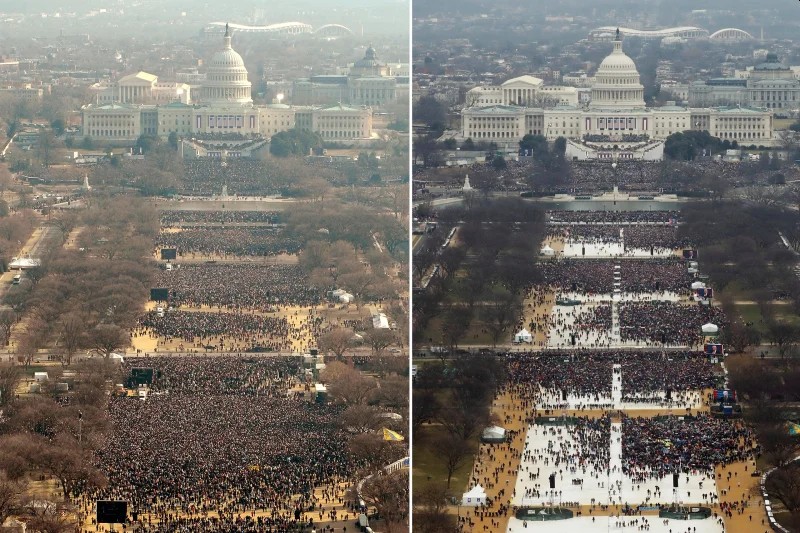
On January 20, 2017, Donald Trump was inaugurated as President of the United States. Leading up to the event, Trump boasted about the enormous crowds he was certain his inauguration would draw. This led many in the media to point out, after the inauguration, that it had in fact not drawn as large a crowd as either of Barack Obama's inaugurations.

Crowds from Barack Obama's first inauguration (left) and Donald Trump's inauguration (right). Emily Barnes—Getty Images; Lucas Jackson—Reuters

The next day, at White House Press Secretary Sean Spicer's first press briefing in his new job, he attacked the media and falsely claimed that Trump's inauguration had drawn the "largest audience to ever witness an inauguration – period – both in person and around the globe."

Later, high-ranking Trump staff member Kellyanne Conway defended Spicer's lie by claiming that Spicer was merely giving "alternative facts," and I feel like this infamous statement was a preview of so much that has happened in the five-plus years since. I feel like we are living in a country where more and more, everyone has their own alternative facts and it's getting increasingly difficult to bridge the divides they create.

I wrote a post last year in which I outlined the reasons that I characterize the modern Republican Party as akin to a cult. The reasons I focused on were two very prominent false beliefs around which the Republican Party had come to organize itself - one, that COVID vaccines are bad, and two, that Trump won the 2020 election. The first of those false beliefs has led to hundreds of thousands of preventable deaths. The second of those false beliefs led to a violent mob assault on the US Capitol and continues to threaten to tear apart our democracy.

These are only the tip of the iceberg when it comes to alternative facts popular on the right. The epidemic of mass shootings and gun violence in this country gets worse and worse and nothing gets done because one of our two major political parties has concluded against all evidence that the solution is more "good guys with guns." Abortion bans are now going into effect in many states, the proponents of which ignore many inconvenient facts such as (to name just one) that ectopic pregnancies are never viable and the only safe course of action is abortion. Laws targeting LGBT people or targeting the accurate teaching of the role of racism in American history continue to be pushed forward based on total fantasies about non-existent harm to children, and instead cause very real harm to ordinary people who are just trying to live their lives.

I recently attended a birthday party for a relative and saw a number of other relatives who I hadn't seen in quite some time. I was reminded of how nice and enjoyable it can be to just spend time with people in person. But also of how there are certain topics that you just can't talk about because you're inhabiting two different worlds. Avoid those topics, and it's a perfectly lovely day with perfectly lovely people. Get into those topics, and you'll just get a headache as the alternative facts fly.

I've written a lot about the falsehoods that are popular on the American right. I'm also becoming more and more aware that different sets of alternative facts are becoming increasingly popular among many on the left. Don't get me wrong, I'm not saying the two are equivalent to each other - the American right is waging an active campaign to end democracy based on lies, and no one in a position of real power or influence on the left is doing the same. Nonetheless, it's all bad and I feel it's all contributing to the fracturing of society.

With the recent disastrous rulings by the Supreme Court, a lot of people have pointed out that these things wouldn't be happening if Hillary Clinton had won the 2016 election, as a way of highlighting the importance of voting. Other people, many of whom in 2016 were diminishing the importance of voting for the Democratic nominee, have gotten angry at these statements.

Look, I get their frustration at the many failures of the Democratic Party, but that doesn't make it less true that the Supreme Court would not be making these rulings if not for Donald Trump, rather than Hillary Clinton, getting to appoint three new justices. That's a fact. The idea that voting doesn't matter is an alternative fact.

(I think we should take a "yes, and" approach in discussions of who is to blame for the current fiasco instead of a "no, but" approach. So if someone says that more people should have voted for Hillary, you can respond, "This is true, and at the same time, the Democratic Party should have done x, y, and z," instead of saying, "No, the Democratic Party should have done x, y, and z, so it's their fault, not people who didn't vote." There are so many things that could have been done differently to avert this nightmare, and I'm not pinning all the blame on not enough people turning out to vote for Hillary Clinton, just using that as an example.)

One issue where I'm becoming increasingly aware of alternative facts becoming popular in some circles on the left is COVID. Obviously, as I've written about before, COVID misinformation on the right has taken a horrible toll. I don't want to minimize that at all. But I also see a lot of people on the side who say we should "follow the science" who... aren't following the science.

For a couple of specific examples, here are things I've seen people say on Twitter recently that were racking up huge numbers of likes and that I think represent pretty common sentiments among certain groups of people. Yes, I'm sure these views are over-represented on Twitter compared to society as a whole, but I'm also pretty sure there are a lot of people out there who think similarly.

One was a person posting the weekly case averages for the state of Virginia at this time in 2020 (608 cases/week), 2021 (200 cases/week), and 2022 (2,695 cases/week). "The biggest changes? No more mask requirements and a governor who refuses to acknowledge this multi-organ damaging virus is an issue," they wrote.

No. The biggest change, or at least by far the most important, is that the version of COVID circulating today spreads much more easily and is much more immune evasive than the versions circulating in 2020 and 2021. To an absolutely ridiculous extent. These numbers say literally nothing about the effectiveness of mask requirements or guidance from the government. Yet many people out there very confidently hold the incorrect belief that the much higher case numbers now vs. one year ago are because of mask mandates going away.

My other example is someone who said this:

Every time I tell a friend their in-person social activities prolong the pandemic & prolong my isolation, 9 times out of 10 they say, "I need SOMETHING to give me release/a break."

And I say, "So do I, but your actions mean it'll be longer until I can."

Many of them are still friends because we have conversations about why their actions are ableist & they change their behavior.

The ones who don't are no longer friends.

The person who said this has some sort of condition (I'm not sure what it is) that puts them at higher risk from COVID. I have a huge amount of sympathy for people like this. I hate that this is the new reality of the world. It has to be unbearably awful to feel that you have to isolate yourself for an unknown duration because even in spite of being vaccinated, your level of vulnerability to a COVID infection is still too high to risk getting infected. (I think there are some people who are correct in feeling this way and some people who are overestimating their risk, but I don't know which category this person falls into and I'm not criticizing their personal risk assessment.)

The harsh reality, though, is that the idea that people engaging in in-person social activities are "prolonging the pandemic" is not an idea grounded in evidence.

Imagine that somehow we could make everyone stop their in-person social activities for some amount of time. (We can't, without being a totalitarian state, but imagine we could.) The number of cases would go down, but the virus wouldn't be eradicated because it's too widespread (even in many non-human animals!) and a functional society requires some contact between people and other people. Also, lots of bad side effects would happen - people's mental health would suffer; businesses like restaurants and music venues would have to close, etc. Eventually, after whatever amount of time, social activities would resume... and the case numbers would go right back up. Stopping in-person social activities would have accomplished nothing toward the goal of ending the pandemic.

To be fair, I said similar things about people "prolonging the pandemic" in 2020 and early 2021, and I can see now that I was wrong. I now think that once the virus started to spread globally, it was essentially inevitable that we would eventually reach a situation like our current one. But in my past self's defense, back then, we didn't yet know that the virus would evolve to a form where reaching herd immunity would be impossible even with very good vaccines. Also, in 2020 there was a very clear goal - by limiting in-person social activities to reduce the number of people infected until vaccines were available, we could clearly save a lot of lives. And it was a goal with an end point. Now there's no clear goal and no end point.

I want to also say that there is a lot of very justified frustration about people pretending the pandemic is over and the government not doing more about it! There are a lot of things we should still be doing - namely, pouring huge amounts of funding into improving indoor air quality and into research on better vaccines, as well as mandating paid sick leave, and better accommodations such as remote options for vulnerable people. All of these would have huge benefits both in the near term and for the foreseeable future. But I don't think there's anything that anyone could realistically do right now that would change the reality of a virus still running rampant.

The people who think there is seem to also be ignoring that, with the much more easily transmissible and immune evasive omicron variants, case numbers continue to surge even in countries that had largely suppressed the virus through the pandemic's first year-plus. This is no longer a situation where America is screwing up and we can look to a lot of other countries that are doing a lot better. We can just all be grateful that the surges in case numbers are becoming decoupled from surges in deaths.

Why is this such a big problem? These alternative COVID facts on the left aren't directly causing a bunch of people to die the way the alternative COVID facts on the right have. So what's the harm?

Well, let's look at what the second person I quoted said. "Many of them are still friends because we have conversations... & they change their behavior. The ones who don't are no longer friends."

So what we have, really, is someone telling their friends to do something based on ideas that aren't well supported by evidence. And then cutting people out of their lives who don't do that. They certainly have a right to make that decision, yes. But it's pretty bad, I think, especially if it's happening on a large scale! I think people everywhere are building up a huge amount of resentment toward other people because they don't subscribe to the same alternative facts. And it's all contributing to the fracturing of society.

Specifically, regarding alternative facts on the left, I think that with the growing threat of fascism from the right, anything that leads to a fracturing of the different groups of people who should be united to oppose fascism is a big problem.

I realize as I write this that I might sound like I think I'm above all the other people with their alternative facts and I'm some ultimate arbiter of truth. I'm not. I'm sure there are things I believe that aren't true. I just try to be really careful about believing too strongly in things that aren't really well supported by evidence.

So a big question about all of this is, are things really different now from how they've been at various other times in human history? I mean, people everywhere have always believed things that aren't true.

I'm not sure of the answer to this question. But one thing I think might make this moment actually different is the Internet. In the pre-Internet days, everyone everywhere believed some things that weren't true, but they just had their own untrue beliefs, or the untrue beliefs shared by relatively small (at a societal or global level) groups. They didn't have the ability to instantly connect with lots of other people around the world who have similar untrue beliefs, leading to increasing reinforcement of those untrue beliefs. During the flu pandemic of a century ago, someone could tell their friends an alternative fact about the flu. But they couldn't send that alternative fact out into the world and instantly be rewarded with hundreds of little hearts and the resulting little dopamine hits.

People have always to some degree self-segregated themselves based on beliefs they hold. But it seems like the extent to which that is happening today, to which people are organizing their whole lives around certain sets of alternative facts and then organizing themselves into social groupings based on belief in those alternative facts, is unusual. Perhaps even unprecedented.

It feels like we've entered a post-truth America, a place and time where the truth largely just doesn't matter. Where different groups of people all live in their own alternate realities. From my perspective, it seems like the alternate reality that is shared by the most people, and that is the most threatening to society, is that inhabited by many on the right. And that it's imperative that everyone else recognize that threat and work to stop it, but instead different groups on the left and center are drifting off into their own alternate realities. But maybe that's just what it looks like from my perspective.

Anyway, it's all pretty scary!

I don't know what the answer is. I guess I'll keep trying to do my own little part to encourage people to look at the evidence on things and not just accept at face value whatever so-called facts are popular in their in-group. As well as to encourage people to regard other human beings and their life situations with empathy and decency. It often seems futile, but I'll try.

Thursday, January 27, 2022

"3895 people died of COVID in this country yesterday" (why that's misleading, what the numbers really mean, and implications for omicron's severity)

I want to say up front, because if I didn't I think this could be easily misconstrued, that my purpose here is not to question the seriousness of what's been happening with the COVID pandemic. It's a horrific situation. And I'm also not questioning whether all those deaths were really caused by COVID. There's no reason to doubt that they were.

Also, I'm not trying to call out people who make this error, because I find it very understandable why people who haven't directly engaged with the data might make this mistake.

I also want to say up front that the most important thing to know about COVID is that everyone who's eligible should get vaccinated and boosted. People who are unvaccinated have a roughly 68x chance of dying from COVID as people who are vaccinated and boosted according to the latest numbers. We are incredibly lucky to be able to receive, for free, such an effective intervention against a deadly disease.

Anyway, I just want to talk about a thing that I see all the time that isn't accurate and that bugs me, and try to educate people a little. Because it's important to me to try to understand what's going on in the world, and I like trying to share that knowledge.

I guess I've always been someone who is a stickler for accuracy. I have a strong tendency to "well, actually" people. When I see someone make a blatant error, it's like something is triggered in my brain and I have a strong urge to correct the error. Literally, when I was in second grade I frequently corrected my teacher's spelling mistakes in front of the class. So this tendency has been around for a long time!

I very often see people on social media say "[x number of] people died yesterday from COVID" to complain about how other people aren't taking the pandemic seriously enough. (And yes, certainly, people not taking the pandemic seriously enough has been a problem since the very beginning of the pandemic.) The most recent example being "3895 people died of COVID yesterday," talking about the numbers (for the United States) that have come out in the past day as I write this post.

It is not accurate to say 3895 people died of COVID yesterday. In fact, it's impossible to say how many people died of COVID yesterday, because the vast majority of those deaths have not yet been officially recorded as COVID deaths.

Here's a graph, from the New York Times, showing where this number came from.


So, a couple things to immediately notice. One is that it's a graph of "new reported deaths by day," meaning that the deaths were reported on that day, which says nothing about when the deaths occurred. (I wrote a post in June 2020 - yeah, this has really been going on for almost two years, sigh - with a lengthy explainer on this very topic. It's been very frustrating to me seeing people continuing to make this mistake over and over for almost two years, but again, I don't really blame people who haven't directly engaged with the data for not understanding this.) The second thing is that the daily average for the last week is 2466, meaning that 3895 is a big outlier. If you're in a period of time where about 2500 people are dying each day from a disease, it's extraordinarily unlikely that suddenly nearly 4000 would die in one day. That's just not how these things work. And I notice the "[x number of] people died yesterday of COVID" trope usually comes up when there's a big outlier like this.

Why is there such a big outlier? It's because sometimes a big backlog of previously unreported deaths will be cleared in a single day.

But when did the deaths actually occur?

Well, right now I find this particularly interesting, because it relates to the issue of how big of a toll the omicron wave will end up taking.

Lately, when I see this trope about so and so many people died of COVID yesterday, I sometimes see someone add something like, "at least they were mild deaths." A snarky reference to the news stories saying the omicron variant is milder than previous forms of COVID.

The implication here is that 3895 people died yesterday of COVID, and because we're in the omicron wave those 3895 people died from omicron, and therefore omicron can't be that mild. But did those people really die from omicron?

Let's try to figure that out.

I took a look at the data reported by the state of Ohio and identified the dates of death for all the COVID deaths that Ohio reported in the one week period from January 20 to January 26, 2022. Here's a graph of those deaths showing the number that occurred on each day (there's also a handful that occurred on earlier dates that I left off the graph):


What this tells us is that more than half of the deaths that Ohio reported in the last week occurred on or before January 3; in other words, most of the deaths occurred several weeks ago. (Certainly not "yesterday.")

Incidentally, when I analyzed this for that post in June 2020, the median delay from date of death to report date was 5 days, so the delay has become much longer. I can't say what the typical delay is in other states. I'm sure that substantial delays are quite common, but as substantial as those in Ohio? I don't know. Perhaps yes in some states and no in some others.

That graph shows us when the recently reported deaths occurred. The next piece of the puzzle is, when did those people get COVID?

It's been reported that the median duration from symptom onset date to date of death, for people who get COVID and then die from it, is roughly 17 days. (I don't know if it's exactly the same for the delta and/or omicron variants, but I expect it's at least fairly similar.) So for a quick and dirty estimate of the case onset dates (which, it should also be noted, would be a few days after the infection dates), let's send everything back 17 days:


More than half of the deaths reported by Ohio in the last week would be people whose cases started on or before December 17. At that point in time, what was the prevalence of the omicron variant?

It turns out, for the week ending December 18, about 62% of the cases in the US were still the delta variant, and about 38% were the omicron variant (from the CDC's variant tracker):


I will note that, at that point in time, omicron had already reached a higher prevalence in Northeast Ohio, where I live. Still, delta hadn't been wiped out, and the rest of the state probably had numbers comparable to the country as a whole.

So we have several pieces of data from which we can extrapolate.

1. About half of the COVID deaths reported in Ohio in the last week were likely the result of cases that began in mid-December or sooner.

2. In mid-December, the majority of cases were still delta, not omicron.

3. Delta has a higher infection fatality rate than omicron. There is now an abundant amount of evidence showing this, although we don't know exactly how much higher, but it's probably at least several times higher.

Taken together, this implies that the majority, and perhaps even a large majority, of COVID deaths reported in Ohio in the last week were caused by the delta variant, not the omicron variant. This might also be true for the country as a whole, but I'm not sure because I don't have an easy way to see deaths by date of death for all the other states.

We've seen that a lot of other countries have had massive surges of cases from omicron without anywhere near as dramatic of increases in deaths as what we're seeing in the US now. This has been attributed to the poor vaccination rate in the US. And this is indeed true, but an important point that is being missed when interpreting the current death numbers is the poor vaccination rate in the US also means that the omicron wave is happening on top of an already large baseline of delta cases. Therefore, it's hard to say right now how much of the latest wave of deaths is the direct result of omicron.

Really, to be able to tell what the impact of the omicron wave is on the US's death rates, we'll have to wait at least a few more weeks. That's not the most satisfying answer, but it's the most honest answer. Additionally, teasing out the impact of omicron vs. delta on death numbers is likely going to require a more rigorous level of analysis than what is being done by most people who are commenting on COVID death numbers.

We are actually incredibly lucky that omicron does cause considerably less severe disease and death per case than all previous versions of COVID. It's horrific to contemplate how things might look right now if that weren't the case.

I hope this was informative. My purpose here was simply to try to educate people. I'm not trying to tell anyone what to do with this information. At this point, almost two years in and with no real way to know what's going to happen in the future, I hesitate to try to tell anyone what they should do in regard to COVID matters. With one definite exception, which is that everyone who's eligible should get vaccinated and boosted, and that we collectively have to increase our efforts to vaccinate people both in this country and around the world. I don't know how many people are going to end up dying from omicron vs. delta, but it's going to be a lot either way, and it continues to be true that the vast majority of those deaths could have been prevented by vaccination.

Wednesday, October 27, 2021

Watching superstitions and rituals emerge in real time

Do you ever stop and think about the things that people do in their day-to-day lives because it's taken for granted that doing the thing will serve a certain purpose, but the reality is there's no connection between doing the thing and the intended purpose? I've thought about that a lot this year.

I recently wrote about some false beliefs that a lot of people in society hold due to their having been propagandized to hold those beliefs. This is about a different sort of false belief. False beliefs that didn't become widespread through malicious disinformation campaigns, but rather because some people thought something was true even though evidence was inconclusive or had been misinterpreted, the belief became widespread, and then when evidence emerged to show it was wrong, it was too late - the belief had already become entrenched in society.

The COVID pandemic has really been quite the object lesson here.

I strongly suspect that, years from now, if you polled people on what were the important things to do to stay safe during the pandemic, two of the top responses would be "wash your hands" and "stay at least six feet away from other people." To be clear, these are absolutely not two of the most important ways to stay safe from COVID.

Public health messaging at the start of the pandemic was based on a misunderstanding about how respiratory viruses spread. It was thought that spread happened mainly through virus-laden droplets emitted from people's respiratory tracts, droplets that would fall to the ground in short order and travel less than six feet from the infected person. 

Graphic from a nice writeup in the journal Science about airborne spread of respiratory viruses.

This model of transmission was based on misinterpretations of data going back many years. It had already been challenged by some scientists but it wasn't until COVID that we got a really large scale and obvious demonstration that this model was wrong. Transmission in fact occurs through aerosols (blue-green in the figure) that linger in the air and can travel much farther than six feet due to air currents.

With the droplet model (gray in the figure), if you are six feet away from an infected person, no virus will directly reach you. But droplets could end up on surfaces you might touch, so washing your hands frequently and avoiding touching your face with potentially contaminated hands would be important. Frequent sanitization of commonly touched surfaces, like everyone was going crazy about early in the pandemic, would also be important.

There have been 244 million reported COVID cases worldwide, a huge underestimate of the actual number of people who have been infected, and from what I have gathered, there has never been confirmation of COVID spreading through a contaminated surface. This doesn't prove that it's completely impossible for COVID to spread through a contaminated surface, but it does very strongly suggest that it's extraordinarily unlikely to happen. Frequent sanitization of surfaces to protect against COVID? It's a ritual, one that isn't actually doing anything to protect against COVID. It's also a big waste of time and resources and a distraction from effective safety measures and therefore does more harm than good when businesses and organizations promote it.

This has sunk in for a lot of people by now, although I see a depressingly large number of places still talk about how they're sanitizing surfaces to keep you safe. What seems to have sunk in less is what seems to me like the obvious next step. If COVID doesn't spread through surfaces, then washing your hands also isn't doing much of anything to protect you from COVID. (I often see people online say things like "We're still masking, distancing, and washing our hands" to show their continued commitment to pandemic safety.) I'm not saying washing your hands isn't a good idea. It is, for other reasons. But not for COVID safety. For COVID safety, it's another ritual. The ubiquitous hand sanitizer we still see everywhere? Also a ritual, and a distraction from actual effective safety measures.

How about six feet of distance? That's a little more complicated. Because virus-laden aerosols will tend to be more concentrated in the immediate vicinity of an infected person, having people be more spread out from each other rather than packed together does help reduce the chances of spread. But there's nothing special about six feet. The important factors are concentration of virus in the air and duration of exposure. Passing close by an infected person for a few seconds and then going your separate ways is not going to be as dangerous as being twenty feet away from an infected person in the same poorly ventilated room for an hour. Thinking that six feet of distance is a protective barrier is a superstition.

The aerosol model of transmission tells us that some of the most important ways to slow spread (other than vaccines, which since their widespread availability are the most important in allowing a return to normal activities) are recognition that outdoors is orders of magnitude safer than indoors, ventilation and filtration of indoor air, and use of good quality and properly worn masks indoors. A lot of people are aware of these things now, but the superstitions and rituals persist. Another one? Those plexiglass dividers that seem just as ubiquitous as hand sanitizer. Their use is also based on the droplet model and there's no evidence they protect against COVID. I wouldn't be surprised if twenty years from now, a lot of the plexiglass dividers will still be there and there will be people who won't even know why.


It strikes me that, since COVID is not going away, and other respiratory viruses also harm and kill many people, and there will be future pandemics, one of the very most important things we should be doing is a large scale effort to improve the quality of indoor air through ventilation and filtration. People want to be able to live their normal lives. Vaccines help make this a lot safer, but aren't 100% effective, and won't stop the next pandemic. Masks help enable some semblance of normal life but also aren't 100% effective, and mask wearing does have real drawbacks so we should strive to make it unnecessary. Social distancing (in the "avoid gathering with other people" sense, not the "six feet of distance" sense) definitely slows the spread but also goes against human nature and in a long-term scenario is harmful in many ways, so we should ideally get to a place where it's a last resort, not a primary pandemic control measure. To me, vaccines and improving indoor air quality are the two things that best enable safe enjoyment of normal life and should be used in tandem - improving indoor air quality could be the second most important big infrastructure program of our time (the most important is definitely tackling climate change) and could create so many jobs in addition to improving people's health and saving lives! We should do this!

But instead, so many organizations and people are sticking to the superstitions and rituals that don't do much, if anything, to protect against COVID. (And maybe, contrary to what I said at the start about these beliefs not being the product of disinformation campaigns, there is some element of bad acting here, in that organizations are incentivized to promote the easier, ineffective methods over the more difficult but actually effective steps toward improvement of indoor air quality.) It's sad, but it's also been a fascinating experience to watch in real time as these new belief structures have emerged. And it makes me wonder how many other superstitions and rituals there are that most people take for granted as serving some real function when they really don't. I'm sure there are a lot. I'm also aware that this sort of thinking, of always questioning the conventional wisdom, can be taken much too far and can lead to nonsense like the Flat Earth movement, 9/11 truthers, and most harmfully right now, anti-vaxxers. So be careful with this. But it's an interesting thing to think about! Do you have any other good examples? If you do, I wonder what their origins were.

Sunday, September 19, 2021

Thoughts on sharing a country with a cult

When I was in grad school, I spent several years as a teaching assistant for my PhD advisor's class. I remember well something that he liked to say to me and the other TAs about teaching.

If a handful of students did poorly on a particular assignment, those individual students could be blamed for their poor performances. But if a large number of students did poorly on an assignment, we shouldn't blame the individual students as much as we should blame ourselves.

I think there was a lot of wisdom in that. It was our responsibility to impart to the students the information they would need to complete the assignment successfully. If so many of the students were unable to succeed in the assignment, the instructors had failed. It wasn't just a failure of individual students, it was a systemic problem within the class, and therefore the responsibility of the people in charge of the class.

Right now in the United States of America, there is a simple assignment being given to people, an assignment with very clear right and wrong answers, and millions upon millions of people are failing that assignment.

Over the course of the COVID pandemic, people have had to make a lot of difficult decisions, decisions where the right and wrong answers haven't always been clear. I think a lot of liberal discourse on COVID has failed to acknowledge some of these complexities. That's not to say there haven't been a lot of people on the clearly wrong side of certain issues - but, for example, the "stay home and save lives" mantra, although well intentioned, can come across as awfully dismissive of people who, because of their jobs, never had the option to stay home. And there are a lot of other examples.

With the arrival of the vaccines, though? Now we have a decision that, if you are operating with the correct information, should be the opposite of difficult for the vast, vast majority of people. A decision where there is a very clear right answer (get the free, safe, and effective vaccine) and a very clear wrong answer (don't get the vaccine, thereby dramatically increasing your own chances of contracting COVID and developing severe illness, hampering efforts to get the pandemic under control, contributing to devastating strain on our health care systems and workers, harming local businesses that are struggling because of the pandemic, etc., etc., etc.).

Depressingly large numbers of people are continuing to go with the wrong answer. After getting off to one of the fastest starts thanks to our early access to large supplies of vaccine doses, something for which we are incredibly privileged, vaccination efforts in the US are stalling at levels well below those in most peer nations.


Now I want to be clear, the disinformation campaigns that are the focus of this post are not the only reasons for people not getting vaccinated. There are people who, for instance, haven't gotten vaccinated because they are worried about having heavy side effects (a real thing, I can say from my own experience) and not being able to take a sick day from work. There are people who are members of communities that have long histories that continue to the present day of being mistreated by the medical establishment, and therefore have valid reasons to distrust the medical establishment which translate into vaccine hesitancy - an understandable reason for questioning whether to get the shot, even if in this particular case it's not a good reason to not get the shot. There is a lot more that could have been done and could still be done to get past such reasons for hesitancy and increase vaccine uptake.

But there's vaccine hesitancy, and then there's outright vaccine refusal.

It's become very clear that the people most likely to fall into the latter category are people with right wing political leanings. And now we see not only people refusing to take a proven effective and safe vaccine, but also trying to fight the disease that the vaccine protects against with quack "cures" that have no evidence of efficacy and are much riskier in terms of side effects than the vaccine is!

It's bewildering. Why is this happening?

I can't help but think of my PhD advisor's words. When this many people are failing an assignment, the fault doesn't lie primarily with the individual people. The problem is with the information the people are receiving. But whereas in the example at the beginning of this post, the problem was that the instructors were trying but failing to clearly convey the correct information, here the problem is that the "instructors" are succeeding in conveying bad information.

Right wing media personalities and Republican politicians are pounding into the heads of their viewers, listeners, and followers false information about the vaccines. Many of those public figures are themselves vaccinated, but continue to spew out this vile propaganda because they think it will be to their political advantage. It's basically a crime against humanity.

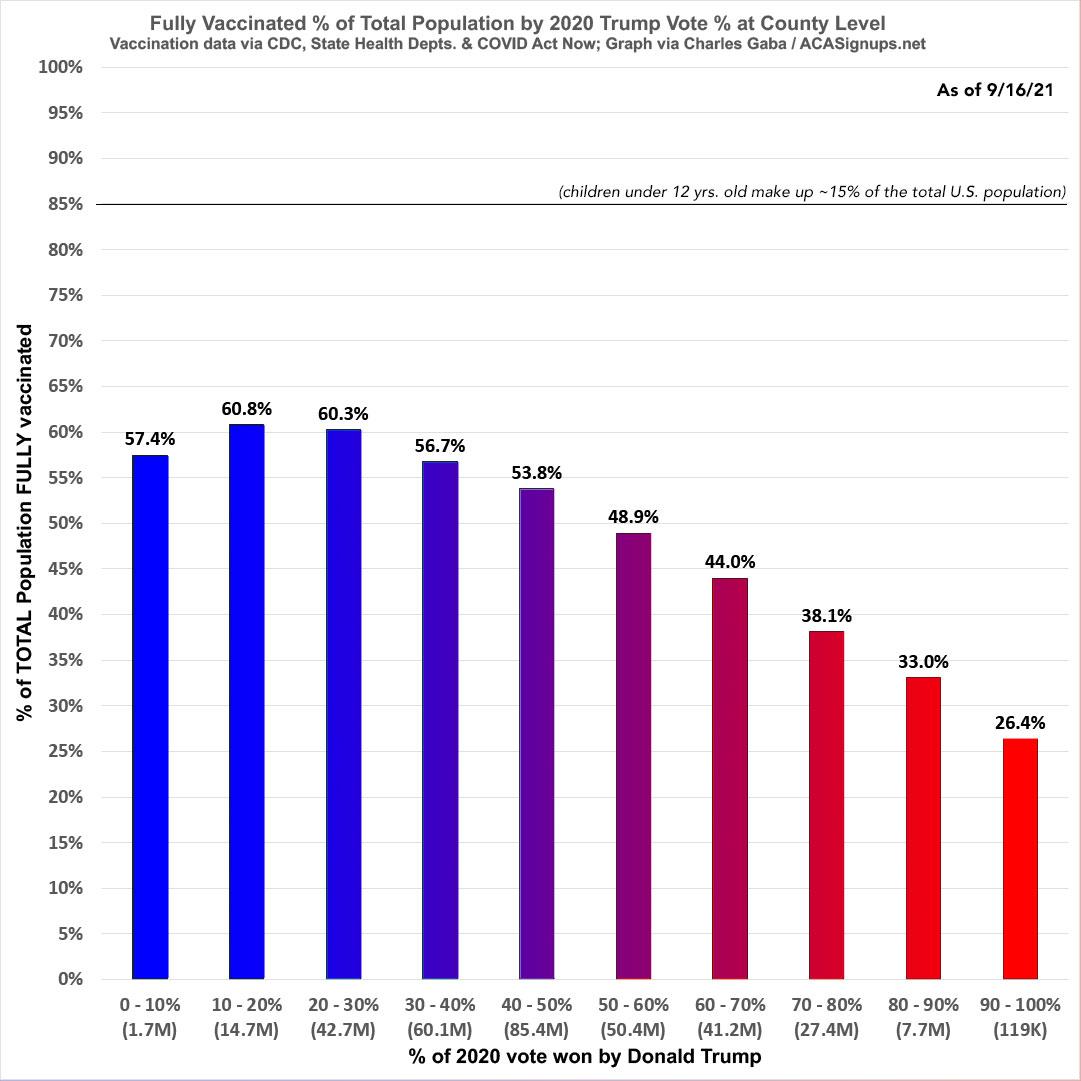
I came across a nice analysis recently showing the vaccination levels and COVID rates in all counties of the United States grouped by 2020 Trump voting rate. Here's the graph of county vaccination rate by Trump voting rate:


(Note that the 0-10% and 90-100% group have relatively small sample sizes here.)

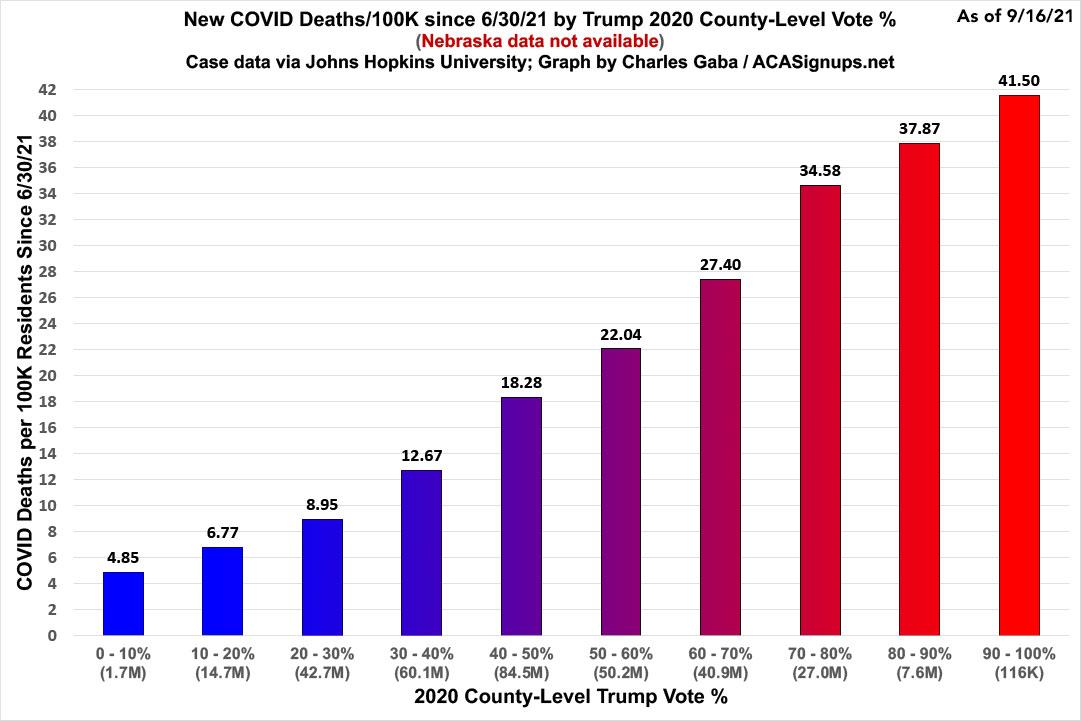
And here's the graph of rates of COVID death since the end of June 2021, which is a good cutoff point because it means that very nearly all of these deaths would have been prevented if everyone who was eligible had gotten vaccinated:


The images pretty much speak for themselves. In a real sense, people are killing themselves and their relatives and neighbors in order to prove their loyalty to a political movement. A political movement, it's important to note, the leader of which did get vaccinated but refused to make any effort to promote vaccination because if more people got vaccinated it could be politically beneficial to his enemies.

I imagine most everyone who is reading this post has gotten vaccinated. And you are probably, at least to some extent, part of a community in which people encourage getting vaccinated. If you had lived your whole life in an insular bubble in which extreme right wing views are promoted and other viewpoints are shunned, would you still submit the correct answer on the "should I get vaccinated?" assignment? Can you really say?

We all, every single one of us, firmly believe in some things that aren't true. It's a fact of life. Speaking for myself, I can't say what those things are, but I know that there are some. As I wrote about not long ago, we should all be more humble about the things we "think we know." For all of us, this is to some extent related to the sources from which we gather information, something that is not entirely in our control.

At the same time, some people believe more strongly in more wrong things than other people, and some wrong beliefs are much more harmful than others.

There is a big overlap between tendency to believe falsehoods about COVID vaccines and another set of false beliefs that are also doing tremendous harm to our society.

recent poll found that a whopping 66 percent of Republicans believe, against all evidence, that the 2020 presidential election was stolen from Trump, with just 18 percent saying that President Biden is the rightful president. Such beliefs are, of course, being used as justification for attacks on our electoral system to try to enable Trump to steal the next election. The irony of the "rigged election" claims is that our electoral system is already effectively rigged in favor of Republicans thanks to gerrymandering, the Electoral College, and the makeup of the Senate (two senators per state regardless of population) all giving disproportionate power to rural white voters, thus enabling Republicans to control the government despite having far fewer people vote for them.

Again, when so many people are failing an assignment, we can't just blame the people as individuals; we have to blame the sources of information pertinent to the assignment. Again, Fox News, talk radio, Republican politicians, etc., are all spewing constant disinformation about our elections. This is not a new problem, but it's been getting worse and worse. At this point the Republican Party has essentially abandoned the concept of representative democracy. That isn't an exaggeration.

I have an older relative who I had always considered a really lovely person. The last few years have severely strained that perception. Recently I saw him post this on Facebook:


Let's not mince words. This (especially taken in context of other things my relative has posted) is some straight up fascist shit.

But that doesn't mean the things about my relative that made me like him for all those years aren't still there. Have a conversation about something not related to politics, and he still seems like the same person he always was. These aren't fundamentally evil people we're talking about. These are ordinary people who have had their minds warped by misinformation and as a consequence support evil things.

(This particular relative is vaccinated, by the way. But has also posted anti-vax stuff. Go figure. Cult behavior obviously doesn't have to make sense.)

I have several relatives who are like this, and I think it's hard for me to really blame them that much for the way they are. It makes me really sad. But propaganda is effective. 

It's kind of a weird balancing act for me. Recognizing that the people who are doing these things are not fundamentally horrible people, they're just very misguided, but simultaneously recognizing that by doing these things they're threatening the very foundations of our society and this has to be stopped in any way possible.

The people who I feel real animosity toward are the people who are creating and spreading the propaganda. The politicians and media figures who have filled people's heads with so much garbage that we now, literally, have people dying of a deadly virus to own the libs, and we have a still ongoing attempted insurrection trying to topple our form of elected government and replace it with white nationalist authoritarianism.

So that's the problem, as I see it. Millions upon millions of our fellow Americans have been so inundated with misinformation that they are constantly and horrifically failing the assignment of being a decent citizen of this country in multiple devastating ways. It's a cult. It really is. That's the problem.

What should we do about the problem? That's the hard part. I wish I knew. I'm largely at a loss. But I have a few thoughts, hopeless as it all sometimes seems.

People who are in a cult are never going to listen to someone trying to tell them that they're in a cult, with a possible exception if they have a close personal connection with the other person. Getting in arguments with hardcore Trump supporters and anti-vaxxers is not going to be effective.

People who do have close personal connections to cult members might sometimes be able to appeal to their better natures. Sometimes. I'd imagine the closer the connection, the more likely. And I'd imagine it also depends on how deeply someone is into the cult. But I'm definitely not an expert on the psychology of cult members so I'm not going to try to go into how to do this.

I think what's paramount in importance is the rest of us recognizing the threat and the urgency of acting to stop it.. Perhaps close to one-third of the people in this country are members of a cult that, if it gets its way, will destroy most of the things we love about this imperfect but still in so many ways amazing nation. But as depressingly large as the cult is, it's really not close to being a majority of the country. It can only succeed (with help, unfortunately, from the aforementioned biased-toward-rural-white-people electoral system) if enough of the non-cult-members keep their heads in the sand about what's going on.

We're all influenced by the information spheres we inhabit. And I think an important thing to realize about the information people in the United States receive is that, taken as a whole, the media today are incredibly biased in favor of Republicans.

"But, but, the liberal media..." you might be saying. Which if you had that reaction, is a good example of the pro-Republican bias.

We have, as I mentioned, right wing media outlets that have become just straight up propaganda factories. They aren't even attempting to accurately report what's going on. They're just trying to spin everything in whatever way is most favorable to the political right wing.

Then you have the rest of the mainstream media. They, for the most part, aren't trying to propagandize. They're trying to report the news. It's impossible to do this with no bias, and different sources have different biases. But the overriding bias of the mainstream, non-right-wing media is a bias toward trying to be unbiased - which manifests as a bias toward "both sides" reporting and "the truth is in the middle."

If you have two political parties, and both political parties are basically normal political parties that are both sincerely trying to engage with reality and the problems of the real world in different ways, then maybe this sort of "truth is in the middle" approach makes some sense. What we have instead is two political parties, and one of them is a basically normal political party, but the other one is an authoritarian white nationalist cult that is trying to overthrow democracy.

Thanks to all the "liberal media" accusations over the years, mainstream media outlets are terrified of being excessively friendly to Democrats and unfriendly to Republicans, so most of the time they try to be equally critical toward both parties. They portray disagreements between the two parties as normal partisan squabbling, just politics as usual. When one of the parties is an authoritarian white nationalist cult that is trying to overthrow democracy, and you treat this as all just politics as usual, you're doing a huge favor to the authoritarian white nationalist cult that is trying to overthrow democracy!

Most people don't really think about this. And I don't blame them; they have plenty of problems to worry about in their own day-to-day lives. But I think it's an important thing to recognize when considering why voters make the decisions they do.

As I mentioned, we all believe in things that aren't true. One such mistaken belief that I think is common for people who fall toward the middle of the political spectrum to hold is the belief that bipartisanship is, in and of itself, an important goal in the political process, rather than something that is sometimes a means toward achieving other worthy goals.

When the other party is actively trying to overthrow democracy, trying to work with that party is definitely not an important goal.

But people are set in their ways. So you have, for example, the situation in Maine where Joe Biden won the presidential vote but Republican Susan Collins was reelected to the Senate. A bunch of voters in Maine decided that although they didn't want the authoritarian white nationalist president to be reelected, they were cool with potentially giving the party led by an authoritarian white nationalist control of the Senate. That's not what their thought process was, of course, but that's the reality of their voting choices. And then you also have centrist Democrats in Congress who are putting President Biden's agenda in jeopardy and threatening to help the Republican plot to overthrow democracy, because they still seem to naively think that bipartisanship is a worthy goal.

Those are some of the obstacles we face.

We all have to think about what we can do to save American democracy. We have to engage the people around us, the people who aren't in the cult but also aren't as tuned in to politics, to make sure they aren't going to sit on the sidelines. We also have to be aware that a lot of people will just tune all this talk about fascism out. This is partly because people have an understandable need to just want to focus on their own issues, partly because of the impressions they get from the lazy "both sides" media, but regardless, those people have to be reached by other means. There should be reasons that just about any non cult member would not relish the chance of returning to the non-stop horror show of a Trumpist government. Find the reasons that are important to people around you and make sure they remember those reasons.

The election of 2020 was the most important of our lifetimes, but it unfortunately looks like every election for the foreseeable future could also be the most important of our lifetimes. What gives me hope? The Republican brand has been poisoned forever for a large majority of people my age and younger. Eventually, it's the people of these younger generations who will have the most say in our democracy.

If democracy survives that long.

So we have to do everything we can to make sure it does.

Monday, September 13, 2021

This is what the songs are for

I'm just going to gush about one of my current favorite musicians here for a bit. Is that okay? Because I would really like to do that.

I've been thinking about writing more about this artist for a while. After being extraordinarily blessed to have gotten to see them live the other day, I went from "thinking about" to "feeling compelled toward." More on that show in a bit, but first...

The album

It's a very exciting thing to me when I have the realization, after listening more and more to a newly obtained album that I really like, that said album is in fact becoming one of my favorites of all time. This has happened this year with Ignorance by The Weather Station.

It seems that every eight years now, an album enters my life that has lyrics that just really speak to my soul in a profound way. This is something I realized recently. It's one of those weird things that I notice because I have a weirdly heightened tendency to notice patterns. I'm really weird. Whatever, I enjoy it. Anyway, I was thinking about it, after thinking about how much I love the lyrics of Ignorance and pondering what other albums had lyrics that I had loved that much, and there are two other albums that were on that level.

In 2005 (not this album's release year, but the year I started listening), it was Ozma's Rock and Roll Part Three. Its lyrics spoke to me because I was a really shy, nerdy young adult who was into things like video games, Star Wars (there's a song about having a crush on Natalie Portman!) and punny wordplay ("an apple pie, the number pi, I studied you in math class" from the song "Apple Trees"? Classic!). Also, the lyrics lean heavily on nostalgia, something that speaks to me even more today, even as I've to some extent outgrown certain other aspects.

In 2013, eight years later, the album was Typhoon's White Lighter. Its lyrics, heavily influenced by the lead singer's near-death experience from Lyme disease and consequent pondering of mortality, spoke to me because I got into the band shortly after my wife was diagnosed with stage IV lung cancer. The album was in fact released the same week she was admitted to the hospital.

In 2021, another eight years on, it's Ignorance. (What will be the album of 2029, I wonder?) And as for why this album's lyrics speak to me so much? I'd say they speak to me because, well, I'm a human being living in this strange and distressing era of history.

There are reasons why the lyrics speak to me personally more than they might to the average person, but in comparison to the other two albums I cited, I think the appeal and the relatability are broader, because it's not about a specific aspect of my life, it's about human (and non-human!) life in general. Given that, I've decided that if I had to pick one album that I would subjectively assess as having "the best lyrics" of any album I know, this is the one.

The music is great too. Tamara Lindeman has really evolved the sound of her music from the folk stylings of her early records, which were quite good too, but this is even better. The jazzy indie rock on Ignorance has this consistently propulsive feel from the rhythm section and piano that just lends this sense of urgency that goes so well with the subject matter of the lyrics. And Lindeman has a wonderfully expressive voice. It all comes together in a great package, but to me the lyrics are just next level so I want to talk about why I love the lyrics so much.

I'm going to go through the songs of the album in order and pick out a favorite line or two and explain why they're favorites. I hope this post can properly convey the brilliance contained on this album. I think these lyrics are by far best experienced reading along with the liner notes while listening to the album front to back. But I want to talk about it, so, here goes.

1. Robber

"You never believed in the robber.  You thought a robber must hate you to wanna take from you.  The robber don’t hate you, you never believed in the robber but the robber never believed in you."

Okay, this song is about how the heartless capitalistic system we live in robs us all of so much (uh oh, we're getting political here!). And I think this bit expresses so nicely and succinctly how people don't even think about how so much harm is done by just a system, a mindless thing, that has no intent, good or bad, it's just the way things are. It doesn't have to be the way things are. But most people don't question it.

2. Atlantic

"My god, I thought, my god, what a sunset; blood red floods the Atlantic. With a wine in my hand, laid back in the grass of some stranger’s field, while shearwaters reeled overhead, thinking; I should get all this dying off my mind, I should really know better than to read the headlines, does it matter if I see? Or really, can I not just cover my eyes?"

Just incredibly evocative imagery, which Lindeman excels at, to open this song. And then the lines about all the dying in the headlines that the first time I heard I just thought, wow, this pretty much sums up how it feels to be in the world right now. (The album was released in early February of this year, when COVID deaths in the US and many other countries had just recently reached their very peak. Not that this song is specifically about COVID - I would read it as more about the ongoing and worsening climate catastrophes that heavily inform Lindeman's songwriting.)

3. Tried to Tell You

"But some days there might be nothing you encounter, to stand behind the fragile idea that anything matters."

Don't we all feel this way sometimes? The idea that "anything matters" can be a fragile idea, but it's important to remind ourselves of the things we encounter that do reinforce this idea. Also, this is the song from which the line "This is what the songs are for" that I used to title this post came from, and for me, great songs, such as those on this album, are some of the most important things to help me feel there are things that matter.

4. Parking Lot

"Waiting outside the club in a parking lot, I watched some bird fly up and land on the rooftop, then up again into the sky, in and out of sight, flying down again to land on the pavement.  It felt intimate to watch it; its small chest rising and falling, as it sang the same song, over and over again, over the traffic and the noise.  Is it alright if I don’t wanna sing tonight?  I know you are tired of seeing tears in my eyes.  But are there not good reasons to cry?"

The image of the bird, and the description of how it feels intimate to watch it - so, so good. And then the connection from the bird to how the observer - the human singer - is feeling. I'm honestly envious of Lindeman's way with words. Also from this song:

"But everywhere we go there is an outside, over all of these ceilings hangs a sky."

Something about this line blows me away in a way that's hard to articulate. But it just really makes me think about our place in the world.

Okay, and I have to mention one other line from this truly incredible song:

"I confess I don’t wanna undress this feeling, I am not poet enough to express this peeling."

I disagree with this statement. I would contend that Tamara Lindeman absolutely is "poet enough."

5. Loss

"You lay in bed, the sun streamed through the blinds.  Sweat soaked through your shirt.  You lay a hand across your eyes, every other part of you hurt.  From inside the confines of the story that everything would be alright, it was only so wide you could open your eyes, you could only let in so much light.  But you knew the story had never been true - loss is loss, is loss, is loss."

I think anyone who has experienced great personal loss can relate to the idea of the "story that everything would be alright" - the story that "had never been true." And again, the imagery here stuns me.

6. Separated

A few months ago, I wrote a whole post that was largely inspired by lyrics from this song. Here's another good excerpt:

"You try again your arguments out on me, I try and tell you again; but if you wanted to understand me you could, if you wanted to hold my hand you would, but you don’t want to, you’ve committed to this wall we sleep against."

I think this is such a great description of two people in a relationship that is no longer working.

7. Wear the World

"It does not matter to the world if I embody it.  It could not matter less that I wanted to be a part of it."

A very poetically stated reflection on our ultimate significance, or lack thereof.

8. Trust

"In the throes of this divorce, in this court proceedings; for some reason my mind was filled with all my softest feelings."

To me this is about how when a relationship has stopped working and it's ending or ended, at times you can still have very sentimental feelings about that person and the relationship, which I'm sure is a familiar concept but one that people often don't seem to talk about.

9. Heart

Okay, I love the lyrics of this song so much (I'd say this and "Parking Lot" are my top favorites of the album), I'm going to go through them all.

"I don’t have the heart to conceal my love, when I know it is the best of me.  If I should offend you, I will show myself out, you can bury me in doubt if you need to."

Being in love, and not knowing if the other person feels the same way, and not being able to keep it inside any longer. Or it can also work if this is about, rather than love for another person, love for the world - being passionate about important things, and the way some people recoil at this passion. I think it works on both levels.

"I can walk out in the street, no-one need look at me, it is with my eyes I see.  I guess that I am soft, but I am also angry, but I will feel all my loss, I will hold my heart inside me."

The idea of being soft but also angry is so striking and so relevant at this moment in time. I also like the "loss" callback.

"My dumb eyes turn toward beauty; turn towards sky, renewing.  My dumb touch is always reaching; for green for soft for yielding."

This, to me, hearkens back to earlier songs on the album like "Atlantic" and "Parking Lot." There's this deep appreciation for the beauty of the world we inhabit. And there's doubt over whether it's worth caring so much with all the ongoing tragedy. In a way I think this song brings all the themes of the album together. I guess you could say it's the "Heart" of the album. Heh. (Still like corny wordplay!) Sorry, moving on...

"In the pale dim light, I am always reeling, through long midnights of feeling."

This is a staggeringly poignant and poetic description of an experience that is no doubt familiar to many.

 "Of all the many things that you may ask of me, don’t ask me for indifference, don’t come to me for distance."

An excellent statement of the importance of caring - which again, could be about a specific other person, or about the world as a whole.

"No, I don’t have the heart to conceal my love, if it is too hard to look at me, I will show myself out, walk out in the city.  You can bury me in doubt if you feel it necessary."

And returning to the opening lines, restated but slightly altered with a different final rhyme which I like because I guess it just sounds more interesting that way!

10. Subdivisions

"Got in the car, and the cold metallic scent of snow caught in my throat as I reached out to turn on the radio; the unfamiliar songs, the voices sing of love, and of wanting to dance and to sing in the rhythm of.  The road was overwhelmed with snow piled high in all the ditches, I drove as though I did not understand all the divisions, the yellow signs and the painted lines, and the order they envisioned was so clear.  I joined the steady line of cars on the highway, as though I was going home, but I drove the wrong way.  Past the looming walls of subdivisions, out past the strip malls, white fields and gray gas stations."

There is even more incredibly vivid imagery here. Again, I'm envious. And the divisions/subdivisions thing, without even really saying it, I think so much is being said here about the way that modern society has been structured and how it divides us and all the harm it causes. I'll spare you the rant about car culture that I could easily go on here.

And that's not even close to all that the song is about. It dips back to the personal relationship themes from earlier in the album: "I left you back at home because I simply could not do it, tell you I could be with you when I could see right through it; our whole life.  But what if I misjudged; in the wildest of emotion, I took this way too far?" (I enjoy the "took this way too far" double meaning here.) So the album is simultaneously about struggling with one's place in a relationship and struggling with one's place in a world that is being devastated by humanity's callous actions. And speaks beautifully on both themes.

So that's it. Check out Ignorance. I implore you!

Next up...

The show

I caught The Weather Station live at the Magic Bag in Ferndale, Michigan (a Detroit suburb) on Thursday, September 9. I made the drive up from Cleveland late in the afternoon, grabbed some dinner (takeout I'd ordered ahead of time), and headed over to the venue.


It struck me as I was waiting outside that it was really nice just to be doing this. To have driven to another city for the purpose of seeing a band I really love. That's something I do all the time, normally, because music is such a huge part of my life, but it had been almost two years since the last time I'd made such a trip.

It was not the first show I've attended this year (there were some others earlier this summer in Cleveland), but it was the first at which I had to show my vaccine card to get in. I'm very glad that venues have enacted this requirement. Additionally, at the request of the artist, attendees were required to be masked at all times except when actively eating or drinking. I support this as well, due to the current situation with the delta variant - in fact I recently bought a pack of KN95 masks specifically for wearing at shows - but going into it I thought it might feel a little weird to be wearing a mask at a show.

It turned out, which I had not thought much about ahead of time, that having a show with both vaccine and mask requirements for attendees seemed to select for an audience of people who all really wanted to be there to experience the music. The crowd wasn't huge, but it was one of the best audiences I've ever shared a concert experience with, because everyone had their full attention on what was happening on stage, and there was none of the annoying audience chatter that often irritates me at shows.

If requiring masks at shows leads to people in the audience not talking during the performances, then I say let's have masks at shows forever! (I mean, I don't think this will really happen, but if it actually does cut down on audience chatter I would genuinely be glad of the change.)

I didn't realize it ahead of time, but this was the first club show The Weather Station had played since before COVID, as well as the first time since before COVID that the Canadian band had crossed the border. I felt very lucky to be there for such an occasion.

It was truly a magical experience, something that I've missed so much in this last year and a half. The band played almost all the songs from Ignorance as well as a few older cuts, including standout track "Thirty" from 2017's self-titled album. The band's keyboard player was not present due to a border crossing snafu, so Lindeman took on extra keyboard duties while singing, which she handled well. All the band members' performances were on point - guitar, bass, drums, and nice clarinet and saxophone flourishes from the wind musician adding some great texture to the songs.

It was easy to tell that it was a really emotional occasion for everyone, the people on stage and the people in the audience. We've all missed this. Going a year with almost no person live music has made me realize that I really do think live music is a nigh essential part of the experience of being human. Sure, that's more true for me than for the average person, but I think it applies broadly.


After a great main set, Lindeman returned to the stage alone to begin the encore, sat at the keyboard, and played a beautiful song I'd never heard before but hope to hear again. It contained a lot of her usual evocative imagery as she described looking at the stars in the night sky as a child and then connected that to looking at the night sky as an adult and seeing fireworks on New Year's Eve as the year 2020 approached.

2020, man. Wow.

This was followed by a full band performance of "Subdivisions," a fitting closer. After the band left the stage a second time, the audience applauded enthusiastically, and some of us, me included, just kept clapping. I think we just really didn't want it to be over. In a way that is often true when you see a really excellent show, but now even more so than usual. I don't know whether Lindeman was anticipating doing a second encore, but she came out again, and treated us to a performance of "Traveler" from 2011 album All of It Was Mine. I've listened to that album many times, but I had never truly listened to the lyrics of that song in a way that their meaning sunk in the way all the lyrics of Ignorance have. And I found myself sitting there just stunned once more at the beautiful and emotional pictures Lindeman paints with her songs.

Most of the way through the song, though, at an instrumental part, she stopped playing and said one of the strings of her guitar was out of tune and she had to tune it. So then, while tuning, she kept talking to the audience, and kind of started rambling. And then laughed and said that before going out on tour again after all this time, she had thought about how she wanted to present herself on stage, and had decided she wanted to go out and just be serious and play the songs and not spend much time on banter. And here she was at the first show out on tour and already getting away from doing that.

I, for one, really enjoy hearing the interesting things musicians talk about on stage, so I welcomed this.

Eventually she said that the end of the song was sad and after getting sidetracked on amusing banter she couldn't get back into that place so she wasn't going to finish the song. Instead she'd play a different song that was more upbeat. She started playing the song, got about one line in, then stopped and confessed she had forgotten the words to the song and broke down laughing.

That was the end of the show! Lindeman said she owed us one and promised that they'd be back, thanked the audience again, and left the stage. It was a very unusual ending but I have no complaints at all. It was such a, well, human moment. A moment of that special connection that happens between a musician and their audience. When musicians get in a room with people who really love their music, magic happens, magic that can't truly be replicated in any other way. It happened throughout that evening at the Magic Bag.

There was just so much joy in that room! I had almost forgotten what it felt like.

There was another thing that Lindeman said during the show that really struck me, in a sad way. She said that it was good to be back in America. She noted that the news from here is "intense" (no kidding!), but whenever she actually comes here, it's really nice. It's a nice place, she said, "and it always will be."

The way she said "and it always will be"... it was one of those things where you say something and the words you use express certainty, but you don't actually feel certain, you actually are just hoping that it will be true.

These really are scary times. And as I drove home, I was thinking about how, when I was a kid, I was told all this stuff about the USA being the greatest country in the world, and a lot of it was BS, but I do think that back then, it was at least generally the case that this country was admired by people in other countries. Nowadays, people in other countries feel bad for us. And for very good reasons! I've been aware of this before, but Lindeman's words really drove it home for me. And it did make me feel sad.

To quote a favorite tweet from Julien Baker (who I'm very much looking forward to seeing live in a couple weeks), though, "at least there's music am i right." The Weather Station's show on Thursday was the best reminder of that that I've had since my trip to California to see Ozma in December 2019. And it was all the more poignant now, in a way I never could have imagined back then. This truly is "what the songs are for."

That wraps up what I have to say about The Weather Station, but I also have some thoughts about...

Going to concerts during COVID

This was not the first show I've been to this year, but it was the first show I've been to since the delta surge in the US got bad (although it's currently not that bad in Michigan, at least). There was a part of me, and I know this stems to some part just from me being a generally anxious person, that was worrying, am I doing something wrong by going to a concert now?

I know that, rationally, when you look at the way most people are living their lives at this stage of the pandemic (see, for example, crowded indoor restaurants at which people are talking and eating and obviously not wearing masks while doing so), the relative added risk of COVID spread from a concert at which both vaccines and masks are required is tiny. (Especially a concert that was not crowded, as was the case here.) I know that musicians and venues have been put in a horrible place by this pandemic, and additional economic assistance from the government is not coming, and I think that if these events can happen in a way that does a good job minimizing risk, it's a good thing to support those musicians and venues. I also think that having events with vaccine requirements will likely help increase vaccination rates, even if by a small amount, in a way that not having events at all, or having events without vaccine requirements, would not do, and therefore could very well be a net positive in the fight to end the pandemic.

Still, it was hard to shake the feeling, what if it was wrong to do this? I've seen some people on Twitter say things like, "There shouldn't be concerts right now!" Which gets to my anxious brain.

It got me thinking about how people have talked about COVID risk in general, and I realized even more something that I had already been realizing. I think that the way a lot of liberals (myself included, when I think back to earlier in the pandemic), have talked about COVID risk has been very sanctimonious, and has come across (sometimes intentionally, sometimes not), as basically trying to paint people as morally wrong for simply having normal human wants and needs.

I realized how essential a part of life live music is to me. And I'm sure to a lot of other people. Now, I'm fairly introverted, and although I definitely missed getting to spend time with my family, to be honest I could just as well do without social gatherings of more than, say, five or six people. (With the exception of concerts! Which are a different sort of social gathering, I suppose.) So other than the lack of concerts, the restrictions on gatherings of large groups of people weren't so much a problem for me. But I'm sure there are other people who find going to parties just as essential a part of life as I find going to concerts.

Now, look, I totally do think that the restrictions on indoor gatherings were well justified prior to vaccines being widely available. (Now, I think vaccine requirements are a better option.) But I also think it's pretty messed up that people have been shamed so much for just wanting to do things that humans, as social animals, have a natural want and need to do.

I remember seeing someone tweet something that was like, "If people had just done the little things like get vaccinated, wear a mask, and social distance, we wouldn't be in this mess." (I think an emerging theme here is that I spend too much time on Twitter...)

And yeah, getting vaccinated, that absolutely should be a little thing for the vast, vast majority of eligible people. It's a huge problem that a lot of those people aren't getting vaccinated, which is a topic for another post. Wearing masks? Yeah, not that big a thing generally speaking. But at the same time, it's pretty privileged for someone who is working from home and only has to wear a mask at the grocery store to say that about people who are toiling in hot kitchens all day.

But social distancing? Calling social distancing a "little thing" when this has been going on for a year and a half, to me, just betrays a fundamental misunderstanding and/or denial of human nature.

(I'm sure the counterargument would be that if everyone had just done what they were supposed to, it would have all ended a long time ago, but when you look at what has happened in numerous other countries around the world, I just don't think it's realistic that that could have ever happened in the US. Especially with the emergence of the delta variant. Yes, things did not have to be nearly as bad as they have been, but it wasn't going to just go away in any realistic scenario.)

Now, I find it very understandable why people have talked about COVID risk in this way. It's been a horrible time that has been hard on everyone in different ways. I'm not trying to shame people for shaming people, which would be hypocritical. I just don't think it's been productive.

I wonder how much difference it could have made if the moralizing about COVID could have been avoided and instead there had just been a focus on giving accurate information on what the risks were and what were the best ways to mitigate those risks. Of course, the bigger problem all along was all the misinformation and politicization of the pandemic coming from those on the right politically, but I think those of us on the left could have done a lot better too.

Ultimately, I think all the moralizing likely led people to react in one of three general ways. First, there are those people who were never going to take this seriously. Nothing could have ever reached them, but I think the moralizing might have made them even more eager to flout restrictions, "to trigger the libs."

Then there are the people who did want to take it seriously, but I think those people fall on a spectrum of risk tolerance. Many of those who fall more toward the "want to live as close to normal life as possible while mitigating risks" side would be likely to eventually get annoyed by the moralizing and then start tuning out all the rules and restrictions. Those who fall more toward the "want to avoid risk as much as possible" side have probably gotten complexes where we now experience unhealthy levels of stress and anxiety about doing even low risk activities. And none of this is helpful to the overall health of individual people or of society.

That was pretty rambling, but I think there's a point in there somewhere.

Anyway, major kudos to artists and venues for requiring vaccines and masks for concerts (although I still think we need more attention to ventilation and filtration of indoor air!). Please, let's all make sure everyone around us is getting vaccinated so we can all go back to enjoying in person live music and all the other things that are essential for us to fully live our lives as the social animals we are.