Showing posts with label health care. Show all posts

Thursday, March 26, 2020

The cost

Having been married to a really amazing person who was diagnosed with stage 4 lung cancer at the age of 34 and tragically succumbed to the disease at the age of 36 has, I think, given me a perspective on the COVID-19 pandemic that most people my age don't have.

For a related example, during my early adult years, I didn't bother getting an annual flu shot. I'll be fine even if I do get the flu, so what's the point? I thought. I know this is a very common attitude.

After Cara became ill with lung cancer, she passionately advocated for everyone to get their flu shots. Obviously, I did get mine, and I've continued to ever since, because now I understand - the reason it's important for young, healthy people to get their flu shots isn't to protect those young, healthy people from the flu; it's to decrease the chances that someone like Cara, who had compromised lung function and at certain points during her various treatments a compromised immune system, would get the flu. Getting a flu shot is such an easy thing to do but something with such enormous benefits if everyone does it. (Yes, flu shots aren't perfect and sometimes there are outbreaks of a strain that the shot didn't cover - that doesn't mean that flu season wouldn't have been much worse without the flu shots.) But before it was made personal, the importance of getting those shots never got through to me. So now I try to remind all the people out there who are lucky enough to not yet have had it made personal.

Now we're facing a historic outbreak of a viral respiratory infection that is far more deadly than the flu, and there's no shot we can get to protect ourselves and our vulnerable loved ones. So we have to do other things to protect all the vulnerable people out there - be diligent about washing our hands, don't touch our faces (these are things that would help against flu outbreaks too, and hopefully that's a lesson that society will learn going forward), and most important right now, social distancing.

It's simple math and biology. When an infectious disease is spreading in a population and we don't know who all has it, the more contacts there are between people, the more likely it is that the disease will spread. And with this particular disease, unless strong containment measures are taken, exponential, uncontrollable growth is inevitable, and it will result in our health care system being overwhelmed. There's a tendency for people to think "it can't happen here" but it can and it will. Look at places like Italy and Spain where the body counts are piling up and doctors are having to triage patients like during wartime. People who have severe symptoms and are too old are simply not given life-saving treatment because the resources just don't exist. It's already starting to be like that in New York City, and without serious intervention it will eventually be like that Everywhere. In. The. Country.

I've been thinking a lot about that twenty month period of time between Cara's diagnosis with lung cancer and her death, and what that time would have been like if it had happened against the backdrop of the raging COVID-19 pandemic.

Three months after Cara's initial hospitalization, her first treatment failed, her condition dramatically worsened, and we spent Thanksgiving in the ICU leading up to a surgery to create a window in Cara's pericardium and drain the fluid that was accumulating in the space around her heart. Imagine if that had happened while ICUs were overwhelmed with COVID-19 patients and there were no available beds. Stage 4 lung cancer is incurable; although some people now live a long time with the disease thanks to new treatments, the expected prognosis is still, ultimately, death. Someone with a terminal illness would not and could not be a top priority for an ICU bed in such a situation. Chances are Cara would have been dead. It would all have been over just three months after her diagnosis. Those additional seventeen months that have so many memories that I cherish so much (because that Thanksgiving in the ICU my honest assessment of the situation was that she likely did not have a whole lot more time left) would never have happened. And that's what will happen to so many people if the pandemic spreads unchecked. So many people will die premature deaths of COVID-19 and of so many other things, deaths that could have been prevented if the health care system wasn't so overwhelmed.

After the Thanksgiving in the ICU, Cara started a new treatment and her condition improved greatly. She never again returned to the ICU until the week before her death. But imagine also how different those seventeen precious extra months would have been if COVID-19 had cropped up during them. Cara would have had to live in constant fear of contracting the illness. She couldn't have continued working. She wouldn't have been able to hang out with her friends. The two of us couldn't have done so many great things that we did together. We couldn't have gone out and done pretty much anything other than go for walks. And walks are wonderful and I'm sure a lot of us are gaining newfound appreciation for them right now, but there are so many other things, so many wonderful social activities - for humans are social creatures, after all - that we and especially Cara would have had to miss. She would have been essentially trapped in our home for most of every day to reduce her risk of getting the infection and knowing Cara, I know how awful that would have been for her. And if I happened to find myself in any situation where there was a fear I might have contracted the virus, I'd have had to physically separate myself from Cara, and it's hard to imagine how hard that would have been for both of us, the whole time knowing that she had a life-threatening disease and every moment we had together was precious.

The spring after Cara's diagnosis, I successfully defended my dissertation after many long years of graduate school. Cara was so proud of me and so excited that she got to walk across the stage with me as I received my diploma.


Imagine if that had happened against the backdrop of COVID-19. The dissertation defense would have been virtual. There'd have been no going out to celebrate with family. The graduation ceremony wouldn't have happened. Cara wouldn't have gotten to walk across the stage with me. So many happy memories would never have been created.

In early March of 2015, Cara and I took a trip to Miami Beach together.


Obviously, that trip would not have happened during a COVID-19 pandemic. It was really great that we got to take that trip because it had been a very cold winter and that was really hard for Cara. We had no idea at the time she only had a month and a half to live. Because of that the memories are extra special to me.

When Cara did go, in a room on the Cleveland Clinic's palliative care floor, her mother and I were with her, and one or the other or both of us had spent a great deal of the time with her during those last few days. Right now at the Clinic there are no visitors to hospital patients with certain very limited exceptions. So for most of that time, at least until it became clear that the end was imminent, Cara would have been scared and alone in her hospital room. Or if the hospital system had become overwhelmed, maybe she wouldn't have even been able to receive proper end of life care.

And of course after Cara died, there was a funeral. When someone we love dies, it's such an important part of the grieving process to be able to get together with others who loved that person and to share memories and hugs and tears. Right now, that couldn't happen. There would probably be a video chat memorial service. There are probably going to be a whole lot of those in the weeks and months to come. And we would be thankful for having the technology to allow us to do that, but we would also be missing out on an essential part of the human experience by not being able to get together in person to say our goodbyes, to grieve, and to celebrate the lives of our lost loved ones.

Because being physically together with people we care about is such an important part of the human experience, it's hard right now to remove so much of that contact from our lives. But understand - the hypothetical scenarios I envisioned in this post, of what Cara's life with and death from cancer might have been like under the specter of COVID-19, those are reality right now for so many people. That's part of the cost of all this. And although we cannot control the fact that this virus exists and has spread to our country, we, collectively, have a great deal of power to control how bad it gets. If we let it get really bad, if a large percentage of the population ignores social distancing, the scenarios I imagined in this post multiplied by millions could be the ultimate cost. That is a really horrible thing to imagine. But it's not imaginary. It's already real in places like Italy. It's already starting to become real here.

Every time someone ignores social distancing, they potentially add to that cost. Every time someone decides to get together with a group of friends because they think this can't hurt them. Every time people go and play basketball at the park (playing basketball is something I really miss right now, but I understand why I can't do it!). Every time a business owner decides their business is essential when it isn't really essential and keeps their employees coming into contact with each other and with other people. Most especially every time someone in a position of government authority makes a decision to not enact strict social distancing measures when all the evidence and all the experts say it's imperative we do that right now. Every time someone does one of those things, it's potentially adding another name to what will be a very long list of people who had to suffer alone in a hospital without their loved ones visiting them, to die not because there was nothing that could be done to save them but because there weren't enough resources to do it, and then to not have a funeral to give their loved ones some comfort at such a horrible time.

That's the cost. Please do everything you can to minimize that cost. Please. I know most of my friends are already taking this seriously, but if you aren't, please, please do. And if you know other people who aren't taking it seriously, please, please pass along this message to them. It could be one of the most important things you'll ever do in your life.

Saturday, March 18, 2017

Kicking cancer's ass

"Kicking cancer's ass." I'm sure most of you have heard the expression. After Cara was diagnosed, people would talk about how she was going to "kick cancer's ass." It's kind of a weird expression. As if cancer is some sentient being, and as if simply by fighting hard enough, someone with cancer can defeat it.

Of course, that's not true. Cara didn't die because she didn't fight hard enough. How hard you fight has very little to do with whether or not cancer will kill you. (Which isn't to say that how hard Cara fought was not a very beautiful and meaningful thing. It was! It will continue to inspire me for the rest of my life.) Cara died because of simple biology. Out-of-control Darwinian evolution of a small mass of cells in her body that eventually spread to become something much larger and more destructive. For reasons we are not near fully understanding, the response to treatment of those malignant cells, even those that we've identified through the tremendous, decades-long work of countless scientists and doctors as having the same driver mutations, varies widely from person to person. Some people have much better luck than Cara did. It's not because she didn't fight as hard to "kick cancer's ass."

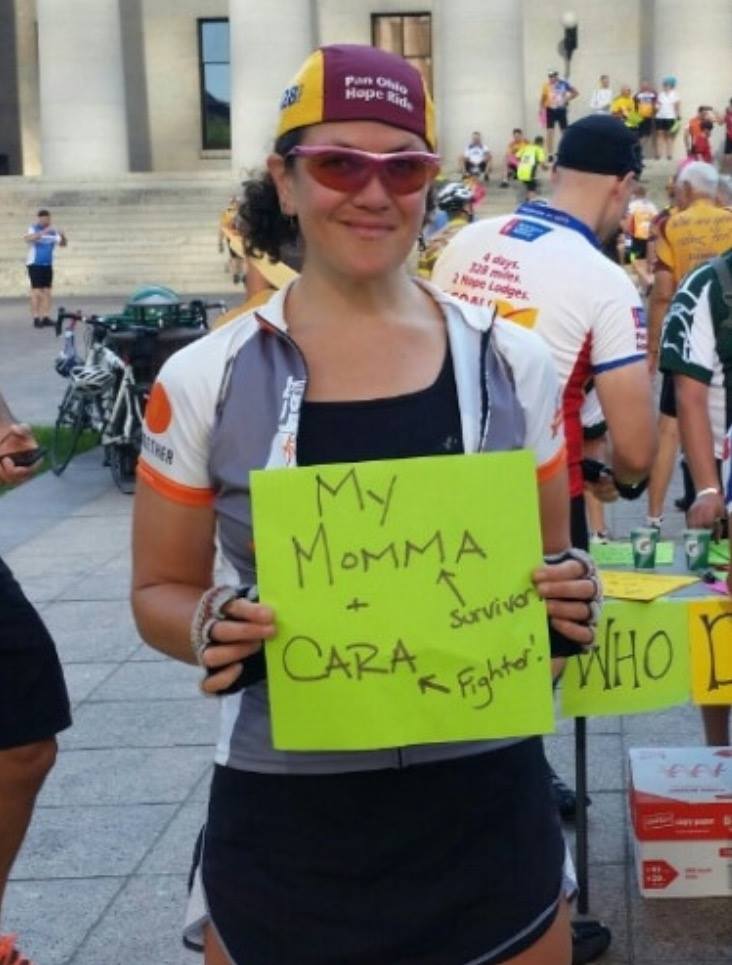
I've also seen people use the expression when they talk about participating in charity events (especially those involving strenuous athletic pursuits) to raise money for the struggle against cancer. Events like the Pan Ohio Hope Ride, a four-day, 328-mile bike ride to raise money for the American Cancer Society. 

The Pan Ohio Hope Ride's Facebook profile picture - a picture of my dear friend Shelli Snyder!

Another such charity event (although one requiring much less exertion on the part of its participants) that is very near and dear to my heart is Breathe Deep Cleveland, a 5k fun run and walk to benefit lung cancer awareness and research funding that Cara founded before she passed away.

These events are great. The battle against cancer is one in which we need all the help we can get. Every dollar raised has the potential to positively affect someone's life.

We've come a long, long way in our understanding of this horrible disease. We know vastly more about the underlying biology than we did a hundred, fifty, or even (especially when it comes to certain specific genetic abnormalities) ten years ago. This helps us devise better treatments. It also helps us better understand the underlying causes - why people get cancer in the first place. There's a whole lot we still don't know, but we've made great strides in the fight against cancer.

Sadly, today, in this country, there is a concerted effort underway to reverse much of that progress.

Republicans in Congress are trying to pass the "American Health Care Act" - their replacement for the Affordable Care Act. The Congressional Budget Office has estimated that this act would result in a whopping 24 million Americans losing health insurance compared to current law. Don't trust that number? Think it's "fake news"? The White House estimated an even bigger loss - 26 million.

It's pretty simple - if you get cancer, and you have health insurance, your odds are going to be a lot better than if you don't. If you can afford medical treatment, your outcomes will tend to be better than if you can't. If Cara didn't have health insurance when she was diagnosed, she would have died a lot sooner. The same is true for many terminal cancer patients. And there are many other cancer patients who have had their lives saved by medical treatments. If the AHCA passes, there are going to be a lot more people who have to make the horrifying choice between bankrupting their families or giving up on their treatments.

There's more.

The White House recently released their budget proposal, which cuts funding to most of the government programs that are vital in our shared efforts to (I have to say it) Make America Great. Two items in particular are especially relevant to the fight against cancer. A nearly 20% cut is proposed in the budget to the NIH, which provides an enormous amount of the funding for medical research in this country.

Without NIH-funded research efforts, I can say without any doubt that Cara would have died much sooner after her cancer diagnosis than she did. It was because I saw firsthand the benefits of cancer research that I decided to enter the field myself after obtaining my PhD in Biology.

The other highly pertinent and disturbing item in the proposed budget?  A greater than 30% cut to the EPA.

That is something that should horrify everyone who breathes air and drinks water.

(That is, everyone. Duh.)

Although there's still a lot we don't understand, we've come a long way in our knowledge of what causes people to get cancer. Probably the most widely recognized such causative link is that between cigarette smoking and lung cancer. Of course, it's not a one-to-one link; Cara didn't smoke. But we all know that years of smoking increase the chances someone will get cancer. That's because the toxins in cigarette smoke damage DNA in cells and make it more likely that those cells' genetic programs will go awry and lead to uncontrolled malignant growth.

Cigarette smoke is far from the only toxin that can do such damage.

In China, rates of lung (and other) cancer have skyrocketed. This is a direct result of rapid industrialization without the protections the EPA affords us here leading to a dramatic increase in pollution. In less than a decade, rates of lung cancer in Beijing rose more than fifty percent. We've all seen the images of the horrendously smoggy Chinese capital city.

Without government-mandated environmental protections, things would look much the same in major American cities.

But surely, you might say, even with a 30% cut to the EPA, we won't let things get that bad here. And that might be true. Still, it's a simple equation. More exposure to environmental toxins = higher rates of cancer. That's just a fact.

In the war between humanity and cancer, Donald Trump has staked his position firmly on the pro-cancer side. And any Republican elected officials who support these budgetary and health care proposals have likewise staked their positions just as firmly on the pro-cancer side.

Doing charity events like the Pan Ohio Hope Ride and Breathe Deep Cleveland is great. We have a good time with friends and we raise money for a good cause. But as much as that makes us feel good about ourselves, the sad reality is that Donald Trump and the Republican Party are setting out to do far more harm in the fight to save people's lives from cancer than all the good that will be done by all of the participants in all of those charity events.

Right now, if we want to kick cancer's ass, we have to kick Donald Trump's ass.

Saturday, December 31, 2016

Jeff's search for meaning (or, the year that was)

I recently met and became friends with a 29-year-old widow. It's been a really good thing. As another widow friend of mine (someone significantly older than me but still quite young to have become widowed) said, it's great to talk to someone who "gets it."

After we had talked for a while, my new friend told me that my approach to life made her think of a book called Man's Search For Meaning. I decided to read the book, and after doing so found myself quite flattered that she had said that. Man's Search For Meaning was written by psychiatrist Viktor Frankl, a survivor of Holocaust concentration camps. The first half of the book tells of his experiences in the camps, while the second half lays out his formulation of logotherapy, an approach to psychotherapy based on the idea that the most important desire of humans is not to seek pleasure, but to find meaning in life (the form that this meaning takes can vary from person to person). Frankl wrote of how some people in the camps were able to persevere the horrors that surrounded them by finding meaning in their existence. For some, simply enduring suffering could provide meaning.

A brief aside: writings about the Holocaust seem distressingly timely right now.

I realized that, although I had not previously thought of it in such terms, a lot of what I do in how I choose to live my life, and perhaps especially in my writing, is an attempt to make sure that the lives of both Cara and myself have been and will continue to be meaningful.

Another friend posted today on Facebook asking if people had a blog and if so, "What does having a blog do for you?" With the book I had recently read in mind, I replied, "Helps me search for meaning in this very strange, terrible and wonderful thing called life." (Being honest, I added, "Also, gratification from people complimenting my writing.")

I have always had a strong interest in staying in touch with the history of my life. This interest was strengthened by Cara's death, but it was there long before that. My mom has told me, "You save everything," commenting on the fact that I have a drawer full of things I wrote or made when I was in elementary and middle school and that I also have basically every computer file of mine that I've created since the early '90s. As I've written before, it is a really wonderful thing for me that among those computer files are included all the electronic conversations Cara and I had from when we were first getting to know each other (a time at which the vast majority of our conversations were electronic in nature) all the way up to the last weeks of her life.

The world is a scary place right now, and it seems that this has strengthened even more my desire to connect with the past. When I was at my parents' house for Christmas, I went for a walk around Grandview Heights, the suburb of Columbus in which I grew up. This is something I've done many times over the years, but on this particular walk something was different. I had this strong urge to connect with my childhood in a way that I had never felt before. I went to McKinley Field, where I played youth baseball while in elementary school. I sat for a moment on the bench in the dugout, then walked out onto the field. I stood in the batter's box. I stood on the pitcher's mound. I ran around the bases. All the while I was trying to conjure up memories of doing those same things some 25 years ago. Later in the walk, I went by my old schools. From kindergarten through twelfth grade, all of my schooling happened within the same city block (very conveniently located just a half-mile or so from my parents' house). Kindergarten and first grade were in a little building called the "Annex" located across the playground from the building that housed the elementary and middle schools.

When I was in kindergarten and first grade, that playground was not there; instead, there was a street that now dead-ends on either side of the playground. Those changes had been made by the time I got through middle school. I know this because I have a specific memory from a recess on that playground during middle school. There was a kid, a football player, who liked to bully me and would often try to steal my lunch bag. One time he had my lunch bag and I (at least as skinny back then as I am today) charged across the playground and knocked him to the ground. We both got in trouble (an extreme rarity for me!) and had to sit down on a curb next to the playground for the rest of that recess. More changes have occurred since then. The Annex is no longer used to hold classes, and the elementary/middle school building is now entirely a middle school with the elementary school on the other side of town.

Anyway, although I've walked past those buildings countless times over the years, I can't remember ever before feeling the urge to look into the classroom in which I attended kindergarten. But on this walk, something drew me to that little building, and I peered in through the window into the depths of my past.

The truth is, I retain very few specific, episodic memories from when I was in kindergarten. They've mostly faded away with time. But I very much remember being in that room. The sight of it was a very familiar one.

The reality that the little boy who sat in that classroom some 28 years ago would become the person peering through that window some 28 years later, and in fact is the same person but separated and molded by that passage of time, is so surreal for me to ponder.

Why was I so drawn to those spots from my childhood - my old ballfield, my old school buildings - on this particular visit to my hometown? I'm pretty sure it's because the world today feels like a totally different place than it did just two months ago. And not in a good way. So I cling even more tightly to the past, nostalgically yearning for the happy innocence of my youth. Yet knowing I can never have it back.

The election of Donald Trump to the presidency is without a doubt one of the worst things that has ever happened in my life. The fact that he was selected by only a minority of voters softens the blow a little bit, but the fact that someone who is an open and unapologetic racist and misogynist, and a serial sexual predator (and, let's not forget, completely unqualified for the job), could be elected the leader of the most powerful country in the world is absolutely horrifying. And yes, some will say, people voted for Trump for other reasons, in spite of his racism and misogyny, not because of it.

That doesn't make it okay.

If you're willing to overlook how your candidate utterly dehumanizes vast sections of the population, that's not a whole lot better than being openly supportive of that dehumanization.

And let's not be naive. There are a lot of people - I won't try to estimate what percentage, but a lot - who were drawn to Trump in large part because of the racism and sexism.

As 2016 draws to a close, it's become a cliche to remark on how horrible a year it was. Trump's election being a large part of that, but for many other reasons as well. So it's kind of funny for me, while fully recognizing and acknowledging the reasons that 2016 was horrible, to realize that 2016 - on a personal level - was overall one of the best years of my entire life. Why?

Fittingly for New Year's Eve, I'll count down the top ten reasons.

10. I got to spend a lot of great time with friends and family, and made a lot of new friends along the way!

9. I was adopted by this very crazy but very adorable little fellow!

Gavroche joins my two lady kitties Eponine and Mitters, and I'm very glad to have all three in my household. I especially cherish all the time I have with Mitters, who was Cara's cat long before I knew Cara, and who will be 19 years old in less than two months.

8. I took up a new hobby in mountain biking and totally fell in love with it! Riding the trails is something I'm missing a lot during these winter months.

7. I've greatly enjoyed playing pickup basketball at the fitness center at work, and over the course of the year I've gone from being pretty good at rebounding but pretty bad at everything else to being able to hold my own in most aspects of the game (while still being best known as a ferocious rebounder - opposing players who are guarding me and aren't familiar with my game are often warned by their teammates, "You have to box him out.").

6. I had a really wonderful family vacation in the Adirondacks, and best of all, I finally climbed the highest peak there, Mt. Marcy, something I'd hoped to someday do for most of my life. It was probably my favorite hike ever!

5. I also had an amazing time visiting my aunt Jeri and cousins Chelsea and Calyn in California! It was especially great that I got to spend so much time with Chelsea and, despite us having spent very little time together in the past (they are actually blood relatives to Cara, not to me, and plus they live across the country), it instantly felt like Chelsea and I had been great friends our whole lives! And I also got to meet my online friend Deana, a lovely person who first befriended Cara through the online lung cancer social media community.


4. Anyone who knows me knows that going to concerts is a huge part of my life, and 2016 was undoubtedly the best year for concerts of my whole life! Some of the top highlights were Florence + the Machine, Temple of the Dog, Daughter, Explosions in the Sky, Okkervil River, Nada Surf, Lucius, Bruce Springsteen, and Madi Diaz, and there were so many other great shows too!

3. The Cleveland Cavaliers won the NBA championship after coming back from a 3-1 deficit to the greatest regular season team of all time in the Finals, ending Cleveland's 52-year title drought in one of the most dramatic events in sports history, and I was in downtown Cleveland with my good friend Fiona when it happened! One of the best days of my life!

2. Shelli Snyder is still with us and is making great strides in her long road to recovery.

Enough said.

Well, I guess I should add that the events surrounding Shelli's crash are another example of how good things can follow from a tragedy. Just as I learned so much about life from watching my wife live with and then die from cancer, I made and strengthened many friendships and was drawn much more into the wonderful Cleveland cycling community by that horrible incident some three months ago in Montana.

And the top reason why 2016 was a good year for me...

1. The first three months of the year were pretty bad for me. Quite bad, in fact. For the reasons why, feel free to refer to this post from last December. But then things began to improve. Improve a lot. Don't get me wrong, I'm not pain-free and probably never will be, but for the majority of the year I've been at a point where chronic pain is not preventing me from enjoying life. There have been plenty of other times in all my years with chronic pain that that has also been true, but this is the first time ever that my seeking out of health care actually directly led to an improvement in my condition, rather than it failing to help and then things eventually changing for reasons that often seemed largely random. As a consequence, I feel more in control of my life than I have at any point in more than a decade!

There are a lot of good reasons for the world at large to look at 2016 as a bad year, but the sad reality is that there's a good chance things are going to get a lot worse, and in the future we'll look back on 2016 nostalgically. Whether or not this is true, it's important for us to always cherish the good things we do have, and the friends and family who play such a large part in making life worth living.

One way to find meaning in life is to work to make the world a better place. That's something you can find meaning in whether or not that work is successful. Unfortunately, there are times when we have to work really hard simply to try to prevent things from getting worse. Now is one such time. There are a lot of scary things on the horizon. One ties directly to my number one reason that 2016 was good. I was able to receive health care that resulted in my life going from basically terrible to pretty darn good. Being able to receive needed health care is so, so important and is something that should be denied to no one in any prosperous society. We have made a lot of progress in expanding access to health care, and although there are still enormous flaws in our health care system, more people have access to health care now than ever before.

Efforts are underway to reverse that. Because Republicans in Congress value giving bigger tax breaks to Donald Trump literally over people's lives. We all have to do everything we can to stop that from happening.

Happy New Year, everyone.