Showing posts with label cancer. Show all posts

Sunday, November 22, 2020

Thankful, redux (or: Thanksgiving in the ICU)

I've been thinking a lot about all the people who will be spending this Thanksgiving in the ICU.

Unlike most people, I've already had the experience of seeing a loved one spend Thanksgiving in the ICU. Seeing a loved one spend Thanksgiving in the ICU while on supplemental oxygen, at that.

In November 2013, my wife Cara, who three months earlier had been diagnosed with stage 4 lung cancer at the age of 34, had a sudden downturn in her health after her first treatment failed the week of Thanksgiving. Two days before Thanksgiving, having noticed an increasingly distressing deterioration of her respiratory function, she went to the hospital, was admitted, and soon found herself in an ICU bed.

I wrote about the whole experience four years ago in a post called Thankful so I won't recount the story in detail this time. The title of that post was taken from a post Cara herself wrote just days before her hospital admission called Thankful in which she reflected on how much she had to be grateful for despite her lung cancer diagnosis. She wrote the post before she realized her health was suddenly worsening again. That's a reminder to me about how precious our lives and good health are and how we should never take those things for granted.

Cara hated being in the ICU. I remember well how much she hated it. The crowded conditions, the lack of privacy, all the beeping of hospital machines and all the other noises that made it so difficult to get any restful sleep. She was very glad when she got to move to a room in the cancer center later that week, before the surgery she had the following week. But on Thanksgiving Day, she was still in the ICU.

A picture Cara posted from her ICU bed: "That bag looks like a turkey, right? Is it?? #adventuresoftheICU"

Every year since Cara had moved to Cleveland, we had traveled to Columbus together for Thanksgiving dinner with my family. I would make applesauce. Cara would make rolls. We would enjoy a delicious feast and quality time with loved ones. Despite Cara's recent cancer diagnosis, that was again our plan in 2013. Obviously, the plan changed. But Cara and I did still get to share Thanksgiving dinner with family. Her parents came up to Cleveland and together they and I, with Cara's father doing most of the cooking, prepared a feast just as scrumptious as any we'd had in the past, and we took the food in to the hospital to share with Cara.

(I fondly remember how much our cat Mitters loved to munch on pieces of leftover turkey. She went crazy for that stuff.)

It was not the ideal way to enjoy a Thanksgiving dinner. But we were all glad that we could at least do what we did. Looking back from the vantage point of November 2020? I'm even more grateful.

As much as Cara hated being in the ICU, her accommodations and the fact that she was able to share a Thanksgiving dinner with her husband and her parents were absolutely luxurious compared to what things are like for someone in an ICU during the raging COVID pandemic. An ICU patient now would likely only be permitted a single visitor, if even that. Certainly not three. And sharing a meal with a visitor would be out of the question due to the exposure risk.

For someone who is intubated, as many COVID ICU patients are, the simple act of eating food would be beyond their capacity. Something they could only dream of hopefully being able to do again in the future, if their condition improves.

And then there are all the nurses and doctors and other health care workers toiling away in those ICUs instead of having a relaxing holiday at home with their families. They've already sacrificed so much all year, and now they're being asked to sacrifice even more as the pandemic reaches its worst levels yet in most of the country.

As much as it breaks my heart to think of all the people spending this Thanksgiving in ICUs across the country, I fear that Christmas next month could be even worse.

In all likelihood, it will be even worse, if enough people decide to have their usual Thanksgiving gatherings this week.

So I beg you, think of all those overwhelmed health care workers, and think of all those ICU patients, and think of all those potential future ICU patients whose illnesses could be prevented if we all decide to stay safe this week. Think of those people when you decide how you're going to celebrate this Thanksgiving. And even if you've already decided to avoid risky gatherings, perhaps someone you know has other plans. Perhaps by politely urging that person to reconsider, you could make a difference - a difference that could (although you'll never know it) save someone's life.

If my writing this post stops just one person from getting sick with COVID, it will have been a success.

I know how exhausted everyone is from this horrible pandemic. I know we all want it to be over and to be able to go back to doing all the things we miss so much from our normal lives. It's very understandable to just want to have a normal Thanksgiving right now.

The bad news is, this week the pandemic is worse than it ever has been, and it is less safe than ever to hold such a gathering.

Why, then, am I thankful at this dark point in time?

Because the good news is that the end is in sight.

We have recently gotten amazing news about vaccines that have been developed in record time.

When I wrote my previous post about Thanksgiving in the ICU, and about being thankful, the reason I was thankful was this: when Cara was in the ICU that Thanksgiving, it looked like her life was near its end, but thanks to amazing advances in cancer treatments and to the heroic work of scientists and doctors, she got to have another 17 months of life, and during that time we made so many wonderful memories together. And now I am thankful for similar reasons.

It borders on miraculous that we are getting these vaccines this quickly. And think about the past, before these marvelous advances in science and medicine had occurred. Think about what it was like before there were vaccines. The Black Plague killed a third or more of the people in Europe in the mid-1300s. The 1918 influenza pandemic killed about 50 million people worldwide.

If we were not able to develop a vaccine, we might have to eventually settle for just letting the virus run its course through the population while doing our best to protect more vulnerable people (efforts that so far are failing rather horribly here in the United States). Think about that. In New York City, about 3 out of every 1000 residents has been killed by COVID. Extrapolate that death rate to the entire US and it would be about one million deaths. And cases have started rising again in New York, showing that as much as some people would like to tell you otherwise, "herd immunity" has not been achieved.

Who can say how long it would take and how many people would have to die for the pandemic to run its course without vaccines? Not to mention the even larger number of people left with long-lasting reduced quality of life by their infections? It's horrific to contemplate.

We should all be so, so thankful for these advances in medical science, and for all the people whose hard work has made them possible.

Now is not the time to gather with people from outside your household for a Thanksgiving dinner. But it is a good time to reflect on reasons to be thankful.

In the coming months, people will start getting vaccinated. Over time, more and more of the population will be protected against the virus. In the spring, weather will start getting warmer again and more suitable for spending time outdoors, further driving infections down. By the summer, we could very well be back to something like normal.

I'm going to be so incredibly thankful when I can safely hang out with a group of friends, have a normal dinner with my family, go to concerts again. Probably about as thankful as I've ever been for anything in my life. Just imagine what that's going to feel like. And keep those thoughts with you through these dark winter months.

Next year, let's have the best Thanksgiving ever.

Thursday, March 26, 2020

The cost

Having been married to a really amazing person who was diagnosed with stage 4 lung cancer at the age of 34 and tragically succumbed to the disease at the age of 36 has, I think, given me a perspective on the COVID-19 pandemic that most people my age don't have.

For a related example, during my early adult years, I didn't bother getting an annual flu shot. I'll be fine even if I do get the flu, so what's the point? I thought. I know this is a very common attitude.

After Cara became ill with lung cancer, she passionately advocated for everyone to get their flu shots. Obviously, I did get mine, and I've continued to ever since, because now I understand - the reason it's important for young, healthy people to get their flu shots isn't to protect those young, healthy people from the flu; it's to decrease the chances that someone like Cara, who had compromised lung function and at certain points during her various treatments a compromised immune system, would get the flu. Getting a flu shot is such an easy thing to do but something with such enormous benefits if everyone does it. (Yes, flu shots aren't perfect and sometimes there are outbreaks of a strain that the shot didn't cover - that doesn't mean that flu season wouldn't have been much worse without the flu shots.) But before it was made personal, the importance of getting those shots never got through to me. So now I try to remind all the people out there who are lucky enough to not yet have had it made personal.

Now we're facing a historic outbreak of a viral respiratory infection that is far more deadly than the flu, and there's no shot we can get to protect ourselves and our vulnerable loved ones. So we have to do other things to protect all the vulnerable people out there - be diligent about washing our hands, don't touch our faces (these are things that would help against flu outbreaks too, and hopefully that's a lesson that society will learn going forward), and most important right now, social distancing.

It's simple math and biology. When an infectious disease is spreading in a population and we don't know who all has it, the more contacts there are between people, the more likely it is that the disease will spread. And with this particular disease, unless strong containment measures are taken, exponential, uncontrollable growth is inevitable, and it will result in our health care system being overwhelmed. There's a tendency for people to think "it can't happen here" but it can and it will. Look at places like Italy and Spain where the body counts are piling up and doctors are having to triage patients like during wartime. People who have severe symptoms and are too old are simply not given life-saving treatment because the resources just don't exist. It's already starting to be like that in New York City, and without serious intervention it will eventually be like that Everywhere. In. The. Country.

I've been thinking a lot about that twenty month period of time between Cara's diagnosis with lung cancer and her death, and what that time would have been like if it had happened against the backdrop of the raging COVID-19 pandemic.

Three months after Cara's initial hospitalization, her first treatment failed, her condition dramatically worsened, and we spent Thanksgiving in the ICU leading up to a surgery to create a window in Cara's pericardium and drain the fluid that was accumulating in the space around her heart. Imagine if that had happened while ICUs were overwhelmed with COVID-19 patients and there were no available beds. Stage 4 lung cancer is incurable; although some people now live a long time with the disease thanks to new treatments, the expected prognosis is still, ultimately, death. Someone with a terminal illness would not and could not be a top priority for an ICU bed in such a situation. Chances are Cara would have been dead. It would all have been over just three months after her diagnosis. Those additional seventeen months that have so many memories that I cherish so much (because that Thanksgiving in the ICU my honest assessment of the situation was that she likely did not have a whole lot more time left) would never have happened. And that's what will happen to so many people if the pandemic spreads unchecked. So many people will die premature deaths of COVID-19 and of so many other things, deaths that could have been prevented if the health care system wasn't so overwhelmed.

After the Thanksgiving in the ICU, Cara started a new treatment and her condition improved greatly. She never again returned to the ICU until the week before her death. But imagine also how different those seventeen precious extra months would have been if COVID-19 had cropped up during them. Cara would have had to live in constant fear of contracting the illness. She couldn't have continued working. She wouldn't have been able to hang out with her friends. The two of us couldn't have done so many great things that we did together. We couldn't have gone out and done pretty much anything other than go for walks. And walks are wonderful and I'm sure a lot of us are gaining newfound appreciation for them right now, but there are so many other things, so many wonderful social activities - for humans are social creatures, after all - that we and especially Cara would have had to miss. She would have been essentially trapped in our home for most of every day to reduce her risk of getting the infection and knowing Cara, I know how awful that would have been for her. And if I happened to find myself in any situation where there was a fear I might have contracted the virus, I'd have had to physically separate myself from Cara, and it's hard to imagine how hard that would have been for both of us, the whole time knowing that she had a life-threatening disease and every moment we had together was precious.

The spring after Cara's diagnosis, I successfully defended my dissertation after many long years of graduate school. Cara was so proud of me and so excited that she got to walk across the stage with me as I received my diploma.


Imagine if that had happened against the backdrop of COVID-19. The dissertation defense would have been virtual. There'd have been no going out to celebrate with family. The graduation ceremony wouldn't have happened. Cara wouldn't have gotten to walk across the stage with me. So many happy memories would never have been created.

In early March of 2015, Cara and I took a trip to Miami Beach together.


Obviously, that trip would not have happened during a COVID-19 pandemic. It was really great that we got to take that trip because it had been a very cold winter and that was really hard for Cara. We had no idea at the time she only had a month and a half to live. Because of that the memories are extra special to me.

When Cara did go, in a room on the Cleveland Clinic's palliative care floor, her mother and I were with her, and one or the other or both of us had spent a great deal of the time with her during those last few days. Right now at the Clinic there are no visitors to hospital patients with certain very limited exceptions. So for most of that time, at least until it became clear that the end was imminent, Cara would have been scared and alone in her hospital room. Or if the hospital system had become overwhelmed, maybe she wouldn't have even been able to receive proper end of life care.

And of course after Cara died, there was a funeral. When someone we love dies, it's such an important part of the grieving process to be able to get together with others who loved that person and to share memories and hugs and tears. Right now, that couldn't happen. There would probably be a video chat memorial service. There are probably going to be a whole lot of those in the weeks and months to come. And we would be thankful for having the technology to allow us to do that, but we would also be missing out on an essential part of the human experience by not being able to get together in person to say our goodbyes, to grieve, and to celebrate the lives of our lost loved ones.

Because being physically together with people we care about is such an important part of the human experience, it's hard right now to remove so much of that contact from our lives. But understand - the hypothetical scenarios I envisioned in this post, of what Cara's life with and death from cancer might have been like under the specter of COVID-19, those are reality right now for so many people. That's part of the cost of all this. And although we cannot control the fact that this virus exists and has spread to our country, we, collectively, have a great deal of power to control how bad it gets. If we let it get really bad, if a large percentage of the population ignores social distancing, the scenarios I imagined in this post multiplied by millions could be the ultimate cost. That is a really horrible thing to imagine. But it's not imaginary. It's already real in places like Italy. It's already starting to become real here.

Every time someone ignores social distancing, they potentially add to that cost. Every time someone decides to get together with a group of friends because they think this can't hurt them. Every time people go and play basketball at the park (playing basketball is something I really miss right now, but I understand why I can't do it!). Every time a business owner decides their business is essential when it isn't really essential and keeps their employees coming into contact with each other and with other people. Most especially every time someone in a position of government authority makes a decision to not enact strict social distancing measures when all the evidence and all the experts say it's imperative we do that right now. Every time someone does one of those things, it's potentially adding another name to what will be a very long list of people who had to suffer alone in a hospital without their loved ones visiting them, to die not because there was nothing that could be done to save them but because there weren't enough resources to do it, and then to not have a funeral to give their loved ones some comfort at such a horrible time.

That's the cost. Please do everything you can to minimize that cost. Please. I know most of my friends are already taking this seriously, but if you aren't, please, please do. And if you know other people who aren't taking it seriously, please, please pass along this message to them. It could be one of the most important things you'll ever do in your life.

Tuesday, June 25, 2019

Thirty-six

Thirty-six is an interesting number.

One thing that makes thirty-six interesting is that it's both a square number and a triangular number - a square triangular number. Square numbers include (of course) 1*1 = 1, 2*2 = 4, 3*3 = 9, etc. Triangular numbers include 1, 1 + 2 = 3, 1 + 2 + 3 = 6, etc. Thirty-six is equal to 6*6 and it's also equal to 1 + 2 + 3 + 4 + 5 + 6 + 7 + 8. Square triangular number.


I learned that bit of trivia as a child and for whatever reason it popped into my head shortly after midnight on my 36th birthday last week (although to be honest I had to use Google for help because I had forgotten the term "triangular number," even though the concept was in my head).

There are infinitely many square triangular numbers, so 36 isn't unique in that sense, but it occurred to me that because the previous number in the sequence is 1, and the next is 1225, 36 is the only square triangular number that can be the age in years of a person who is capable of comprehending and appreciating the fact that their age in years is a square triangular number. Interesting? Well, to me, anyway!

Of course, that's not the main reason 36 is an interesting number for me.

I'm sure a lot of people can relate to feeling a certain way when their age reaches that at which someone close to them died. A parent, perhaps, or perhaps a sibling or a close friend. And for me, it is undoubtedly surreal that my age in years is now the same as the age at which my wife died.

I'm currently reading a sci-fi short story anthology edited by Isaac Asimov called Where Do We Go From Here? Published in 1971, the book includes stories from the previous few decades, and each story is accompanied by a short discussion by Asimov of the scientific concepts in the story as well as some suggested thought exercises and study topics for intellectually curious readers. A very interesting book.

The first story, "A Martian Odyssey" by Stanley G. Weinbaum, was published in 1934 and is about the first manned mission to Mars, which the story envisions taking place in the 21st century (but amusingly only ten years after the first man reached the Moon, in the story's timeline). In the story, intelligent alien creatures are encountered on Mars, along with an alien artifact, a "little crystal" that gave off light that "destroyed diseased tissue and left healthy tissue unharmed."

The story closes as follows:

"I should like to see," he murmured.

"Yeah," said Harrison. "And the wart cure. Too bad you missed that; it might be the cancer cure they've been hunting for a century and a half."

"Oh, that!" muttered Jarvis gloomily. "That's what started the fight!" He drew a glistening object from his pocket.

"Here it is."

And so our protagonist has absconded with a potential cure for cancer.

I chuckled to myself at this ending.

I was stunned when I read Asimov's words on the next page:

It was the first published science fiction story of Stanley G. Weinbaum who, at one bound, became the most popular author in the field. It was not just the realism of his alien other-world creatures, but it was also his light and easy style, a far cry from the creakiness of the writing of most of the s.f. authors of the early thirties. For two years, he retained his popularity and then, as suddenly as he came, he vanished, for in 1936, at the age of thirty-six, he died of cancer.

This was a few days before my birthday. I was already thinking of the deeply personal significance of my turning thirty-six. The age at which my wife died, of cancer. So to read those words, after reading that story? Very surreal indeed.

This might seem like a mopey post. It's not meant to be. All in all, I feel pretty good about where my life is right now. And I don't mind being thirty-six. I just find it interesting to think about and make note of things like this. They help give life flavor.

Incidentally, in Asimov's discussion of another story in the book, he discusses some odd coincidences, including a story featuring an ichthyologist named Vernon Brock that was read by a real ichthyologist named Vernon Brock who "promptly wrote to" the story's author. Asimov concludes:

Such coincidences abound everywhere. What do you think of them? Suppose I said, "No matter how weird such coincidences may seem, it would be far more weird to have no such coincidences." Would you agree? There is a branch of mathematics called probability that deals with such things among others, if you are interested.

Wednesday, March 29, 2017

Progression/progress

Progress, from the Latin progressus, can be defined as "a movement toward a goal or to a further or higher stage." The word generally has positive connotations. If we hear that progress is being made in the fight against cancer, for instance, we regard this as a good thing.

A synonym for progress is progression.

Many people, myself most definitely included, associate the word "progression" with cancer, and in that context, progression, unlike progress, is a decidedly negative term.

(Note: this interesting relationship between the words progress and progression was put into my mind by a widow friend I've been having some very interesting discussions with. It's good to have people like that to talk to, other people who really "get it.")

Earlier today, I saw in my Twitter feed an article from the Journal of Clinical Oncology with an amazing result that brought me to the verge of tears.

The title of the article is Three-Year Follow-Up of an Alectinib Phase I/II Study in ALK-Positive Non–Small-Cell Lung Cancer: AF-001JP. You can see the whole thing yourself at that link if you feel up to wading through dense scientific prose. Here, I'll provide an explanation and summary of the key findings and how they relate to my dearly departed wife.

Alectinib is something I'm very familiar with. It's a drug that Cara took for about six months, from late 2013 to mid 2014, as part of a clinical trial. The article is also about a clinical trial of alectinib, but a different one from that in which Cara was enrolled.

Alectinib is an inhibitor of the ALK protein; a rearrangement of the gene encoding that protein is what drove the growth of Cara's lung cancer (hence, "ALK-positive.") The first FDA-approved ALK inhibitor drug was called crizotinib. That was the first drug Cara received after being diagnosed. As I wrote in a previous blog entry, "Being a scientist, I had naturally looked up research articles about crizotinib, and had seen that, in the clinical trial, the median progression-free survival [and there's that word - progression] was about 8 months longer with crizotinib than with traditional chemotherapy. This meant that the typical outcome for someone taking crizotinib was that they would gain about 8 months in which their disease would be under control, but ultimately they would still die of lung cancer."

For Cara, progression on crizotinib occurred after only two months. Bad luck, much worse than average. Why? We'll never know. But after crizotinib stopped working, and after Cara underwent a surgery that brought her back from near death's door by draining a massive accumulation of fluid from around her heart, and after her condition stabilized, she started a clinical trial for alectinib, a newer ALK inhibitor drug. The title of that clinical trial was An open-label, non-randomized, multicenter phase I/II trial of RO5424802 given orally to non-small cell lung cancer patients who have ALK mutation and failed crizotinib treatment. As you can see from the title, it was a trial specifically for people who had already taken crizotinib and for whom crizotinib had stopped working.


I've just looked up the results of that trial for the first time on the ClinicalTrials.gov website. The median progression-free survival is listed as 7.5 months. So again, Cara did worse than the average patient, but not to as great an extent.

To summarize, the typical outcome for someone who was diagnosed with ALK-positive lung cancer, put on crizotinib until it failed, and then put on alectinib until it failed, would be that within a year and a half, both drugs would have stopped working, and then it would be time to move on to still other treatments. Until ultimately (in most cases) all treatments fail and death occurs.

That's still significant progress from the previous status quo. I remember well, after being told that it looked like Cara had lung cancer, sitting there in the hospital's surgery waiting area and looking up lung cancer survival statistics on my laptop, and reading that the median life expectancy for someone diagnosed with stage IV lung cancer was only 8 months. Cara lasted 20 months. If not for the heroic work of research scientists in discovering the ALK driver mutation and developing treatments targeting it, that probably would have been less than 8.

But now, given all that background information, let's return to the article that so shook me today. The study in that article was of alectinib as a first-line ALK inhibitor - that is, the patients had not previously received crizotinib or any other ALK inhibitor. And here's the thing - cancer that has evolved to become resistant to crizotinib, even if it's not yet resistant to alectinib, could very well be closer to developing that resistance. So the median progression-free survival in the study of alectinib for ALK-inhibitor-naive patients?

At the three-year followup point, it had not yet been reached.

62% of the patients had not had disease progression after three years. 78% of patients were still alive after three years.

Cara was diagnosed three years and seven months ago. The two-year anniversary of her death is fast approaching.

There are other advantages to alectinib. Unlike crizotinib, it can cross the blood-brain barrier and treat brain metastases. Cara, like many lung cancer patients, developed metastases in her brain, and had to undergo radiation therapy for them. (Fortunately, they never grew large enough to significantly affect her quality of life - although the steroids she took to reduce swelling while undergoing the radiation therapy had some nasty side effects. I remember being woken by her crying in pain from horrible cramping in her calves.) As well, although the specific side effects of specific drugs vary from patient to patient, in Cara's case (and I know she wasn't alone in this) alectinib had by far the least adverse side effects of any of the treatments she received. Alectinib was so effective (until a small spot of disease on her liver evolved to become resistant to it) and its side effects so minimal that for a little while it seemed Cara was almost back to her normal self!

I write all this in the hopes that it will be educational, that people will gain a little bit better understanding of what goes into the fight against cancer, both from the patient perspective and the research scientist perspective. I also write in the hopes of persuading. Cancer research is so important. Great progress has been made in our efforts to control disease progression, but we have a long, long way to go.

What can you do, today, to help?

I'll suggest two things.

One: help promote lung cancer awareness and research funding. One way to do this is to sign up for and/or donate to Team Cara in the Breathe Deep Cleveland event that Cara helped found before she passed away. I've written before about the shocking statistics for lung cancer research: it only gets about 1/15 the federal research funding per patient death as breast cancer research. This needs to change.

Two (and sadly, this is probably far more important right now): speak out in any way you can against Trump's proposed budget and its massive cuts to the NIH. Call your elected officials, write letters to the editor, tell your friends. Use personal examples. This article that just came out is one perfect example of the importance of funding medical research. If such research was better funded, the critical discoveries might have been made sooner, and Cara might still be alive. Conversely, if more cuts are made, a lot of potentially life-saving studies will be shut down. Let's not let that happen.

Saturday, March 18, 2017

Kicking cancer's ass

"Kicking cancer's ass." I'm sure most of you have heard the expression. After Cara was diagnosed, people would talk about how she was going to "kick cancer's ass." It's kind of a weird expression. As if cancer is some sentient being, and as if simply by fighting hard enough, someone with cancer can defeat it.

Of course, that's not true. Cara didn't die because she didn't fight hard enough. How hard you fight has very little to do with whether or not cancer will kill you. (Which isn't to say that how hard Cara fought was not a very beautiful and meaningful thing. It was! It will continue to inspire me for the rest of my life.) Cara died because of simple biology. Out-of-control Darwinian evolution of a small mass of cells in her body that eventually spread to become something much larger and more destructive. For reasons we are not near fully understanding, the response to treatment of those malignant cells, even those that we've identified through the tremendous, decades-long work of countless scientists and doctors as having the same driver mutations, varies widely from person to person. Some people have much better luck than Cara did. It's not because she didn't fight as hard to "kick cancer's ass."

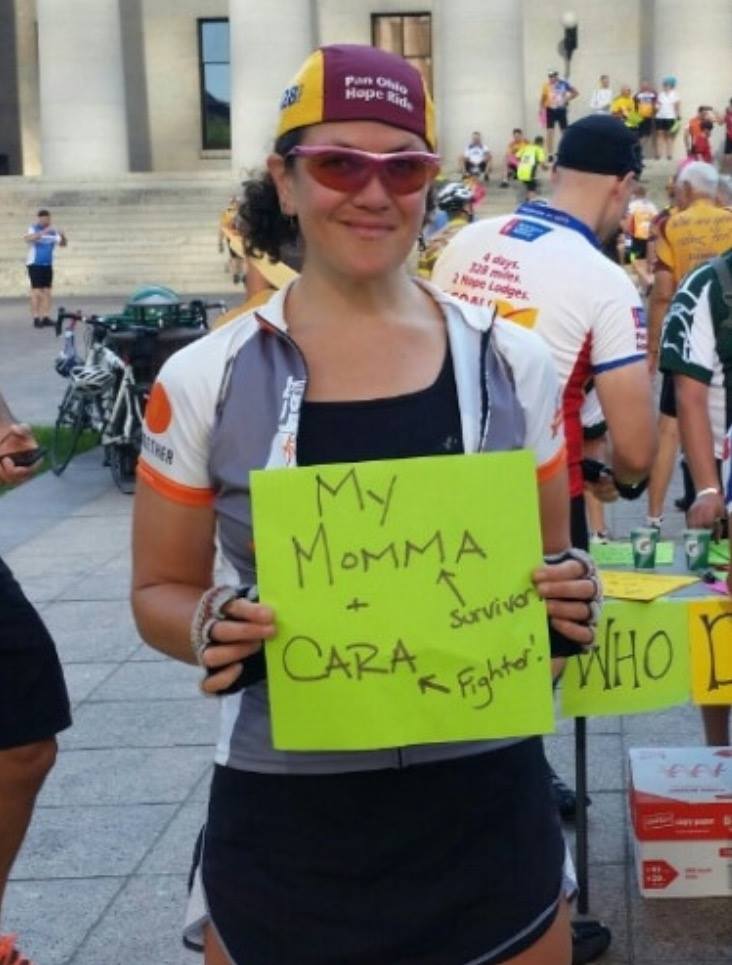
I've also seen people use the expression when they talk about participating in charity events (especially those involving strenuous athletic pursuits) to raise money for the struggle against cancer. Events like the Pan Ohio Hope Ride, a four-day, 328-mile bike ride to raise money for the American Cancer Society. 

The Pan Ohio Hope Ride's Facebook profile picture - a picture of my dear friend Shelli Snyder!

Another such charity event (although one requiring much less exertion on the part of its participants) that is very near and dear to my heart is Breathe Deep Cleveland, a 5k fun run and walk to benefit lung cancer awareness and research funding that Cara founded before she passed away.

These events are great. The battle against cancer is one in which we need all the help we can get. Every dollar raised has the potential to positively affect someone's life.

We've come a long, long way in our understanding of this horrible disease. We know vastly more about the underlying biology than we did a hundred, fifty, or even (especially when it comes to certain specific genetic abnormalities) ten years ago. This helps us devise better treatments. It also helps us better understand the underlying causes - why people get cancer in the first place. There's a whole lot we still don't know, but we've made great strides in the fight against cancer.

Sadly, today, in this country, there is a concerted effort underway to reverse much of that progress.

Republicans in Congress are trying to pass the "American Health Care Act" - their replacement for the Affordable Care Act. The Congressional Budget Office has estimated that this act would result in a whopping 24 million Americans losing health insurance compared to current law. Don't trust that number? Think it's "fake news"? The White House estimated an even bigger loss - 26 million.

It's pretty simple - if you get cancer, and you have health insurance, your odds are going to be a lot better than if you don't. If you can afford medical treatment, your outcomes will tend to be better than if you can't. If Cara didn't have health insurance when she was diagnosed, she would have died a lot sooner. The same is true for many terminal cancer patients. And there are many other cancer patients who have had their lives saved by medical treatments. If the AHCA passes, there are going to be a lot more people who have to make the horrifying choice between bankrupting their families or giving up on their treatments.

There's more.

The White House recently released their budget proposal, which cuts funding to most of the government programs that are vital in our shared efforts to (I have to say it) Make America Great. Two items in particular are especially relevant to the fight against cancer. A nearly 20% cut is proposed in the budget to the NIH, which provides an enormous amount of the funding for medical research in this country.

Without NIH-funded research efforts, I can say without any doubt that Cara would have died much sooner after her cancer diagnosis than she did. It was because I saw firsthand the benefits of cancer research that I decided to enter the field myself after obtaining my PhD in Biology.

The other highly pertinent and disturbing item in the proposed budget?  A greater than 30% cut to the EPA.

That is something that should horrify everyone who breathes air and drinks water.

(That is, everyone. Duh.)

Although there's still a lot we don't understand, we've come a long way in our knowledge of what causes people to get cancer. Probably the most widely recognized such causative link is that between cigarette smoking and lung cancer. Of course, it's not a one-to-one link; Cara didn't smoke. But we all know that years of smoking increase the chances someone will get cancer. That's because the toxins in cigarette smoke damage DNA in cells and make it more likely that those cells' genetic programs will go awry and lead to uncontrolled malignant growth.

Cigarette smoke is far from the only toxin that can do such damage.

In China, rates of lung (and other) cancer have skyrocketed. This is a direct result of rapid industrialization without the protections the EPA affords us here leading to a dramatic increase in pollution. In less than a decade, rates of lung cancer in Beijing rose more than fifty percent. We've all seen the images of the horrendously smoggy Chinese capital city.

Without government-mandated environmental protections, things would look much the same in major American cities.

But surely, you might say, even with a 30% cut to the EPA, we won't let things get that bad here. And that might be true. Still, it's a simple equation. More exposure to environmental toxins = higher rates of cancer. That's just a fact.

In the war between humanity and cancer, Donald Trump has staked his position firmly on the pro-cancer side. And any Republican elected officials who support these budgetary and health care proposals have likewise staked their positions just as firmly on the pro-cancer side.

Doing charity events like the Pan Ohio Hope Ride and Breathe Deep Cleveland is great. We have a good time with friends and we raise money for a good cause. But as much as that makes us feel good about ourselves, the sad reality is that Donald Trump and the Republican Party are setting out to do far more harm in the fight to save people's lives from cancer than all the good that will be done by all of the participants in all of those charity events.

Right now, if we want to kick cancer's ass, we have to kick Donald Trump's ass.

Thursday, December 1, 2016

Thankful

As it is for me, writing was an important part of Cara's life. She kept a number of different blogs over the years. The last of these was Mets SUCK! (The story of a girl with metastatic lung cancer.) Prior to that was A Girl About Cleveland, a blog that Cara started shortly after she moved to Cleveland in 2008 (having decided that if our relationship was going to continue to progress, it could no longer be a long-distance one) and that mostly focused on food but also contained various tidbits about Cara's life in her new city.

On November 24, 2013, Cara posted on her Girl About Cleveland blog for the first time in over half a year, a post that would be the final one on that blog, titled simply Thankful. She wrote:
This summer started out wonderfully. I logged over 1000 miles on my bicycle and had great fun with friends and family. At the end of August however, I was diagnosed with ALK+ adenocarcinoma of the lung. Needless to say, that has kept me busy. I spent a week in the hospital after diagnosis and ended up going back about two weeks later for a related medical complication (for another week). 
Treatment is going well though, and my prognosis actually looks good. As we approach Thanksgiving, I truly have a lot to be thankful for. I may not be at 100% healthwise, but I'm here and all things considered...I feel pretty good. I am surrounded by friends and family who care tremendously for me, and I'm in the capable hands of the staff at one of Cleveland's best cancer hospitals. 
I have so many stories to tell all of you - even though chemotherapy has changed my palate and appetite some, I've been able to eat and drink some amazing things. I'm hoping to get a blog or two under my belt during the holidays (no Black Friday shopping for me!) so I can tell you all about them. 
I wanted to share a recipe that Cleveland's own Chris Hodgson posted on Dim and Den Sum's Facebook page back in November 2011. This cranberry sauce is the perfect combination of tart, sweet and spiced. It's a hit with my family. Make enough to share (and enough to put on your turkey sandwiches in the days following Thanksgiving)!
(She finished the post with the cranberry sauce recipe.)

Before continuing this story, I want to pause for a moment to point out that Cara was completely incorrect when she wrote, "my prognosis actually looks good." And I knew that she was incorrect. However, no one told her this, and it's an interesting ethical question.

You see, when we got the results of the genetic testing showing that Cara's lung adenocarcinoma was ALK-positive, Cara's doctor explained that this was good news, because it opened up more treatment options. There was a drug called crizotinib (brand name Xalkori) that had been developed in recent years to specifically target ALK-positive tumors, and for patients who had such tumors the response rate with crizotinib was much better than with traditional chemotherapy. When Cara wrote that post, she had been taking crizotinib for a little over two months, and was responding well based on how she was feeling and on her most recent scans. Therefore, she felt that her prognosis looked good.

Being a scientist, I had naturally looked up research articles about crizotinib, and had seen that, in the clinical trial, the median progression-free survival was about 8 months longer with crizotinib than with traditional chemotherapy. This meant that the typical outcome for someone taking crizotinib was that they would gain about 8 months in which their disease would be under control, but ultimately they would still die of lung cancer.

There is no cure for stage IV lung cancer. The hope was that the progression of research generating new treatments would outpace the progression of Cara's disease, so that her disease would continue to be controlled and perhaps, some day in the future, a novel treatment would come about that could completely eradicate it. Or that could turn it into a chronic condition that would not actually progress to lethality. This hope was not a totally unrealistic one. There are people who have been able, thanks to the development of new treatments, to live much, much longer with the disease than Cara did, some who are still alive and well more than a decade after diagnosis. Still, the most likely outcome was always that Cara would succumb to her disease.

Cara's doctor did not explain this. In fact, Cara's doctors never told Cara that she should expect to die of cancer until the last week of her life. Should she have been told? I don't really know the answer to that question. I lean toward thinking that in Cara's case, it was better not to directly tell her. I think it was good for her, and for me, that she had that optimism, and could try to live life as normally as possible. Of course, even if she had been told, "You're probably going to die of this," that's not the same as, "You're definitely going to die of this," and Cara would likely have been just as determined to beat those odds. Don't get me wrong, she was well aware that she had a life-threatening condition, just not fully aware of how the odds were stacked against her. I knew all along that Cara would probably die of cancer, but I still hoped that she wouldn't. I never told Cara that she would probably die of cancer. The first time I ever heard her express the sentiment herself wasn't until 2015 when she told her mother, as the three of us sat in a doctor's office, "You know, this is probably going to kill me some day," and as it turned out, "some day" would arrive just a few weeks later.

Returning to November 2013. The very next day after Cara posted her "Thankful" post, she messaged me from work to say, "Ugh. This cold weather sucks. My chest just aches!" She later told me one of her online friends was urging her to call the doctor, leading to this exchange:
Jeff McManus
It's still bad? 
Cara McManus
It sort of feels like someone's sitting on my chest 
Jeff McManus
That sounds unpleasant. 
Cara McManus
It kind of is.
I'm breathing okay but there's a definite weight on my chest
Feng isn't at Seidman today
So I don't know what I'd do.
I'm kind of worried but I don't want to be a complainer
I'm raspy and stuff 
Jeff McManus
Well, it wouldn't hurt to call. 
Cara McManus
Kinda busy right now
I mean, I don't have the time to have a conversation with a doctor right now
Am kinda concerned though
And still later that afternoon:
Cara McManus
I am really hoping this chest pain gets better. It is making me nervous. 
Jeff McManus
I hope so too! 
Cara McManus
It seriously feels like i'm missing half of my lung
This was something that happened several times during Cara's illness - Cara being reluctant to go to the doctor about serious symptoms she was experiencing because she didn't "want to be a complainer." I don't say this to be critical of my late wife, but it's an interesting insight into the mindset she had. The next morning when she was feeling no better I convinced her to call the doctor, which led to her being admitted to the hospital, and it turned out to be a very good thing that she didn't wait much longer because if she had there's a chance she could have died way back then.

When Cara was in the ER, this exchange occurred:
Jeff McManus
What have they told you? 
Cara McManus
I stopped responding to Xalkori 
Jeff McManus
Well, that's not what I wanted to hear :( 
Cara McManus
You and me both
Haven't talked to Feng since she first came in though
I assume i'll do the other drug
I hate that doctor in the ER 
Jeff McManus
Why's that? 
Cara McManus
I don't feel like typing that much
I'll tell you when I see you
The reason that Cara told me she hated that doctor in the ER was that an ER doctor, someone who had no relationship with Cara and had never seen her before, had offered Cara the completely unsolicited opinion that there was no shame in considering hospice care. Needless to say, this was extremely upsetting to Cara, especially since when it happened she was alone in the ER, with no family or friends present. Cara's doctor (Dr. Feng) was also extremely upset at hearing of this incident. That conversation, if it were to come up, would be one for Cara's personal doctor to have with Cara. An ER doctor who did not know Cara had no place bringing it up. And that doctor had no idea about the different treatment options that Cara might have available. It would have been a terrible mistake to go to hospice care at that point in time, and I shudder to think how someone in a similar position but without Cara's strength of will or her strong support system might have taken that advice.

Cara was certainly in a grave state health-wise. We learned that that feeling of a weight on her chest was due to the fact that her pericardium, the sac that contains the heart, had filled up with 800 milliliters of fluid. That's a lot. (In September, after she had been diagnosed but before she started taking crizotinib, a similar incident had occurred when Cara's breathing worsened fairly rapidly over a couple days and after admission to the hospital we learned she had a whopping three liters of fluid in her chest cavity - but the pericardium is a much smaller space, so this time the situation may have been even more urgent.) She would have to have surgery to drain the fluid and to create a pericardial window - a hole in the pericardium so that additional fluid would not be stuck there. The surgery was scheduled for December 2. I don't remember all the details of that week or why it was exactly that the surgery was a week after Cara was admitted, but I'm sure there were good reasons. So while waiting for that surgery to take place, we spent Thanksgiving not in Columbus as we normally did, but in the ICU at University Hospitals in Cleveland.

Cara's parents came up from Columbus to spend Thanksgiving with us. At my and Cara's apartment, the three of us (her father Trent doing the majority of the cooking) prepared a Thanksgiving dinner to take to the hospital. I personally made the same applesauce that I have made for family Thanksgivings for many years, as well as the cranberry sauce that Cara had posted the recipe for on her blog and had made in the past. Making that cranberry sauce has become my thing as well - I've done it every year since, including 2014, when Cara was well enough that she made rolls and a dessert for our family gathering. It's a really delicious recipe.

Having Thanksgiving in the ICU was definitely not what we wanted, Cara most of all. But it was good that we still had a Thanksgiving, and good that Cara's parents could join us. The day after Thanksgiving was the last Friday of the month, meaning it was the day of the monthly Critical Mass bike ride, and Critical Mass rode to the hospital in honor of Cara.

The location of her room did not allow us to see them, but Cara was so moved that her friends did this for her. "Happy tears tonight. Cleveland Critical Mass FOREVER. All of you give me so much hope," she posted on Facebook.

The following day Cara was able to be moved out of the ICU and to a room in Seidman Cancer Center, which was very good because she hated being in the ICU.

There are several conversations over the course of the almost two weeks Cara ended up staying in the hospital that stick with me. I don't remember the exact order in which they occurred. I do know the first was with Dr. Feng. I was very worried about the fact that Cara's condition had worsened so dramatically in such a short period of time. She told me that sometimes when cancer became resistant to a treatment like crizotinib, there was a sort of rebound effect resulting in rapid progression. I asked her what the next step would be. She told me that she hoped to enroll Cara in a clinical trial for a newer ALK inhibitor drug, alectinib.

I was very stressed out and feeling very distraught throughout that first week. I remember going to the pharmacy at Target to pick up a prescription. I remember hoping that a young pharmacy tech named Ally who Cara and I had met recently would be there. The way we met Ally was quite remarkable. While picking up a prescription for blood-thinner medication, Ally asked Cara, if she didn't mind telling, why she had to take that drug. Cara explained why, and we were startled to learn that Ally's fiancé (now husband, and yes, he is still alive and well) Matt had been diagnosed two years prior with the exact same stage IV ALK-positive lung cancer! It was such a remarkable coincidence. We shared our experiences with each other, and learned that Matt had been on death's door at diagnosis but had made a remarkable recovery after taking the same drug crizotinib that Cara was on. That drug had saved his life. That story was one of the main things that gave me hope.

I told Ally about what was going on and she could tell I was very upset. I told her how Dr. Feng had brought up the alectinib trial, but the fact that Cara had failed crizotinib so quickly made me worry that the same would happen. Ally told me that she and Matt knew of some people for whom alectinib had worked more effectively and for a longer time than had crizotinib. "Cara is going to get better. That clinical trial is going to work," she told me. "It has to, it just has to."

This made me feel slightly better. Slightly.

On the day of Cara's surgery, Cara's mother Joyce, Cara's aunt Jean, my mom, and I were all gathered in the waiting area. After the surgery, the surgeon came out to us and told us that the surgery had been successful, but based on what he had seen when he was in there (and he did point out to us that he was not an expert), things did not look good.

I'm pretty sure my immediate response was a sardonic smile, like, oh, of course.

During the course of Cara's illness, there were three main low points for me. The first was the time of her diagnosis. The third was the end of her life. This was the second.

After the surgeon was gone, Joyce said something about she wished he had given some sort of time table. Of course, he wasn't really the one who would be able to do so. But we were all given the clear impression that Cara probably didn't have much time left. Perhaps a few months, I remember thinking.

Late that afternoon, I posted a terse status update on Cara's Facebook account:
This is Jeff. Cara got out of surgery about 1:00. The procedure to put in a pericardial window was successful. She is in the recovery room now, still waiting until she is ready to be moved to a hospital room.
I remember sitting across from my mom in the cafe at the hotel across the street from the cancer center, and telling her that, although I had known that there was a good chance that Cara would not survive her illness, I had not expected things to go downhill so soon and so rapidly.

I also remember sitting next to Cara after she was back to a hospital room. I smiled at her. She told me that I looked much more at ease than I had before the surgery. The truth of it was that before the surgery I was so worried about what might happen, but now I was already coming to terms with the notion of her dying.

My mom and I agreed that Cara should be informed of what the surgeon had told us. It was hard to tell Cara, though. Eventually I decided that the best way to inform her of the bad news would be to ask the surgeon to come see Cara and tell her basically just what he had told us, in the same clinical way. Then she could react however she felt like reacting, rather than having my own grief over the words influence her reaction.

So he did come to her room and tell her. To my surprise, Cara seemed unfazed by the news. Like what he was telling her wasn't that big a deal. Perhaps the drugs she was on helped. Her attitude was basically, it is what it is, and now we're going to move on to the next thing.

There was some concern over whether Cara was healthy enough to be accepted into the clinical trial. On December 6, she signed the consent form.

On  December 12, she was officially accepted, and she started the trial the very next day.

When we spent that Thanksgiving in the ICU, I fully expected that it was Cara's last Thanksgiving. Even at Christmas the following month, I thought it was probably Cara's last Christmas. But over the next few months, Cara made the most amazing improvement. By spring she was even able to get back on her bicycle and do some long rides. And not only did alectinib work better against Cara's cancer than any of the other treatments she took during her twenty-month battle, it also had the least side effects. For a little while, in April and May, it was like Cara was almost back to her normal self!

It couldn't last forever, though. In late May we found out that there were some small metastases in Cara's brain and she had to stop the trial. She went through several other treatments over the next almost-year; they all helped temporarily but none worked as well as alectinib. (Alectinib, by the way, has been FDA approved and is now helping lots of lung cancer patients, and they all owe a debt of gratitude to Cara and everyone else who participated in that clinical trial.) Still, through all of that time Cara and I were able to enjoy so many great experiences together. It wasn't until the very last week of her life, in April 2015, that her health and ability to function returned to the low point they had been at in the week of Thanksgiving 2013. None of that would ever have happened without the heroic efforts of numerous doctors and research scientists who made Cara's treatments a reality. So, just like Cara was when she wrote that last post on her Girl About Cleveland blog, I am truly thankful.

Tuesday, August 23, 2016

Three years

It was three years ago today that everything changed.

This morning, I (as I so often do) looked at Facebook's "On This Day" feature. There were several items of interest for August 23. For one, in 2011 I posted, "Whoa, I've never felt an earthquake before just now!" (And yes, I was right here in Cleveland when that happened - anyone else remember that quake?)

Much more significantly, at 1:13 pm on August 23, 2013 I updated my Facebook profile picture to a photo of Cara and me on a sun-soaked beach in Guanacaste, Costa Rica on the last day of our honeymoon.


Instantly I remembered what had happened three years ago today. I did not remember, though, the exact timeline of events on that day. Was there any particular significance to the time at which I had updated my profile picture, I wondered? And so I dove into my online chat history with Cara in order to answer that question.

One of the quirks of our relationship is that so much of our communication was done online. This was especially true in the period of time when we were "just friends," from March through the beginning of November in 2006. Our communication then was almost exclusively via online messaging - we chatted for hours on end most days, while we only got together in person a total of six times over those months and very rarely talked on the phone. After we became a couple, on November 4, 2006, we spent most weekends visiting each other, but continued to do a huge amount of chatting online. This decreased, of course, when Cara moved to Cleveland in September 2008, but we still messaged each other fairly often as we did not live together until June of 2009. When that happened, the frequency of our online messages dropped dramatically, but it picked back up two years later after Cara lost her job at Medical Mutual (where she had no ability to chat with me during the day) and later that summer found a new job at Case (where no such restriction existed).

The upshot of all this is that I have a very detailed textual history of almost our entire relationship, which is rather unusual, although undoubtedly becoming at least a little less unusual than it would have been in past eras. It's really wonderful to have that history. I suppose the equivalent, for more traditional forms of communication, would be if all your in-person and telephone conversations were audio recorded as they happened and then converted to text. That would seem like a really weird thing as it happened, but years later, wouldn't it be cool to have such a record? In the absence of such a recording system, most all of the face to face conversations I ever had with my beloved wife and best friend have become nothing more than vague memories. But all the online messaging communications are still there in the exact same words as when they first happened. Especially now that Cara is gone, that's an amazing thing to have.

Moving past that digression. The month of August 2013 was a very eventful month. Among the messages I have from Cara are some very brief ones during her great Pedal to the Point adventure (sample: "I miss my bed"). For years, Cara had been participating in the MS charity bike tour to Sandusky. On more than one occasion, she had planned to stay overnight in Sandusky and do the return ride on day two, but then had changed her mind after the first day's ride and had me pick her up in Sandusky. In 2013 she finally did the whole thing, covering 150 miles on her bicycle in two days. This was a huge deal. Throughout that summer, she had been experiencing increasingly worse respiratory symptoms such as wheezing and shortness of breath, which were incorrectly diagnosed as being due to asthma at an urgent care in May. Yet somehow, on that last Pedal to the Point ride, she said that she felt great.

Our chat history at that time includes messages about several different health issues of Cara's. One, her visits to a reproductive endocrinologist about our continued unsuccessful attempts to get pregnant. Cara had PCOS, resulting in very irregular cycles and making it very difficult to get pregnant. This was very frustrating for her. Another issue that popped up that month was the pain and swelling in Cara's leg. On August 7 she messaged me: "Um. There's some really bad swelling on my ankle. I just noticed, on the outside." She went to an urgent care, where they said she had a sprained ankle. She wasn't sure how this would have happened.

The foremost issue, though, was with Cara's breathing. Cara was becoming increasingly convinced that the source of the problems was mold in our apartment. This belief was strengthened when she felt remarkably good on her Pedal to the Point ride and then went back to feeling worse after returning home. It was a time of extreme frustration for Cara and a stressful time for both of us. One message she sent me about this was, "I hate to be a buzzkill but if we go to the ADKs and I don't have asthma issues I'm going to insist that we move." (The ADKs means the Adirondacks, where my family vacations every year in August.)

As it turned out, Cara's issues got even worse during that trip.

On August 15, the two of us hiked Cobble Hill, a relatively short and easy but very nice hike in the village of Lake Placid near the house where we stayed. Cara had to go very slowly on the uphill portion of the hike, but once we were at the top, she was very happy and we had fun posing for some pictures and making each other laugh.


One of the pictures was even described by Cara as her favorite picture of herself that was ever taken:


The following day, we went on a bike ride that we had done in the past. It was about the flattest route available in the area but still had some hills. There were a couple of long, gradual hills and I remember Cara was just going so slowly up them. I felt frustrated (undoubtedly nowhere near as frustrated as she herself felt) and also felt really bad for her. I thought back to the very first times we had gone for bike rides together, all the way back in 2007, and how slow she had been back then. She had improved her fitness so, so much in the ensuing years, and now it seemed like all that progress was being reversed.

With a few miles left in the ride, there was a steep uphill. Cara started up it, experienced a fit of hacking coughs, and stopped. She couldn't do it, she said. I had to ride the last few miles myself to retrieve our car and come pick her up. After that we enjoyed our traditional lunch at the Noonmark Diner in Keene Valley, an eatery known for its pies and one I had been going to with my family since I was a kid. Incidentally, my Facebook profile picture immediately before I changed it to that picture of us on the beach was taken at the diner that day, a funny picture of me wearing Cara's sunglasses:


Cara would describe what she had felt when she tried to ride up that steep hill as like one of her lungs was only partially filling up.

This was, in fact, exactly what was happening.

I recall lying in bed at night in that house in Lake Placid, next to Cara, listening to her just cough and wheeze and cough. It should have been clear then that something was seriously wrong. It wouldn't be much longer before we found out what.

The following week found us back in Cleveland (while my parents and brother remained in Lake Placid, having rented the house for two weeks). August 22 brings some heartbreaking messages in my chat history. That morning, Cara excitedly messaged me, "I got non-stop flights!" In October, she was going to be traveling to Baltimore for a training program related to her job as an exam proctor. She had never done something like this before and was very much looking forward to it. I told her, "It will be really weird to be home alone for a week!" She replied, "It definitely was weird any time you left," referring to times I had been out of town for conferences. I, on the other hand, had never stayed at home without Cara in all the time we had lived together, not even for a single night. (Edit: looking back at this, that statement is obviously untrue, because I was home alone for a night earlier that month when Cara did the two-day bike tour. But to my recollection, that was the only time this had happened.) Little did I know that I would be "home alone for a week" much, much sooner than October - in fact, beginning the very next day.

(Well, I spent much of that week in the hospital, of course, but I did go home every night.)

Also on August 22, she messaged me to ask if I could take her to the store when I got home. She said she was "awfully woozy/dizzy." I said that I could, and she thanked me and said she felt bad for "being so needy."

That was a Thursday. That night I was going to see local band Cloud Nothings perform at the Beachland Ballroom. Cara ended up not going to the store; I made a quick trip there by myself before going to the show, picking up some ramen soup and other things typical for someone with a bad cold. I had a really great time at that Cloud Nothings show, which some of my friends also attended. Looking back, that was the last time that my life was anything resembling normal.

The next morning, Friday, August 23, Cara had a doctor's appointment in Family Medicine at University Hospitals, right by Case campus where we both worked. She unfortunately had not had a primary care physician, and this appointment was to establish a relationship with one. Cara wanted to discuss, among other things, the breathing problems she was continuing to have.

At 10:24 am, she messaged me, "Fever is gone as of now" (she had had a fever the previous night). "That's good!" I replied.

At 11:02, Cara messaged me again. "She's actually kind of concerned about a blood clot. Possibly in my leg. Which could attribute to respiratory issues." As Cara would tell me later, after talking about her ongoing problems with "asthma," the doctor had asked Cara if anything else had been bothering her. Cara mentioned the pain she had been having in her leg. The doctor felt Cara's leg, noticed a warm spot in her calf, and was instantly concerned.

Cara, 11:59 am: "They found a clot. I'm waiting in vascular to see what they do. I might be admitted." 12:28 pm: "I'm in family medicine again... it's such a cluster fuck. I have no idea what's going on."

At 1:02 I messaged Cara to say that I had been away from the computer for a while and her boss had just called me. Cara filled me in on what was going on - she was going to be taken to the ER, where she would be admitted. And so it was that at 1:13 pm, full of concern for my wife, I changed my Facebook profile picture to that honeymoon photo of us, and then left to meet her at the ER, a short walk from the lab at Case where I worked. I spent the next hour or two with Cara in the ER, and listened to a doctor explain what was known at the time. Eventually I went home with plans to return later that day, because there were some things at home that Cara wanted. (Among those items, from a chat message she sent while I was at home, "Boco" - her name for the oldest and most beloved of her Chococat plushes - and "yb" - standing for "yellow blanket," her baby blanket that she continued to sleep with throughout her entire life.) Before I left the hospital, Cara asked me how I was feeling. I said I was feeling pretty at ease, because finally there was some explanation for what was going on with her. A problem had been identified and it could be treated, and then, I figured, Cara could get better. The thought that she might have cancer did not enter my mind.

After leaving the hospital, I called my parents, who were still on vacation. "My parents are on a hike but I got through to my dad. I'm at home now," I told Cara at 3:25.

Some time later, I received a phone call from Cara, who sounded upset and told me that I needed to return to the hospital as soon as I could. I asked what was going on. She gave the phone to the doctor, who said she couldn't explain to me over the phone what was going on, and I should just go to the hospital to hear it in person.

So, no longer feeling at ease, I returned to the hospital.

There I learned why Cara had sounded so upset. Cara had had a CT scan of her lungs. Her lungs were full of pulmonary embolisms (blood clots). Moreover, there was an unidentified mass obstructing one of her bronchial tubes.

What.

What.

At that point, it was still an unidentified mass. But an unidentified mass, that sure sounded like it might be a malignant tumor. Through all those months of Cara's increasing respiratory symptoms, all that wondering of what was going on with her, I don't think the notion that cancer was the cause ever occurred to me. And now there it was. In my mind for the first time. The idea that my wife, a vivacious, healthy, and active 34-year-old woman, might have cancer.

As I said at the beginning of this post: it was three years ago today that everything changed.

The next week is something of a blur. Certain specific events stand out, but the exact timeline is lost to my memory. Unlike August 23 and the days leading up to it, there's little chat history for me to look back on. I called my parents, of course, to update them. I remember telling them, trying to put it optimistically, that the doctors had to "rule out lymphoma or lung cancer" - which, of course, actually meant "Cara might have lymphoma or lung cancer." Or maybe I told them that in person, when they came to see us. As I said, it's something of a blur. (I recall at one point, some time in between Cara's admission to the hospital and her actual diagnosis, being told that lymphoma seemed more likely. I'm not sure why that was.)

My parents and brother were already going to be heading back from the Adirondacks that weekend, and rather than driving straight through to Columbus as they usually did, they made a stop in Cleveland to see us. Additionally, Cara's mother came up from Columbus to be with Cara in the hospital. It had been a long time since we had seen her.

One day the next week a bronchoscopy was performed on Cara. I remember sitting with my mom in the waiting area. The surgeon came out to see us. He said that everything went okay with the procedure, but that it looked like Cara had lung cancer. This was another gut punch, because as I said, for whatever reason I had been under the impression that lymphoma looked more likely. Not that a diagnosis of lymphoma is a good thing, but...

Naturally my immediate instinct was to look up lung cancer survival statistics. What I saw was not pretty. I remember being in a hospital bathroom soon after, washing my hands and looking in the mirror, and just breaking down in tears. How could this possibly be happening?

Once Cara was back to her room, it fell to me to tell her what the surgeon had told me - that it looked like she had lung cancer. Not long after, the doctor in charge of her care learned of this, and was very upset, because he said the surgeon should not have told us that, and Cara had not yet been definitively diagnosed. We did not know whether she actually had lung cancer. We would have to wait for the biopsy results.

I remember clearly the morning that we received those results. I made the same nine-tenths of a mile walk from home to the lab that I made every morning, but only stopped in briefly before making the much shorter walk across the street to the hospital's old Lakeside building. As I walked up the steps to the hospital's entrance, I was stopped in my tracks by a striking sight: a praying mantis was sitting there on the handrail, at the top of the steps, facing the doors through which I was about to walk. It was eerie. I'm generally not a superstitious person, but I imagined the mantis might be some sort of harbinger of death. Although this was a moment that will always stay with me, I did not, back then, look up the symbolic meaning of seeing a praying mantis. Perhaps I was being a little superstitious. Perhaps I was afraid of what I might find. (Looking it up now, I see that it's more often regarded as being a sign of good luck. Go figure.)

I took the elevator up to Cara's floor and walked down the hall to her room, where everyone else was already waiting.

The doctor confirmed that yes, Cara did, indeed, have lung cancer.

At these words, everyone in the room started crying. Cara later said that this was the absolute worst moment. She also said that it was the only time she had ever seen me cry (as in full-blown tears, not just welling up), and that she hoped to never see it again. Remarkably, she got her wish. Although I've cried many times since then, both before and after her death, this has mostly happened when I was alone and never when I was with Cara.

The doctors did not actually use the term "stage IV lung cancer" at that time, but did say that the cancer had spread to her liver and bone, meaning that it was stage IV.

During the previous few months, Cara had often been frustrated and at times even angry about all the issues she was having in her life, foremost being her respiratory issues followed by her infertility. This all changed when she was diagnosed. That anger was gone. Having a baby no longer seemed important when she had a life-threatening illness. And now that the horrible true cause of her respiratory issues was known, her attitude was, okay, it is what it is and we and the doctors are going to come up with and carry out a plan to treat it, and we're going to go on living and enjoying our lives the best we're able. She carried this amazing positive attitude and resilience with her for the rest of her life, and in this way, she carried me with her, and has continued to do so even after her death.

I'll finish with an anecdote about a wonderful thing Cara did for me not long after her diagnosis. Earlier that summer, the band Ohbijou, a band I loved and had never seen live, announced that they were calling it quits and playing a single farewell show in their hometown of Toronto on September 7. Seeing this, I immediately decided that I wanted to go, and I asked Cara if she would go with me. She said that she would, and I bought a pair of tickets.

As August turned to September, Cara was in no condition to make such a trip. I remember after she was released from the hospital, she and I were eating lunch with my parents at our favorite restaurant L'Albatros. I remarked that I wasn't sure whether I would still go to the show in Toronto. My mom got a horrified look on her face, like how could I even consider still going. I'm sure a lot of people would react the same way.

Cara, though... she knew how much seeing that show would mean to me. Of course, if she had said that she didn't want me to go, I absolutely would not have hesitated to stay with her and give up going. But instead, she told me that I should go without her. Her mom was staying at our apartment, so Cara would not be home alone. Still feeling uncertain about it, I did head out early that Saturday afternoon on the five-hour drive from Cleveland to Toronto. I told Cara that after the show, I would start driving back from Toronto and then stop to find a hotel when I got too tired. As it turned out, my eagerness to get back to Cara outweighed any feelings of tiredness, and I drove all through the night, getting back into Cleveland just as the sun was coming up (a very strange thing for me to experience). All told, I drove five hours to Toronto, spent five hours in Toronto, and immediately drove five more hours back home. And it was well worth all that driving; the show was an incredible and supremely emotional experience. There is something very, very special about farewell shows. I wrote a review of the show a few days later, but while I shared it on Twitter so that the band and other concertgoers would have the opportunity to see it, I did not share it on Facebook. This was because I figured that many people would have a hard time understanding how I could have gone to a show in Toronto by myself less than two weeks after my wife was diagnosed with lung cancer. And putting it that way, it does sound strange. But Cara understood. I'm forever grateful to her for letting me have the opportunity to experience that show. Just as I'm forever grateful to her for so, so many other things.

Sunday, April 17, 2016

Dear Cara

I saw Andrew Bird perform last night. It was a really great show, and I really wish you could have been there. Even though it was at the House of Blues. I just know how appalled you would have been that Andrew Bird played a show at the House of Blues. I got reserved balcony seats for the show, and can you believe it, my seat had a partially obstructed view of the stage. I could see a little more than half of the stage, and I could see Andrew Bird for the entire show, so that wasn't too bad, but there were other seats next to mine with even more obstructed views. Seriously, why would someone design a music venue that has reserved balcony seating with obstructed views of the stage? Sigh, just another reason to think that place is a terrible venue... I know, you never even went to a show there, just because of the reputation. I think you would have made an exception for Andrew Bird, though.

Venue aside, it really was a fantastic show. It had been four years since we last saw him, and he's the same great performer and quirky personality he always has been. The best part was the encore, with him and his band gathered around a single microphone performing some acoustic songs, "old-timey" as Andrew Bird called it when they did the same thing at that show in Columbus four years ago.


I remember how much you loved that. That was a really amazing experience we had together. We were so close to the stage!

Leia went to the show with me last night and we had a great time together. I actually asked Troy first, partly because the show was exactly a year after that Sufjan Stevens show last year that you gave Troy your ticket to because you weren't feeling well. We had no idea then how little time you had left. Troy couldn't go last night, and Leia was a great second choice. It's funny to think, when we saw Andrew Bird together at Playhouse Square seven years ago (a show you wrote a nice review of), Leia was also sitting next to me, but we didn't know each other yet. I recognized her from being in Afternoon Naps, though. And she told me yesterday that she had also recognized me then, from being in the audience at Afternoon Naps shows! It was the following month that you and I were the queen and king at the Beachland Prom. I don't think Leia ever told us this while you were still alive, but she was the one who got people to vote for us. And that was still before we were actually friends with her! She could just tell we were a really awesome couple and deserved to be the Prom King and Queen. Isn't that great?

Maybe even more than going to the show, I wish you could hear Andrew Bird's new album. I really love it; I think it's one of his best albums. I think you'd love it too, and I really wish I could hear your reaction to it. I didn't know this before I got the album, but Andrew Bird's wife had thyroid cancer (she's better now) and that experience had a big influence on the album. I think that's part of why it's so great. There's one song, "Puma," that's directly about the experience of her going through treatment. I'm really moved by the song, and I really love the lyrics:

Don't try to tell her she's less feline than human
For it gives rise to the rumor
She's a girl and not a puma

And that light that shines is not a pearl
It's just a tumor

When she was radioactive for seven days
How I wanted to be holding her anyway
But the doctors they told me to stay away
Due to flying neutrinos and
Gamma rays

I came across a great interview with Andrew Bird and he talks about this song in the interview:

At one point, my wife said to me when she was going to get this test, she said “I’m afraid they’re going to tell me I’m a girl and not a Puma.” I thought that was such a remarkable thing to say. It’s a bit hard to explain why she would say that, but I can say that she has kind of a feline disposition (laughs). I decided I wanted to write a song that celebrates how she dealt with all of this adversity.

There's another really great song on the album, "Left-Handed Kisses," that is a duet with Andrew Bird and Fiona Apple. I think you'd love the song. Fiona Apple always makes me think of when we listened to one of her albums at the cabin in Holmes County. It's funny how sometimes certain pieces of music can be so tied to specific memories. At the concert, Andrew Bird went ahead and performed the song despite having no female vocalist with him, and he sang both parts of the duet himself. It was great.

Another part of the album that made me think of you is in the song "Valleys of the Young," these lyrics:

Now you're going on 64, driving down 65
To the hospital to see if your adult son will survive or not
After taking those pills in the parking lot
You know the one behind the Marriott

I remember how annoyed you were when an Andrew Bird song showed up in a Marriott commercial. I wonder if it was an intentional, sort of sly self-referential thing for him to put that in the lyrics. I was listening to the album at work, doing some cell culture stuff, when I realized the connection and I just started cracking up, thinking about how you might react to it.

There's been some other music recently I'd also like to share with you. I'm really enjoying the new Nada Surf album as well. And earlier this year, Lucius put out a fantastic new album and I saw them play a really stunning show at the Beachland. I remember how much you were looking forward to seeing them open for the Decemberists in California last year. It's too bad you never got to see them live.

I was originally planning to take your mom to the Andrew Bird show, because she's talked about listening to his music and how it makes her think of you and me, but she ended up deciding she wasn't up for making the trip, which was too bad. It's been a really hard time for her, losing you and then losing Gram just a few months later. I know you'd be very glad to hear, though, that she and I are still great friends. Actually, our relationship became stronger after we lost you. We have some great conversations on the phone, and I usually visit her when I'm in Columbus. I had a really nice Christmas dinner with her and Trent.

Mitters and Eponine are still doing well, although they do still get in fights sometimes (of course). Mitters is starting to show more signs of her age. She still sometimes likes to jump up on the bathroom sink and ask for water from the faucet, but I've noticed it's becoming harder for her to make the jump. Sometimes she fails the jump, which is adorable but also kind of sad. Overall, the old lady seems to be in pretty good health, though. And she really loves me and hangs out with me a lot, although one thing that's interesting is ever since you've been gone, she stopped coming to bed at night (Eponine still sleeps with me). It's hard to believe Eponine is older now than Mitters was when I met you!

It's been a hard year for me too. I've had a lot of great support from my friends, and I owe you a lot for all the great friends I have. Both because a lot of them I met through you, and also that your influence on me really helped me become a lot better at making new friends. I was doing well for a while, but then last fall I had a recurrence of some really bad chronic pain and became quite depressed. Then there were a few times when I felt like I was getting better, but then got worse again, and felt like I was sliding back toward that deep depression. I remember once, when I was going through another period of really bad chronic pain and feeling pretty down about my life, you told me that maybe I should "talk to someone," as in, seek out psychiatric help. I said that the only thing that would make me feel better was if the pain got better (which thankfully it eventually did), so I didn't see the point. I should have listened to you, though. Recently I have been much more proactive in seeking out help in multiple ways, physical and mental. After being officially diagnosed with depressive disorder (which obviously, I already was depressed, but hadn't been diagnosed before), I have been taking Zoloft for about six weeks now, and I feel like that, along with several other things, is starting to really help. My pain has also been less bad recently, but additionally, I feel like even though the Zoloft does not directly target the pain, it modulates the effect the pain has on my mood. And there is a feedback cycle where I feel stress and anxiety about the pain, and those make the pain worse, and also make it harder for me to sleep, and lack of sleep also makes the pain worse. And I feel like I am starting to really break that cycle. In the last few weeks, there have been some times when I've felt really happy. Not just kind of happy, but genuinely very happy. Which is a wonderful thing to feel, because the last time I felt that way was back in October before this pain episode started.

I kind of worry that by writing down and sharing the fact that I feel like I'm really getting better, I will jinx myself and get worse again. But I know that's irrational.

You were so graceful and brave in the way you dealt with the horrible adversity that you faced. I remember you telling me that you couldn't have done it without me. I feel the same way now. Even though you aren't physically here, you'll always be with me, and always be a source of strength. Our time together was too short, and I'll always miss you, but I'll always be grateful that we got to be such a big part of each other's lives.

Love,

Jeff

P.S. Today is a really beautiful day, and I went on a great bike ride!