Tuesday, January 12, 2021

1/6 vs. 9/11

 As I continue to process the horrific events that took place at the United States Capitol last Wednesday, I can't help but think back to another time during my life when our nation came under attack. And to think of the similarities and differences between the two incidents. Especially the differences.

September 11, 2001, started like any other day. I was 18 years old and had recently begun my freshman year of college. That morning I went to the dining hall and ate breakfast before returning to my dorm room to get ready to head off to my morning classes. Upon my return to that small double room, 9/11 very suddenly became a day very unlike any other day. The television was on (very odd), on the television there was a live shot of the twin towers with smoke billowing out of them, and my roommate quickly said, "Two planes just crashed into the World Trade Center."

It was immediately obvious that something unimaginably horrible was happening.

Classes weren't cancelled yet so I headed off to class not long after. While walking across campus I passed some construction workers who were listening to the radio and I heard something about the Pentagon having been struck. In class news and rumors flew (remember those days when we didn't all have the Internet in the palm of our hands?). By some of the early reports, the attacks were even more widespread and destructive than they were in reality. I remember hearing something about a bomb going off at the State Department, which of course had not actually happened. But the reality, obviously, was horrible enough. At the time it was the worst day of my life and there wasn't really any competition.

January 6, 2021 did not start like any other day. It was an unusual, tension-filled day from the start. We all knew that Congress was meeting to certify Joe Biden's election victory and that numerous congressional Republicans were planning to continue their assault on democracy by objecting to the results. We also knew that Trump was holding a rally not that far from the Capitol, a gathering of his supporters who had already been whipped into a frenzy by lie after lie after lie about the election and about so many other things.

I guess it should have been obvious in retrospect that something really awful might happen. Certainly I was nervous. But I wasn't expecting... that.

I was sitting on my sofa, working on my laptop, as I've generally been doing every work day during this awful pandemic. I was periodically checking Twitter, as I also generally do.

Okay, more than periodically.

The previous day I had seen a report about some Trump supporters getting into it with cops in DC, and I kind of thought - oh, that's nice, it's about time! - after all the other news stories this year about various protests and the response, or lack thereof, by law enforcement. Peaceful BLM protests being violently cracked down on by police. Heavily armed anti-mask zealots invading state capitol buildings while cops stood by and watched. Finally, I thought, the MAGA wackos are getting a taste of their own medicine.

So on Wednesday, when early in the afternoon I saw reports of a mob gathering outside the United States Capitol and starting to get in scuffles with police forces, I at first thought it was more of what had happened the previous day. Surely the protesters (I still thought of them as protesters at that time - not yet as rioters, or insurrectionists, or terrorists) would take some licks from the cops and eventually disperse without doing any real damage.

Then around 2 or so I saw a tweet stating that the Capitol had been breached.

The expression "shit got real" comes to mind but when I really think about it? I don't think it got real yet, not for me, or probably for most everyone all over the country as we all in one way or another became aware of the news.

I ended up spending most of the rest of the day watching the news on TV. I was horrified by what I saw. But as horrified as I was that day, it was nothing compared to the horror I've felt in the ensuing days.

I think on 1/6 I was, in a way, watching it more like I was watching a movie or TV show than real events that were really happening in real life.

I suppose 9/11 was also like that, in a way. But on 9/11, man, seeing the WTC collapse? There was no way to deny the sheer magnitude of horror we were all witnessing. No way to not just feel utterly sick and utterly full of dread.

On 1/6, most of the images that we saw, on that afternoon, were tame, often even laughable. A crazy guy in a buffalo costume posing for the camera in the chambers of Congress? Another goofy looking guy with his feet up on Nancy Pelosi's desk? Do those really look scary? It was clear something really crazy and unsettling was happening, but the full extent of it...

The full extent really only started to come out over the next few days and I'm sure there's even more that we still don't know, but the grim details of what happened that day, that most of us have now probably seen but had no idea of that afternoon... A functional gallows erected outside the Capitol. An angry mob chanting, "Hang Mike Pence!" after their treasonous leader told them that the Vice President had betrayed their cause. That same mob beating a police officer to death. Windows and doors being smashed as the mob descended on the locations where vulnerable members of Congress cowered. One rioter being felled by a single shot fired by a brave, outnumbered security officer who resorted to lethal force only when it became truly necessary.

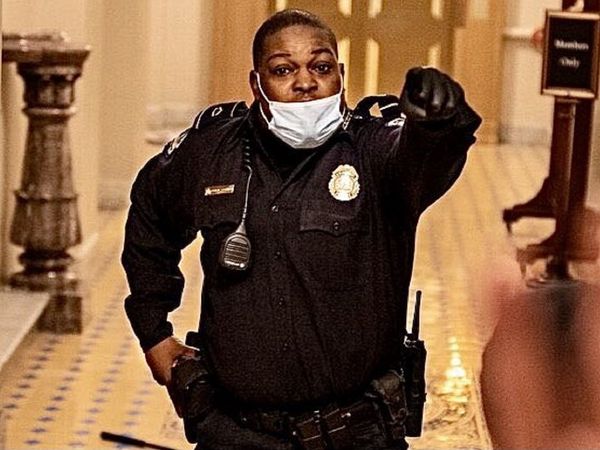
Eugene Goodman, a Black police officer facing off, alone, against an angry white mob, and luring them away from the undefended doors to the Senate chambers. He should be considered a hero in a similar echelon as those brave Flight 93 passengers who gave their lives to protect the Capitol on 9/11.
9/11 was instantly more terrible than anything I'd ever experienced in my life. In the days that followed, the terror remained, but as I think back on it, I think that with each passing day, life gradually moved - not back to normal - but back to a place where I could enjoy the day-to-day moments of life without constant anxiety and dread. It didn't happen right away. But each day seemed a little less bad than the previous one.

1/6, in the moment, didn't seem as terrible as 9/11. But the ensuing days have had the opposite effect. Each day, as more details have come out and the actuality of what happened and is still happening has continued to sink in, has seemed worse.

Looking at it now, I think that 1/6 is more frightening than 9/11. (At least from the perspective of a citizen of the USA - I don't want to diminish the horror that was experienced by the victims of the misguided wars our country launched in response to 9/11.) On and after 9/11, there was never even the tiniest shred of possibility that Osama Bin Laden would overthrow the United States government and install himself as leader. Islamic extremists were never attempting to take over our government and any such attempt would have been utterly futile. On 1/6, the man who currently is president of the United States - and who, thanks to our broken Electoral College system, could have been reelected if the vote counts in a few select states had shifted a little bit in his direction - incited his followers to attempt to overthrow the government and install him as an unelected dictator.

And hours after that happened, a majority of the Republicans in the House of Representatives still voted to overturn the results of the election!

It is incredibly frightening that so many of our fellow citizens have been swept up in this authoritarian movement. It is horrifying that, in our two party representative democracy, one of the two parties has largely rejected the concept of democracy and has now moved beyond gerrymandering and voter suppression into outright violence.

And now we see numerous Republican elected officials and right wing pundits saying that impeachment would be too divisive and we need to just move on for the sake of unity.

This is like if after 9/11, people had said that trying to get Bin Laden would be too divisive, so we should just let him off without consequences and move on.

It is true that we need unity. We need unity against the people who tried to overthrow our government. Anyone who opposes consequences for Trump is picking the side of the people who tried to overthrow our government. The rest of us - conservatives, moderates, and liberals alike - need to unite against them. Only then can we move forward as a country.

And even after Trump is gone from the presidency, the seditious movement he fomented isn't going to disappear. That's a big reason why 1/6 is scarier than 9/11. Because a small group of extremists on the other side of the globe can't do nearly as much damage as what could potentially be done by a homegrown radical movement that has now infected the minds of millions of Americans. But I have hope that things are going to get better. I have hope that 1/6 was a big wakeup call for a lot of people about the threat that we face. And I know there are more of us - the people who want our democracy to continue - than there are of them.

Another reason that I think this past week has been so extremely unsettling (not that the events themselves aren't unsettling enough) is that thanks to COVID so many of us are already so isolated and already under such enormous stress. We can't gather to comfort and reassure each other the way we normally would. I remember shortly after Trump was elected, and I was feeling disconsolate. (For good reason, I'd certainly have to say from the vantage point of four years later.) And my parents came to visit me and we went out for a nice dinner. It was good just to spend time with family. So many small comforts like that are missing now. But it's important to remember that it won't be like this forever. I hope everyone is doing the best they can to take care of themselves and to be there for each other even if it can't be in person. When we look back on this time, years in the future, I think it's going to be hard to believe we really lived through it all. Or that things really were as bad as they are at this moment. I look forward to that day.

Sunday, November 22, 2020

Thankful, redux (or: Thanksgiving in the ICU)

I've been thinking a lot about all the people who will be spending this Thanksgiving in the ICU.

Unlike most people, I've already had the experience of seeing a loved one spend Thanksgiving in the ICU. Seeing a loved one spend Thanksgiving in the ICU while on supplemental oxygen, at that.

In November 2013, my wife Cara, who three months earlier had been diagnosed with stage 4 lung cancer at the age of 34, had a sudden downturn in her health after her first treatment failed the week of Thanksgiving. Two days before Thanksgiving, having noticed an increasingly distressing deterioration of her respiratory function, she went to the hospital, was admitted, and soon found herself in an ICU bed.

I wrote about the whole experience four years ago in a post called Thankful so I won't recount the story in detail this time. The title of that post was taken from a post Cara herself wrote just days before her hospital admission called Thankful in which she reflected on how much she had to be grateful for despite her lung cancer diagnosis. She wrote the post before she realized her health was suddenly worsening again. That's a reminder to me about how precious our lives and good health are and how we should never take those things for granted.

Cara hated being in the ICU. I remember well how much she hated it. The crowded conditions, the lack of privacy, all the beeping of hospital machines and all the other noises that made it so difficult to get any restful sleep. She was very glad when she got to move to a room in the cancer center later that week, before the surgery she had the following week. But on Thanksgiving Day, she was still in the ICU.

A picture Cara posted from her ICU bed: "That bag looks like a turkey, right? Is it?? #adventuresoftheICU"

Every year since Cara had moved to Cleveland, we had traveled to Columbus together for Thanksgiving dinner with my family. I would make applesauce. Cara would make rolls. We would enjoy a delicious feast and quality time with loved ones. Despite Cara's recent cancer diagnosis, that was again our plan in 2013. Obviously, the plan changed. But Cara and I did still get to share Thanksgiving dinner with family. Her parents came up to Cleveland and together they and I, with Cara's father doing most of the cooking, prepared a feast just as scrumptious as any we'd had in the past, and we took the food in to the hospital to share with Cara.

(I fondly remember how much our cat Mitters loved to munch on pieces of leftover turkey. She went crazy for that stuff.)

It was not the ideal way to enjoy a Thanksgiving dinner. But we were all glad that we could at least do what we did. Looking back from the vantage point of November 2020? I'm even more grateful.

As much as Cara hated being in the ICU, her accommodations and the fact that she was able to share a Thanksgiving dinner with her husband and her parents were absolutely luxurious compared to what things are like for someone in an ICU during the raging COVID pandemic. An ICU patient now would likely only be permitted a single visitor, if even that. Certainly not three. And sharing a meal with a visitor would be out of the question due to the exposure risk.

For someone who is intubated, as many COVID ICU patients are, the simple act of eating food would be beyond their capacity. Something they could only dream of hopefully being able to do again in the future, if their condition improves.

And then there are all the nurses and doctors and other health care workers toiling away in those ICUs instead of having a relaxing holiday at home with their families. They've already sacrificed so much all year, and now they're being asked to sacrifice even more as the pandemic reaches its worst levels yet in most of the country.

As much as it breaks my heart to think of all the people spending this Thanksgiving in ICUs across the country, I fear that Christmas next month could be even worse.

In all likelihood, it will be even worse, if enough people decide to have their usual Thanksgiving gatherings this week.

So I beg you, think of all those overwhelmed health care workers, and think of all those ICU patients, and think of all those potential future ICU patients whose illnesses could be prevented if we all decide to stay safe this week. Think of those people when you decide how you're going to celebrate this Thanksgiving. And even if you've already decided to avoid risky gatherings, perhaps someone you know has other plans. Perhaps by politely urging that person to reconsider, you could make a difference - a difference that could (although you'll never know it) save someone's life.

If my writing this post stops just one person from getting sick with COVID, it will have been a success.

I know how exhausted everyone is from this horrible pandemic. I know we all want it to be over and to be able to go back to doing all the things we miss so much from our normal lives. It's very understandable to just want to have a normal Thanksgiving right now.

The bad news is, this week the pandemic is worse than it ever has been, and it is less safe than ever to hold such a gathering.

Why, then, am I thankful at this dark point in time?

Because the good news is that the end is in sight.

We have recently gotten amazing news about vaccines that have been developed in record time.

When I wrote my previous post about Thanksgiving in the ICU, and about being thankful, the reason I was thankful was this: when Cara was in the ICU that Thanksgiving, it looked like her life was near its end, but thanks to amazing advances in cancer treatments and to the heroic work of scientists and doctors, she got to have another 17 months of life, and during that time we made so many wonderful memories together. And now I am thankful for similar reasons.

It borders on miraculous that we are getting these vaccines this quickly. And think about the past, before these marvelous advances in science and medicine had occurred. Think about what it was like before there were vaccines. The Black Plague killed a third or more of the people in Europe in the mid-1300s. The 1918 influenza pandemic killed about 50 million people worldwide.

If we were not able to develop a vaccine, we might have to eventually settle for just letting the virus run its course through the population while doing our best to protect more vulnerable people (efforts that so far are failing rather horribly here in the United States). Think about that. In New York City, about 3 out of every 1000 residents has been killed by COVID. Extrapolate that death rate to the entire US and it would be about one million deaths. And cases have started rising again in New York, showing that as much as some people would like to tell you otherwise, "herd immunity" has not been achieved.

Who can say how long it would take and how many people would have to die for the pandemic to run its course without vaccines? Not to mention the even larger number of people left with long-lasting reduced quality of life by their infections? It's horrific to contemplate.

We should all be so, so thankful for these advances in medical science, and for all the people whose hard work has made them possible.

Now is not the time to gather with people from outside your household for a Thanksgiving dinner. But it is a good time to reflect on reasons to be thankful.

In the coming months, people will start getting vaccinated. Over time, more and more of the population will be protected against the virus. In the spring, weather will start getting warmer again and more suitable for spending time outdoors, further driving infections down. By the summer, we could very well be back to something like normal.

I'm going to be so incredibly thankful when I can safely hang out with a group of friends, have a normal dinner with my family, go to concerts again. Probably about as thankful as I've ever been for anything in my life. Just imagine what that's going to feel like. And keep those thoughts with you through these dark winter months.

Next year, let's have the best Thanksgiving ever.

Sunday, October 18, 2020

"That's the best kind of show, sometimes"

September 13, 2006. An ordinary Wednesday. I got up in the morning, had breakfast, realized I was exhausted, went back to bed, and finally managed to drag myself back out of bed at about 1:15 so I could go to my 2:00 class.

(I know that this is what happened on that particular day 14 years ago because I told it to Cara in a message I sent her that day.)

I was a second year graduate student, living alone in a little apartment on the fourth floor of an apartment building near Case Western Reserve University's North Residential Village. I was also recovering from a broken arm suffered at the beginning of August, and had just very recently gotten my cast removed but was still wearing a wrist brace for support (that figures into this story later). I had a penchant for staying up very, very late playing computer games and chatting with a certain girl who lived in Columbus. Hence the dragging myself out of bed so I could go to a 2:00 pm class.

It was an ordinary day. Little did I know at the time that it was a day that would turn out to be at least a little bit life-changing.

"I'm heading to a concert pretty soon," I messaged Cara at 9:52 pm.

"Tonight?" she asked.

"Yeah," I replied, and explained that it was two local bands, playing a free show at my school. (This was one of the weekly Spot Night shows, a topic I've written about before.)

"Ah," said Cara. "That's the best kind of show, sometimes."

My response? A blunt, "I disagree."

That's hilarious to me now. Both the bluntness (something I still do, but did to a far, far greater extent back then) and the fact that back then I just had no idea how amazing little, local concerts could be! Every really great show I'd been to had been a nationally known band. I'd seen a few decent performances by local bands, but I genuinely didn't consider the idea that a little known Cleveland band might become one of my favorites.

That night totally changed how I viewed local music.

"I just got back," I messaged Cara at 12:26 am. "The concert was really good. It was an interesting mix of genres, the first band was alt-country and the second was post-rock. I bought CDs from both... I liked both of them more than any other obscure Northeast Ohio bands I've seen."

The CDs

That was an enthusiastic endorsement from 23-year old Jeff. (I've realized I tend to express myself much more passionately now than I did back then.) That show really did far exceed any previous performance by local bands that I'd experienced. And in doing so, it pretty much opened up a whole new world of music to me, right in my backyard, as in the ensuing years I went to more and more shows by local artists and discovered more and more to love in the music of "obscure Northeast Ohio bands."

The two bands who played at the Spot that night were called Goodmorning Valentine (the alt-country band) and To Be a High Powered Executive (the post-rock band, and if you know anything about the genre I'm sure you could have guessed which band was which). It was the recent release after a very long hiatus of a new To Be a High Powered Executive album that inspired me to write this post! More on that in a bit.

After seeing their excellent performances and buying and listening to their CDs, I would become big fans of both bands that played that night. One thing that really made an impression on me, in addition to their music, was how friendly and down-to-Earth the musicians were. And that's another thing that seems funny to me now, because why wouldn't they be? But back then, I didn't know that.

I told Cara about how when I bought a CD from Goodmorning Valentine, the lead singer asked what had happened to my (brace-enclosed) wrist and that he "seemed genuinely concerned." I really appreciated that genuine concern. I also said that during their set, he had said, "Do you always get this many people here? We should play here more often."

Despite the crowd of "60 to 70 people," which to me was quite small, I noted that this had definitely been said with sincerity.

"I love that," Cara said.

"Both of the bands seemed really nice and appreciative of the crowd," I replied.

"A show isn't anything without the people," Cara added.

Ain't that the truth. (Thanks, COVID...)

That's one of the great things about being a fan of local musicians, or not just local musicians, but also many other musicians who regularly play to modest crowds. You often get the chance to connect with them on a person-to-person level, and when you tell them how much you appreciate their music, that will really mean something to them. I've said it before, when someone creates something that has an impact on your life, and you get the opportunity to tell them, you should take that opportunity.

I've discovered more and more wonderful local bands in the years since. To Be a High Powered Executive, though... there was just something about that band. In the period from 2006-2008, I'm pretty sure they became the band I'd seen live the most times. And they were just so good. I was pretty heavily into the post-rock genre (mainly instrumental music, usually guitar-driven but sometimes with orchestral elements, featuring complex arrangements and melodies and often quite lengthy songs as well as often lengthy song titles [e.g. "The King Has Bled, We Have Slept, and Now We Must Wake"] and/or band names [e.g. To Be a High Powered... well, you get the point]) at the time, including a strong fandom of big names in the genre like Explosions in the Sky and Godspeed You! Black Emperor. I did feel that in a lot of the lesser acts in the genre, and even sometimes with the bigger names, there was a tendency for the music to be a bit formulaic. Like how many different ways can you write a swelling guitar crescendo?

To Be a High Powered Executive, they never failed to keep things interesting in a way that few post-rock bands could match. Their music kept you on your toes because there was so much variety from song to song and also even within songs; halfway through a song it would go in a totally different direction, but at the same time it all flowed together so well. Another strength was their strong rhythm section; the intricate bass melodies were a marvel to see live, and between that and the drumming the music just had this great groove to it, it was danceable as hell and that was part of why they were so fun live. Add two guitars trading off parts that ranged from delicate to face-melting (oh, plus an occasional fifth member adding some nice percussion and xylophone flourishes), and they were just a machine. One of the best post-rock bands I've ever seen, my favorite local Northeast Ohio band I've ever seen, and a band who deserved far more fame and recognition than they received, but who did have a small but devoted following.

Cara became a big fan of the band too, although she, still living in Columbus at the time, didn't get to see them live nearly as many times as I did. I remember buying a CD for her at one of their shows that I went to solo, their 2007 album We Don't Want It Safe, We Want It Secret. It's an excellent album that I highly recommend.

(Here are a few pictures from a fantastic show at the Grog Shop with TBaHPE opening for Le Loup and also joining the latter band on stage during one of the headliners' songs. I think this was the show where I bought the CD for Cara.)


One of my favorite memories related to the band is something that Cara liked to say. In a great live version of their song "To Morla" that was made available online, at one point one of the guitars inadvertently hits a note a half-step too high before adjusting downward to the correct note, and it doesn't sound bad, just different, but it was very noticeable to people like Cara and me who had listened to the original version of the song so many times. So Cara liked to call that note "the accidental accidental." That combination of music nerdiness and wordplay is an excellent example of why I loved her so much.

On November 25, 2008, two days before Thanksgiving, I sent an email to Cara with a very short subject line:

:(

And in the email I quoted what I believe was a MySpace message from the band:

THIS IS IT..... OUR FINAL PERFORMANCE

WEDNESDAY at the BEACHLAND, $3

DREADFUL YAWNS
HOT RAILS
TO BE A HIGH POWERED EXECUTIVE

Hello friends. With sadness and joy, we announce after many confusing months our final show.....ever. We are playing first, so come early. It will sort of be like a Thanksgiving present from all of us. But, there will be a set full of oldies, goodies, and even some new ones that you'll have this show only to hear.

It is also the last night in Cleveland for our dear Michael Lassins..... if nothing else, come to see him before he is on his way.


<3 tbahpe

"Well, now I want to go to this concert," I added, and also mentioned that I didn't know whether my dad had gotten tickets for "the hockey game" yet. Apparently on Wednesday, the night before Thanksgiving and the night of the concert, there was a Columbus Blue Jackets game and we had been invited to go to the game with my parents and were trying to decide whether we wanted to go. (Cara had moved to Cleveland in September and we would be heading down to Columbus for Thanksgiving.) The sudden and unexpected announcement that my favorite local band would be playing their last show ever made it a very clear decision to me - going to the concert was a much higher priority than going to a hockey game.

So that's what Cara and I did. I remember being in the tiny Beachland Tavern, near the front of the crowd, rocking out to those familiar tunes, feeling exhilarated but also saddened that this was the last time.

That happens a lot with local bands. They come and go. A band member might move to another town and then that's just the end. Or the members might just move on to other things in their lives. It's nice when you at least get a chance for a sendoff, like in this case. I remember Cara and I also happened to be at the final show of another local band we really liked, Unsparing Sea - that time we didn't know in advance that it was the last one. Other local bands I've loved, like Machine Go Boom and Afternoon Naps, have faded out of existence without a farewell show, at least not to my recollection. The band Likenesses released an amazing debut album in 2015 and shortly after dropped off the face of the Earth and I never found out why.

So I'm really glad Cara and I got to go to that last To Be a High Powered Executive show.

I remember after their set Cara and I wanted to get t-shirts, and we tried to give them money but they didn't let us pay, saying, "We're done. Just take them." I still treasure that shirt.

We didn't even end up sticking around for the other bands. So we delayed our trip to Columbus by a day and skipped out on an NHL game to see one band play for maybe an hour or less. But it was absolutely 100% worth it.

At the time, TBaHPE had been working on another album, but then had to break up due to one of the members moving out of state. The album was never completed, and I was always sad about that.

And thus it was to my absolute delight when the album Tall Shapes appeared practically out of nowhere last month after a nearly 12-year hiatus for the band. It might even be one of my favorite things to have happened in this godforsaken year.

The album is certainly a departure in sound from the old TBaHPE (I was very surprised when I hit play for the first time and early in the first track heard singing, something that was completely absent from the band's previous albums) but after giving it a number of listens I'm a big fan and it's a great addition to the catalog. The songs are shorter, there are new and more diverse instrumentations, a few of the tracks have, yes, vocals - all in all, it's a nice evolution of the band's sound (at times reminding me of a cross between the old TBaHPE and the very little known Trumpets in the Snow project two of the band's members did a number of years ago) that at heart retains most of the essential elements that made the band so good in the first place. What a great surprise and gift to have this new album after so, so many years.

I might be even more thrilled if, some day, the band could play a reunion show, playing their old and new songs. Who knows if that's something that could realistically ever happen, but it's nice to imagine. A show in an intimate setting with a small but enthusiastic audience of friends and devoted fans.

That's the best kind of show, sometimes.

Thursday, October 15, 2020

A deeper dive into COVID data: the politics of COVID spread

Most people who live in Ohio are probably aware by now that we're experiencing another new surge of COVID cases. If you hadn't seen yet, or if you don't live in Ohio, now you know: Ohio is experiencing another new surge of COVID cases.

But you might not know in what parts of Ohio most of those new cases are happening.

I live in Cleveland. I'm certainly very concerned and troubled by new spikes in COVID cases anywhere in Ohio or anywhere else for that matter, because I don't want people to get sick and die, but if I want to assess the current level of risk for myself or people around me, I want to know what's happening here in Cuyahoga county. So let's take a look at what's been happening in my county and elsewhere in the state.

I'm going to focus on new hospitalizations. New case counts are important, but are highly dependent on how many tests are being run and on who is being tested. To me, changes in hospitalization numbers are a better indication of how the spread of the disease is changing. (If you're interested, you can see county case data on the state government's COVID dashboard.)

Here's a graph of the hospital admissions in Cuyahoga county by day of the pandemic (all results in this post use the data made publicly available by the Ohio Department of Health):


It's important to note that the numbers from the most recent days are incomplete and will increase somewhat as time goes on. I do see a hint we might be starting to tick up after a long declining period. But there's certainly been no major spike here. In July we were briefly getting around 30 or more new admissions per day. Then the numbers steadily declined to the point where for much of September we only averaged around 2-3 admissions per day. That's quite an improvement!

What happened in July? As far as I can tell, the most important thing that happened in July was a mask mandate went into effect - first county specific mask mandates, but not long after, a statewide mandate. I suspect, though, that adherence to the mandate is not as good in some parts of the state as others.

Ohio has three major cities, Cleveland, Columbus, and Cincinnati, that are in Cuyahoga, Franklin, and Hamilton counties, respectively. Wherever I go around Cleveland, people seem to be generally good about wearing masks now. I suspect that tends to be more true in large cities in general and less true in other parts of the state. Here's a graph showing changes in the new hospitalization numbers (per capita) for the three largest Ohio counties vs. the rest of the state:

(Note: this uses the extrapolation method I detailed in this post to get more accurate estimates for the recent days that have incomplete data.)

We can see that in the big cities, after the mask mandates went into effect there was a big decline and although there may be a recent uptick, the numbers have remained at a level that is close to the lowest since March. In the rest of the state combined, the recent spike has pushed the numbers to the highest level at any point during the pandemic.

I will say that although I think masks clearly help, they aren't the whole story - there are also many other factors that basically can be summarized as how seriously are people taking the pandemic and how seriously are people taking efforts to slow the spread.

Cuyahoga, by the way, has had the most dramatic improvement. From March through July in aggregate, out of 88 counties in Ohio we had the very worst per capita hospitalization rate. August? 53rd out of 88 (first being best). September, 23rd out of 88. And October thus far? 14th out of 88. So I think we should appreciate the efforts we've all made that have saved a lot of people from sickness and death.

Anyway, it occurred to me that this divergence between the big cities and the rest of the state could very well be related to how politicized the pandemic has become. We have a Republican president and we have a right wing media who have pounded into the heads of their followers messages like: COVID is just like the flu, masks don't work and/or might be dangerous and/or are "unmanly," stay-at-home orders were government tyranny, we should just open everything up and let "herd immunity" take over, etc., etc., etc. And it's very clear that as a result of this, Trump supporters are much less likely than the rest of the country to view COVID as continuing to be a serious threat that we have to continue to take serious measures to address, even as the deaths continue to pile up. So I decided to take a look at whether data support the hypothesis that this polarization is affecting COVID spread in Ohio.

Here's a graph of the per capita hospitalization numbers by county from August through today (August being the cutoff point because mask mandates went into effect in July) plotted against the share of the 2016 presidential election vote received by Donald Trump:

Indeed, we see that the more a county voted for Trump in 2016, the more likely it is that that county has had a bad COVID outbreak since the statewide mask mandate went into effect. I was actually surprised at the strength of the apparent effect - the two most pro-Trump counties are the two counties with the worst outbreaks!

Now, certainly, this is suggestive evidence but not proof that Trump support leads to worse COVID outbreaks. There are other potential explanations and I'm open to hearing them.

One alternate explanation that someone raised when I made a similar point recently, and that I don't buy, is that the reason outbreaks are now worse in rural areas is because the worse outbreaks that previously occurred in cities caused a population immunity effect that has subsequently slowed the spread in cities.

This explanation doesn't make sense, because even the hardest hit places in Ohio had nowhere near the fraction of the population become infected as somewhere like New York City. In New York City, nearly 3 out of every 1000 residents has died of COVID, whereas in Cuyahoga county, about 2 out of every 1000 residents has been hospitalized, to give an idea of the magnitude of the difference. Even in New York City it is questionable whether there has been enough population immunity to have a significant effect in slowing disease spread. In Ohio the idea is completely far-fetched.

But let's humor that explanation and address it with data. If cities in Ohio are now doing better because their previous worse outbreaks have caused a protective effect, we would expect that there would be an inverse relationship between how hard hit a county was in the earlier part of the pandemic and how hard hit it has been recently. Is there such a relationship?

No, there is not. There is no relationship whatsoever between hospitalization rate from March through July and hospitalization rate from August through the present. (There is a measure called R-squared of how strong a linear relationship is that goes from 0 (no correlation) to 1 (perfect correlation). The R-squared of this graph is literally 0.00. If you're curious, the R-squared of the previous graph on correlation with Trump support was 0.10, with a p-value of 0.002 - so the claim is not that Trump support guarantees a bad outbreak, but rather significantly increases the chances of one.)

So that takes us back to the explanation that rural counties are now tending to be hit worse because people there aren't taking the pandemic as seriously, which is probably related to Trump support.

This analysis is specific to Ohio, but I know that there exist data showing similar effects at both the county level and state level when looking all around the country.

So I guess the message is: the virus doesn't care whether you believe in it. In fact, the virus (if we are anthropomorphizing the virus) prefers it if you don't believe in it, because that makes it easier for the virus to infect you and people around you. If people don't take the pandemic seriously, these problems will only continue to get worse.

But the other message is, be concerned, but don't panic, about rising COVID numbers in Ohio. We collectively know so much more about how to stay safe than we did in March. If you take that knowledge into account and take measures to stay safe, you're much more likely to stay safe than if you ignore that knowledge. If you and all the people who live around you do that, it is possible to keep the numbers down. So keep wearing masks in public, and keep avoiding dangerous gatherings of people, especially crowded indoor gatherings. We are all in this together and the data suggest that in places where people believe that we are all in this together and act accordingly, the results will be better.

Tuesday, September 22, 2020

Did you know? (Some important facts about American democracy in the year 2020)

Everyone knows that Donald Trump was elected president in 2016 despite losing the popular vote.

Losing the popular vote, in fact, by nearly 3 million votes.

That's what the Electoral College can do. That's the way our system of government works. Whether it's a good idea for our system of government to work that way is another matter. But consider first some other facts that I suspect are less well known.

In the United States, our government has three branches. At the federal level, Republicans control the executive branch despite having received fewer votes by a healthy margin. What about the other two branches?

Currently, in the Senate, there are 53 Republican senators and 47 members of the Democratic caucus (the latter includes 45 Democrats and two independents who caucus with them). Republicans therefore control the Senate.

Did you know that the 53 Republican caucus members collectively represent states with a population smaller by about 12 million than those represented by the 47 Democratic caucus members?


(Note: this uses 2019 census estimates, and is based on splitting into halves the populations of states represented by one member of each party, and assigning the full population to the appropriate party for states represented by two members of the same party.)

In the House of Representatives, thanks to the blue wave of 2018, Democrats hold the majority. Aggregating all House races in 2018, Democrats won the popular vote over Republicans by 8.6%. This was a good thing for the Democratic Party, because prior to the election it was estimated that Republicans would be favored to retain their majority even if they lost the nationwide popular vote by up to 5%!

This is the result of gerrymandering of House districts, which very disproportionately benefits Republicans overall. Importantly, this is also true at the state level; for example, in Wisconsin in 2018, Republicans maintained their majority in the state's House of Representatives by a whopping 63 to 36 seats despite losing the overall popular vote by 8%. This is just one example. Similar situations exist in some other states.


The third branch of government is the judicial branch. At the highest level, United States Supreme Court justices are appointed by presidents and confirmed by the Senate (both of which we've just established are currently controlled by a party with minority support). These judges, who have the final say on so many important issues that affect all Americans' lives, are supposed to be unbiased, nonpartisan arbiters of justice, but let's face it, we all know that isn't really the case.

After the death of Ruth Bader Ginsburg, which has given everything I write about here extra importance, the makeup of the court is 5 justices appointed by Republican presidents, 3 by Democratic presidents.

Did you know that? Did you also know that in the last 30 years, the national popular vote for president, which is also effectively a popular vote for Supreme Court justices, has favored Democrats six times and a Republican just once?


If you have read this far, I'd ask you to just pause for a moment and think about these facts.

Were you aware of them?

Whether or not you were aware of them, do you think that most people know these things?

What does this all mean for our country's ability to function as a healthy democracy? Is it possible for a country to continue to have a functional democracy if a party that receives fewer votes over and over is nonetheless able to retain its hold on power? And therefore a minority of the population is able to continuously exert its will, with the power of the government behind it, on the majority?

I would contend that the answer is no. I would contend that a country where one party continues to succeed in doing whatever it can to consolidate power despite lacking popular support is on a path toward authoritarianism.

In a representative democracy, as we ostensibly have in the United States, when a party's positions become unpopular with voters, what is supposed to happen is that the party modifies its positions to try to once more appeal to a plurality of voters. The modern Republican Party is instead taking advantage of structural problems with our democracy to maintain a hold on power while continuing to push deeply unpopular plans like taking away people's health care, giving massive tax cuts and subsidies to giant corporations and the ultra-wealthy, and rolling back environmental regulations.

Most people see such actions as clearly bad. But let's say that you are a supporter of such actions. Can you not still see the problem? If a party that consistently has minority support continues to hold power and continues to enact policies that most people oppose, and appoints judges to the Supreme Court and lower courts who will hand down important rulings that most people oppose, more and more people will view the government as illegitimate. And if enough people view a government as illegitimate, how legitimate can the government even be?

There are, of course, arguments as to why it is actually a Good Thing that our system of government works this way. Why it is perfectly fine that a resident of Wyoming has approximately 68 times as much of a say in what the Senate (which passes laws that, and confirms judges who, affect everyone in the country equally) does than the say a resident of California has. Why it is perfectly fine that presidential candidates only have to try to appeal to voters in a select group of swing states, and voters who live in safe Democratic or safe Republican states have essentially no say through their votes in who is elected president. To evaluate whether these arguments are valid, I think it's useful to imagine whether any of the people making those arguments would even for a moment buy the same arguments if the roles were reversed. I think it's a safe bet the answer is no. (Yes, different people might then be making those arguments, but the arguments wouldn't hold any more water.)

Anyway, what the arguments essentially boil down to is that empty land should have votes. Or, to be less polite but more accurate, that rural white voters should have a bigger say than anyone else in what the government does.

I can also imagine a potential objection: someone might say that these factors just happen to favor Republicans right now, but that's just the way the cards fell and the same factors could favor Democrats in the near future, so we shouldn't upend our system of government to fix this. To which the response is emphatically no: these issues have been getting worse and worse in the same direction for most of my lifetime, and there has been no point in remotely recent history when there was a remotely comparable imbalance in the other direction.

The more imbalanced things get, the harder it becomes to fix the imbalance. Somewhere along the line you reach a tipping point beyond which you simply don't have a democracy anymore.

I'm not going to use this post to go into detail about what could or should be done to fix these problems. I just want everyone to be aware of them. A lot of people recognize that our government is broken but don't really know the reasons why. Lazy "both sides" media reporting leads a lot of people who aren't as tuned in to politics to think the problem is just that the two parties can't work together.

If you look at what's been happening over the last few decades - with key events including the Supreme Court handing the presidency to George W. Bush in 2000 when it was later shown that a statewide Florida recount would have resulted in Al Gore being president, and then years later the stealing of a Supreme Court seat by the Republican Senate when that seat was vacated with almost a year remaining in President Obama's second term - I don't think that's it at all.

So if the information in this post is new to you, remember these graphs. If someone you know is talking about how broken Washington is but they don't seem to really know why, take the opportunity to educate them. If Republicans are saying that Democratic plans for things like the Supreme Court or the Electoral College or Washington, DC statehood are unfair, think of whether that's true in the context of the information presented here. A lot of things will be changing in this country in the coming years. I hope that we all take what is happening now as a life-long reminder to never take our democracy or our fundamental rights for granted. We have to move forward as engaged and informed and ever vigilant citizens if we want America to live up to its ideal as a land of liberty and justice for all.

Friday, September 11, 2020

Never forget

And so another 9/11 is here.

I realized that this is the first September 11th on which it has, for me, been more than half a lifetime since the 9/11. That's a pretty weird thing to think about, and pretty hard to believe. But yeah, it's been 19 years since that horrible day that shook me, 18 years old and early in my first semester of college, to the core.

So that's one reason that this September 11 is different to me from those of past years.

I think there's something else, though, that makes this one really stand out, and take on a whole new meaning.

I still remember the feelings I had in the aftermath of those horrific terrorist attacks. To me at the time, it was the worst thing that had ever happened in my life. I felt so in a pit of despair that I legitimately wondered if I would ever truly feel happy again.

I was very young and naive. I had no idea of the ups and downs that life could bring.

9/11 was not the worst thing that has ever happened.

I don't want to be dismissive, though. It was a truly terrible thing.

As I reflect back on that day now, I think it's fitting that the anniversary this year comes in the same week that we received definitive audio proof that Donald Trump, in early February, was fully aware of the fact that COVID-19 was a terrible threat, and far more dangerous than the flu, and that all the statements he made to the contrary from that point on were not borne of mere ignorance but were brazen lies, and that it is therefore undeniable that he has the blood of tens if not hundreds of thousands of Americans on his hands.

Never forget 9/11. It's a refrain that has been hammered into us over and over.

Not that anyone who lived through that day could forget it.

But of course, "never forget" doesn't just mean that we should remember what happened. It means that there are lessons we should have learned from the events and those lessons should shape our lives and the actions we take both as individuals and as a country, into perpetuity.

Sadly, the people who are most apt to say "never forget" tend to be the people who took all the wrong lessons from those tragic events. Who used them as excuses for promoting xenophobia and endless war.

This has been clear for a long time. But now, the events of this year have fully revealed the utter hypocrisy and sheer moral depravity of the most vocal members of the "never forget 9/11" crowd.

The official death toll of the victims of the 9/11 attacks is 2977.

Each one of those deaths was a tragedy.

We changed so many things about our country in response to those attacks. Many of those changes were for the worse. All were promoted with the idea that we should do whatever it takes to stop something like that from happening again. Because "never forget."

For the last five-plus months, on average every two to three days a 9/11's worth of Americans has died from COVID-19. This didn't have to happen. Most of those deaths were preventable. If the federal government had taken decisive action at the start of the pandemic, and had committed our country's vast resources toward the challenge of containing the virus, and if our so-called leader had not lied and minimized the threat and encouraged his followers to not take it seriously, most of those people would still be alive.

The people who have been most loudly telling us over and over for the last 19 years to never forget those 2977 victims are the same people who are most likely to just shrug their shoulders at sixty 9/11s' worth (and still climbing, with the end nowhere in sight) of mostly preventable deaths.


What is happening in this country right now is kind of like if 9/11 was happening over, and over, and over, except the terrorists are the people in charge of the country, and we're currently in a campaign season where there's a real chance that those terrorists will be elected to another term.

Which is why on this 9/11 it's more important than on any before for us to say:

Never Forget.

Never forget this horrible tragedy that is unfolding all around us. And this time, let's collectively learn the right lessons from a horrible tragedy.

Donald Trump, by repeatedly lying to the American people to minimize the threat of COVID, and by deliberately slowing down testing efforts that could have helped contain the virus, and by doing numerous other things both before and during the pandemic that sabotaged our ability to effectively respond, is guilty of crimes against humanity. And we should never forget that. But we should also never forget that he's not the only guilty party.

Donald Trump is also the most corrupt and most criminal president in our nation's history. He does things pretty much every day that would fully warrant removal from office under the Constitution's impeachment clause. Early this year, before COVID became widespread in the U.S. but after the threat was already becoming apparent (on January 27, which was during the impeachment trial, USA Today published an op-ed by Joe Biden under the prophetic heading Trump is worst possible leader to deal with coronavirus outbreak), 53 Republican senators had the chance to do their constitutional duty and vote to remove Trump from office for his high crimes and misdemeanors. Only one, Mitt Romney, chose to put country over party.

They didn't know it at the time, but how many lives would have been saved if nineteen of Romney's Republican colleagues had joined him and the Democratic and independent senators and Trump had been removed?

(I'm not saying Mike Pence would have been the ideal president to lead the fight against COVID, but I doubt he'd have gone to nearly the levels Trump has in actively sabotaging our country's response.)

Trump has the blood of countless Americans on his hands. Trump is guilty of numerous acts of criminality and corruption and should have been removed from office many times over. Trump is also blatantly racist and blatantly misogynistic and a serial sex offender.

The Republican Party has stood nearly in lockstep behind him.

And the most distressing and depressing thing, the thing I never could possibly have imagined happening to this country when I think back to the events of 9/11/2001, is that about 40% of Americans are totally okay with this. Totally fine with all the damage Trump has done. Totally fine with their leader's failures and lies directly leading to the deaths of thousands upon thousands of their fellow citizens.

(We should also never forget that the toll of our country's failure on COVID is so much more than those hundreds of thousands of deaths. It's also in the perhaps equally large if not larger number of people left with long-term debilitating effects from the virus. It's also in all the people facing economic ruin thanks to Republicans' refusal to fund adequate relief packages. It's also in so many experiences that are normally parts of the fabric of our lives, precious time with our loved ones, celebrations and mourning, that we've had to sacrifice and will have to continue sacrificing as we continue to not contain the pandemic. We should never forget any of this.)

It's just bewildering that Trump's approval rating has only slightly budged through all of this horror. I never could have imagined it before I saw it actually all unfold before my eyes. I can only conclude that a dedicated right wing propaganda campaign that has been carried out over the course of the last few decades has twisted so many people's minds to the point where they have lost much of their ability to discern fact from fiction or right from wrong.

And so it's imperative that we never forget. Never forget Trump's crimes. But also never forget the crimes of his enablers in the Republican Party. And never forget the perhaps equally as heinous crimes of their enablers in the right wing media.

I know a lot of people who have voted Republican in the past and are now desperate to get Trump out of office. I know a lot of moderates and even liberals who are just desperate to get back to some sense of normalcy.

If Trump is gone next year and we collectively let out a big sigh of relief and then decide life is back to normal? If those never-Trump Republicans go back to voting Republican once Trump is off the ballot? If all those people who have become newly politically active decide their activism is no longer necessary?

Then we'll be just as doomed in the long run as we would be with a second Trump term.

The Republican Party and their right wing media allies are a far bigger threat to the people of this country than al Qaeda could ever have dreamed of being. Sixty 9/11s' worth and counting of COVID deaths make that clear. That threat isn't going to go away if Trump loses.

No decent, patriotic American should ever support the Republican Party again, at least until that party has completely remade itself into something totally different from the extremist, authoritarian  movement it has become. That might happen some day. It definitely won't happen in two or four or even eight years. And we must be constantly vigilant against the threat that propaganda campaigns pose to our democracy. Too many of our friends and loved ones have already been lost to those propaganda campaigns, but there are so many impressionable young minds out there who could still be swayed in either direction.

Never forget 9/11.

Never forget how the meaning of 9/11 was twisted to help reshape our country for the worse.

Never forget 2020.

Most importantly, never forget what allowed the events of 2020 to happen, and always fight to protect our society from going down this path again.

Wednesday, September 9, 2020

Did Sturgis really cause 19 percent of all U.S. COVID cases in August? A skeptical response

I want to make something very clear at the beginning of this post so that it is not misconstrued: I think COVID is a very serious problem that our country has failed miserably to control. I think the motorcycle rally that brought hundreds of thousands of people to Sturgis, SD was a very bad thing and it was incredibly irresponsible and dangerous to hold the rally this year. The point of this post is not to defend the Sturgis rally. I am emphatically not defending the rally. My purpose is more to look at how popular media report research findings and how people tend to believe and uncritically share stories that support views they already hold.

In the last couple days I'm seeing the story about the Sturgis motorcycle rally held August 7-16 being a COVID super-spreader event all over the place. The big headline that everyone is sharing is that the rally has led to more than 250,000 COVID cases nationwide. An article from Mother Jones states, "According to a new study, which tracked anonymized cellphone data from the rally, over 250,000 coronavirus cases have now been tied to the 10-day event, one of the largest to be held since the start of the pandemic."

It is not true that over 250,000 cases have been tied to the event. Let's take a look at the origins of this claim.

The original study, The Contagion Externality of a Superspreading Event: The Sturgis Motorcycle Rally and COVID-19, is from the "Discussion Paper Series" of the IZA - Institute of Labor Economics. I note that the article states, "IZA Discussion Papers often represent preliminary work and are circulated to encourage discussion. Citation of such a paper should account for its provisional character. A revised version may be available directly from the author." As far as I can tell this study has not undergone formal peer review. Now, not going through peer review does not mean something is wrong, just as going through peer review does not mean something is right. But it is, I think, a factor in how much weight should be given to the conclusions.

The study, the authors of which are four economists, uses anonymized cell phone data to show travel of people to Sturgis from the surrounding areas and elsewhere in the country, and looks at changes in COVID case rates before and after the rally in those same areas. (This is a very oversimplified explanation. If you want to see all the details, read the paper.)

The conclusion that the rally caused a large increase in cases in Sturgis and adjacent counties, and even in the state of South Dakota as a whole, is one that I feel very comfortable accepting after reading the paper. I won't spend time here going over the evidence for those findings. And there's no doubt that attendees who traveled from elsewhere in the country brought COVID back home with them. No doubt at all. But what's the evidence for that "250,000 cases" conclusion?

In the discussion section of the paper, the authors state, "In counties with the largest relative inflow to the event, the per 1,000 case rate increased by 10.7 percent after 24 days following the onset of Sturgis Pre-Rally Events. Multiplying the percent case increases for the high, moderate-high and moderate inflow counties by each county’s respective pre-rally cumulative COVID-19 cases and aggregating, yields a total of 263,708 additional cases in these locations due to the Sturgis Motorcycle Rally."

Basically, the authors observed that in counties with more travel to Sturgis, COVID increased more after the rally, and then they did some multiplication and summation based on those percentage increases to arrive at the >250,000 cases estimate.

Let's look at the underlying data.

This is the figure demonstrating that COVID increased more in counties with high travel to the rally:


By the way, the figures in this paper have no figure legends, which is irritating. I'm interpreting the figure based on what is written in the results section.

The vertical axes on the plots show relative changes in COVID case numbers, the horizontal axes show time in days with the red vertical line indicating the start of the rally, and the panels from (a) to (e) go from counties with the highest relative travel to Sturgis to counties with the lowest relative travel to Sturgis.

One thing to note here is that almost all the points on the graphs have large error bars, representing the degree of uncertainty in the estimates. Most of the error bars overlap the zero line. Now, the fact that the error bars overlap the zero line does not mean there's no evidence that the increases are real. But it does mean that we cannot state with an extremely high degree of certainty that the increases are real.

To get the estimate of "263,708 additional cases" the authors put in numbers that had very high degrees of uncertainty, did some math, and got out a point estimate that is presented by itself without any uncertainty. But because the underlying numbers had so much uncertainty, that estimate also has a huge amount of uncertainty! Articles that say over 250,000 cases have been "tied to" the event are ignoring this.

And there's another thing I notice about these graphs. If you look at the trends of numbers from the leftmost point on each graph through the first point to the right of the red vertical line (which would be too early for the rally to have had a measurable effect on COVID numbers), you can see that for the top three panels, counties with travel to Sturgis ranging from high to moderate, it appears the COVID curves were already bending upward. And then they continued to bend upward more sharply. For the last panel, counties with low travel to Sturgis, the COVID numbers were on a steady downward trend, and then continued on that steady downward trend.

An alternate interpretation of the data in this figure is not that Sturgis caused the nationwide increases, but rather that people who live in places that were doing a worse job keeping COVID under control in August are more likely to have traveled to Sturgis for the rally. Which, intuitively, would make sense, wouldn't it?

I'm absolutely not stating that as any sort of definitive conclusion, but I think it's something the authors as well as other people reading the paper should consider as a possibility.

The conclusion about the rally causing over 250,000 cases nationwide does not appear to be the result of a rigorous analysis; it's in the discussion section, not the results section, and it's presented with no measure of uncertainty. It's not the main claim of the paper. To me it comes across as more of a hypothetical discussion point that should be taken with a grain of salt. But it's the part of the paper that is getting all the headlines and that everyone is sharing as if it's a fact and not a hypothetical.

I think that issues like this are all too common with popular media reporting of scientific research studies. But I also suspect that in this case the study authors may be partly to blame. I suspect they knew that the gaudy claims about 19% of all cases nationwide in August and $12 billion in health care costs would get a lot more attention than the much more strongly supported claims that the rally caused large COVID spikes in and around Sturgis and even around South Dakota as a whole state. And they probably wrote the discussion and promoted their findings with this in mind.

Did the Sturgis motorcycle rally cause increased COVID spread in Sturgis, surrounding counties, and the state of South Dakota? Undoubtedly, and this study makes that case quite well. Was there spread from the rally to many other parts of the country from which rally attendees traveled? This is also undoubtedly true.

Did that spread from the rally result in over 250,000 total cases, accounting for 19% of all new cases nationwide in August?

Maybe? But maybe not. Personally, I'm doubtful. And it's certainly not something that should be stated as a fact.

All people have a natural tendency to more easily accept claims that support the views of the world they already hold. As misinformation campaigns threaten to destroy our democracy, it's becoming more and more important to be able to distinguish fact from fiction, as well as to be able to distinguish claims that are very strongly supported by evidence from claims that might be true but aren't nearly as certain. For me, the widespread sharing of this story (one I initially took at face value before I looked into it) is a good reminder of that.